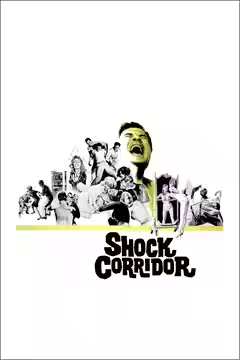
Samuel Fuller’s asylum thriller is crude, loud and frequently absurd, and it is also furious, inventive and hard to shake. Stanley Cortez’s photography and Hari Rhodes’s performance are reason enough to see it; the script’s habit of shouting its point is the price.
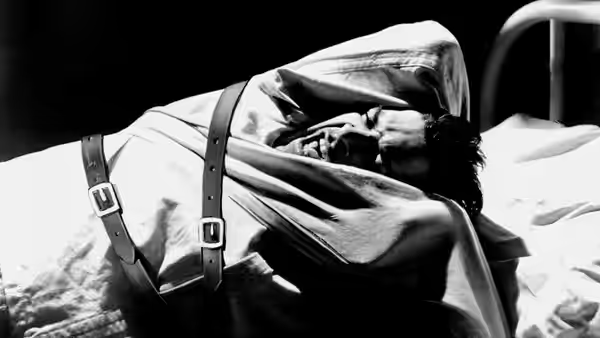
Samuel Fuller worked as a crime reporter before he made films, and Shock Corridor is where the two jobs meet head on. A newspaperman fakes madness to get himself committed, so that he can find out who stabbed a patient in the kitchen and win a Pulitzer Prize for the story. The premise does not survive a minute’s thought. Fuller does not give it a minute. He writes, directs and produces at a pitch that leaves no room for objections, and the result is crude, loud, sometimes ridiculous and, for 102 minutes, more alive than most films made with ten times the care.
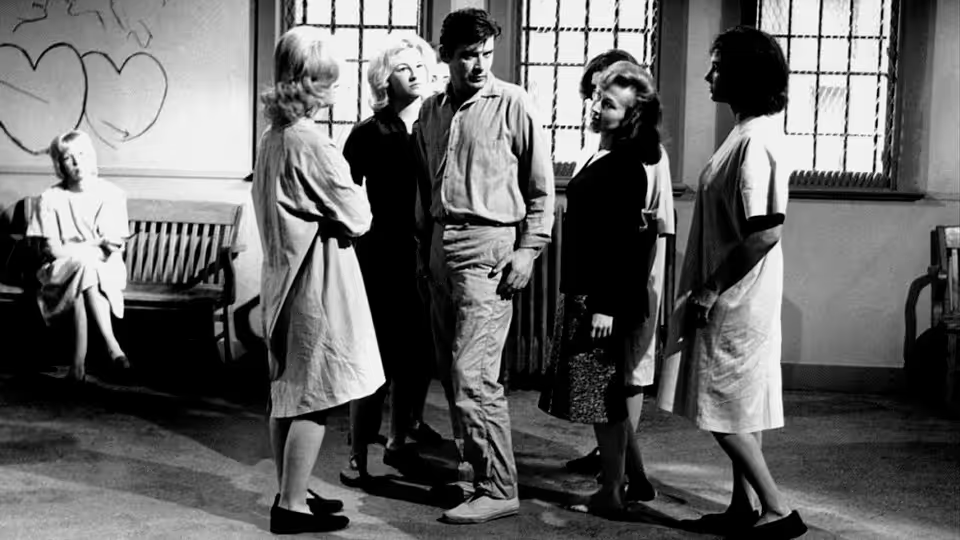
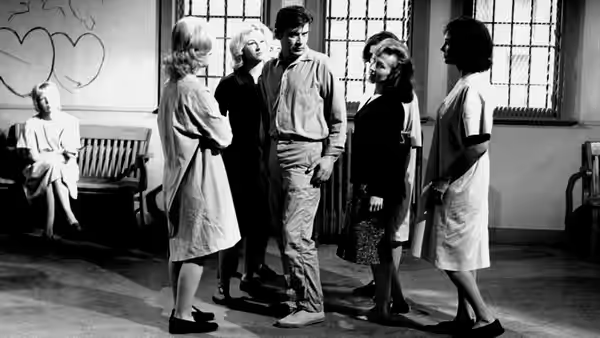
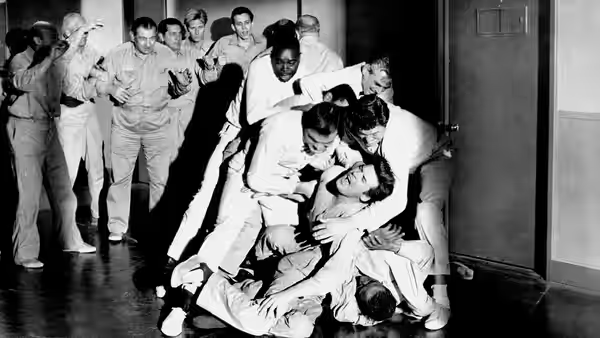
Stanley Cortez had shot The Magnificent Ambersons for Orson Welles and The Night of the Hunter for Charles Laughton, and he gives Fuller’s tatty asylum more than it deserves. The main set is one long corridor, which the patients call the Street, lit hard from above so that the floor gleams and the men pacing it cast short black shadows. Cortez keeps the camera low and the focus deep, so a face in the foreground and a shuffling figure fifty feet back are equally sharp. When the hallucinations come they come in colour, scraps of travel footage cut into the black and white, and in the film’s boldest sequence the corridor itself fills with rain while Barrett stands in it. It looks cheap and it looks like nothing else.
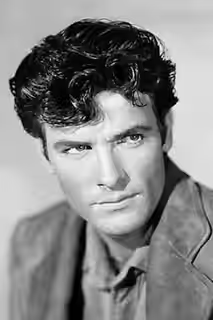
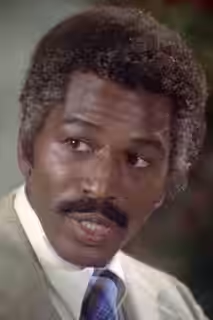
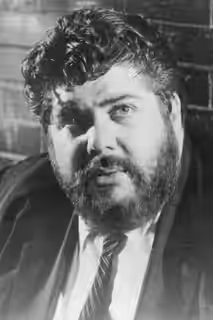
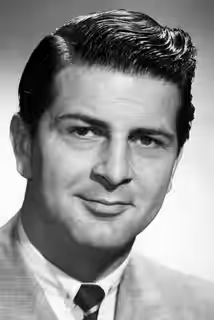
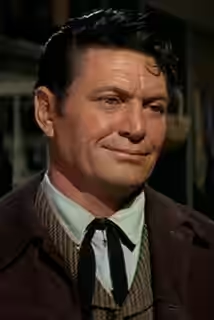
The spine of the film is the three witnesses, and each gets a monologue and a breakdown. James Best plays Stuart, who fought in Korea, went over to the enemy and came home to lose himself in the uniform of a Confederate general, and Best makes him gentle. Gene Evans’s Boden, a physicist reduced to a child, draws pictures on the floor. Hari Rhodes’s Trent is the one we cannot shake. A Black student who tried to enter a Southern university, he now stands on a table preaching white supremacy and leads a mob of patients down the Street after another Black man. We were horrified, and Fuller means us to be: Rhodes plays it straight, without a wink or a plea, and the camera stays on his face while he says things that were being said on the news the same year.
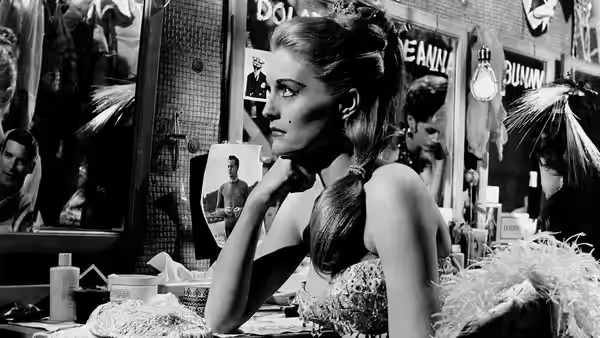
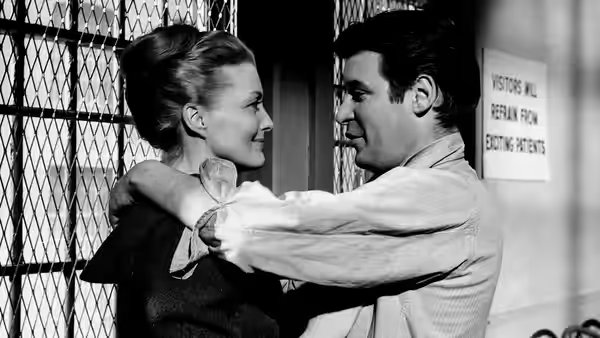
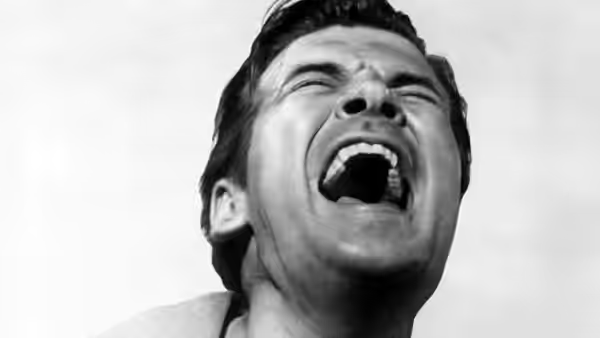
Peter Breck’s Barrett is the weak link. Fuller writes the reporter as a man who thinks in headlines and speaks in them too, and Breck starts loud and has nowhere to go but louder. Constance Towers, as his girlfriend Cathy, is far better. She is a stripper who agrees to pose as his sister and tell the doctors he has been making advances to her, and Towers plays the shame of that lie in every hospital visit. Einar Bourman puts her in a feather boa and sequins for her club number and a plain coat for the ward, and the contrast does the work the script only shouts about.
The shouting is the price. The dialogue is written in capital letters, Paul Dunlap’s score hits every entrance with brass, and Jerome Thoms’s cutting jumps from scene to scene as if the film were afraid we might leave. Some of that is style; some of it is haste. There is also a scene in which Barrett wanders into a ward of women the film labels nymphomaniacs, and it is exactly as sordid as it sounds, a leer dressed up as a warning. The psychiatry throughout is nonsense, and Paul Dubov’s Dr. Menkin and John Matthews’s Dr. Cristo are there mostly to explain it.
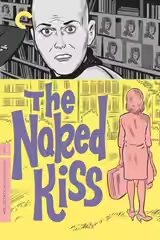
Fuller had made tighter films before this; Pickup on South Street (1953) is better built in every department. But Shock Corridor is the one where his anger about his country, the war, the bomb and segregation gets out into the open and runs down the hall, and The Naked Kiss (1964) would follow it into the same territory. Most critics now rate it warmly. The earliest review we read objected to the sensationalism, and that objection has not aged well; the crudeness is what keeps the film awake.
See it for Cortez, for Rhodes, and for the storm in the corridor. Watch it at home with company that does not mind a film raising its voice, and do not expect the ending to surprise you. Fuller puts a quotation on screen before the first scene that tells you the shape of what follows, and then he keeps his word.