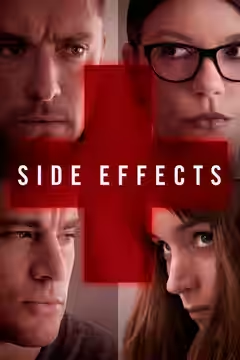
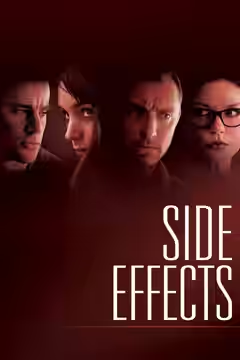
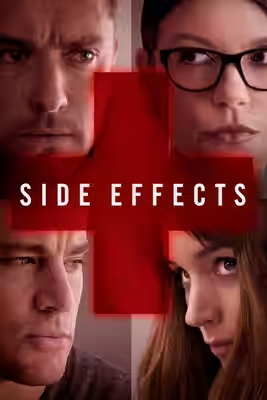
Side Effects poster

Side Effects

2013 · Directed by Steven Soderbergh
1h 46mThrillerCrimeDrama15
70
Fi1m score
71
Critics · 15
Audience · not yet

Where to watch in the UK

Checked 10 September at 22:29. Prices and availability change; the service’s page is the last word.

Synopsis

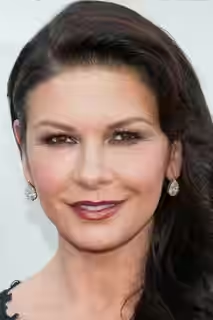
Emily Taylor (Rooney Mara) has waited out her husband’s prison sentence. Martin (Channing Tatum) went away for insider trading; when he comes home, the New York life they had is gone, and so, it seems, is she. She stops eating, stops sleeping, and one morning drives her car into the wall of a car park. The psychiatrist who sees her afterwards, Jonathan Banks (Jude Law), takes her on, tries one drug and then another, and on the advice of her former doctor, Victoria Siebert (Catherine Zeta-Jones), puts her on a new antidepressant called Ablixa. It helps. It also makes her sleepwalk. Vinessa Shaw plays Banks’s wife, and Ann Dowd is Martin’s mother.

Fi1m review

In a sentenceRooney Mara has never looked so ill and Catherine Zeta-Jones has never worn glasses so meaningfully

Soderbergh’s pharmaceutical thriller is a fine, sickly portrait of depression for an hour and a well-oiled potboiler after that. The machinery is cleanly built and Rooney Mara is remarkable, but the film ends up caring less about pills than it began by suggesting.

Steven Soderbergh announced Side Effects as his last film for cinemas, then shot and cut it himself. It was not his last film, but it has the feel of a man clearing his desk: a brisk 106 minutes from a script by Scott Z. Burns, who wrote Contagion for him, about a depressed young woman, her psychiatrist and the pill that comes between them. It is good. For an hour it is better than good, and the rest of this review is about the difference.

The first shot drifts through a window into a flat and finds blood on the floor; a caption then takes us back three months. Rooney Mara plays Emily Taylor as a woman who has run out of energy for her own face. She stands at a party holding a drink she is not drinking, and when she puts her foot down in the car park she does not look frightened, only tired. Soderbergh, behind his own camera, gives New York the light of a hospital corridor, greenish and flat and a little dim at noon, with the focus so shallow that anyone not speaking blurs into the wall. We did not enjoy that hour and we mean that as praise: Mara’s blank face under that light got at us in a way thrillers seldom bother to.

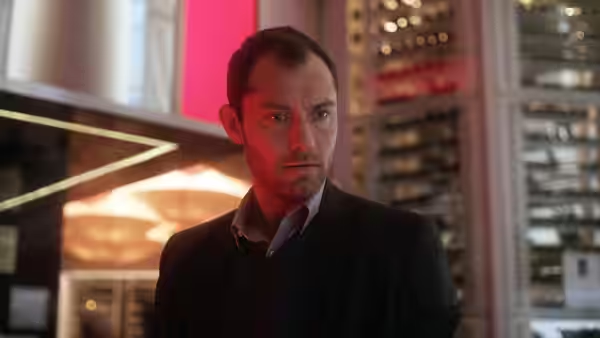
Jude Law’s Jonathan Banks is a decent, slightly vain doctor with a full list, a wife (Vinessa Shaw) worried about money, and a fee from a drug company for putting his patients on a trial. Law plays him as a man who believes he is one of the good ones and has never had cause to check. Howard Cummings gives him an office of pale wood and glass where nothing bad could happen. Susan Lyall puts Emily in grey knitwear a size too big and Catherine Zeta-Jones’s Dr Siebert in black, hair pulled back, glasses she takes off to make a point. Thomas Newman’s score is a low electronic hum, kept so quiet you notice it mostly when it stops.

Then, at the close of the first act, something happens in the Taylors’ flat that we will not describe, and the film changes what it is about. Until then it has been a film about a sick woman, her medication and the people who profit from it. Afterwards it is about who did what to whom, and the medication becomes a device. Burns builds the switch well: the reversals arrive on schedule, each set up in plain sight, and Soderbergh the editor never holds a shot a beat too long to warn us a clue is passing. As a machine it is close to faultless. As a follow-through on that first hour it is a let-down, because the questions about pills are dropped.

The performances hold up better than the plot does. Mara has to play more than one version of Emily and makes each one true while it is on screen, which is the reason the last stretch works at all. Law frays well: the tie goes, the beard comes in, the voice rises. Zeta-Jones has less to do than her billing suggests and does it with a straight face the script does not always earn. Channing Tatum is quietly good in a part that gives him little to push against. We laughed once, late on, at a line we are fairly sure was not written as a joke.

Soderbergh has made this sort of film before and made it better. Contagion (2011), also written by Burns, followed a disease through the institutions meant to stop it and never once cut to a twist. Most of the reviews so far reach for Hitchcock, and it is fair as far as it goes: the cool surfaces, the compromised professional, the wife who begins to wonder. But Hitchcock did not open with an hour of honest misery and then ask us to reread it as a clue.

It runs 106 minutes and carries a 15, and it wastes none of them. See it for Mara, and for a director in full control of a film slightly smaller than the one he began. Watch it with someone who knows nothing about it, and mind what you say when the lights come up.


Critical consensus AI synthesised

71
Positive
10
Mixed
3
Negative
2

Most critics like Side Effects, and the praise clusters in two places: Rooney Mara’s lead performance, which several reviews call the glue holding the puzzle together, and Steven Soderbergh’s control as director, cinematographer and editor. Jude Law’s psychiatrist is singled out nearly as often. Reviewers agree on the shape of the film: it opens as a sober drama about depression and prescription drugs, then turns into a twisting, Hitchcockian potboiler, and most find that turn thrilling rather than cheap. The reservations cluster on the third act. Even admiring reviews concede the plotting grows pulpy, and the mixed notices say the late twists undo whatever the film has to say about the pharmaceutical industry. The spread is fairly wide for a well-liked film. The Hollywood Reporter finds the twists too many to convince, The Skinny calls it ludicrous and its critique unlanded, and IndieWire detects fatigue in the execution. Nobody disputes the craft.

The Guardian
7 March 2013 · Peter Bradshaw
90*

Soderbergh bids farewell to cinema in style with a gripping psychological thriller about big pharma and mental health. It is a noirish satire elevated by Rooney Mara's compelling lead performance and Soderbergh's elegant, eerie visuals.

Read the full review →
The Telegraph
7 March 2013 · Robbie Collin
85*

If this is Soderbergh's final film he goes out on a high. It starts as sober psychological drama and ferments into a queasy, thrilling whodunit that smartly explores prescription-drug culture and moral murk.

Read the full review →
The AV Club
7 February 2013 · B+ · Scott Tobias
83

The critic calls it a vastly entertaining thriller that isn't the message movie it initially appears to be, focusing instead on high-level gamesmanship and duplicity, with Rooney Mara superb as the puzzle's glue.

Read the full review →
Financial Times
7 March 2013 · Nigel Andrews
80*

Soderbergh’s mischievously enthralling thriller mixes paranoia and pharmaceuticals around Rooney Mara's unstable Emily. It is a consummate Hitchcockian trip that loves paranoia while probing mental misfortune and the demon Pharma.

Read the full review →
Time Out
5 March 2013 · ★★★★ · Ben Walters
80

The review calls it a pacy, sleight-of-hand thriller that works as fun genre entertainment with sly digs at consumerism. It highlights strong performances, technical flair and twists while noting it serves as a fitting swansong for the director.

Read the full review →
Vulture
6 February 2013 · David Edelstein
80*

The critic praises it as a smooth, shapely suspense picture where Soderbergh is on top of his material, cleverly mixing conventions in a paranoid yet bouncy noir-tinged thriller.

Read the full review →

Cast

Rooney Mara
Emily Taylor
Jude Law
Jonathan Banks
Catherine Zeta-Jones
Dr. Victoria Siebert
Channing Tatum
Martin Taylor
Vinessa Shaw
Dierdre Banks
Ann Dowd
Mrs. Taylor
Polly Draper
Eileen Spicer

Stills

If you liked this, try…

Contagion poster

Contagion

2011 · Soderbergh and Burns follow a virus through the institutions; no twists, and more frightening for it.

Spellbound poster

Spellbound

1945 · Hitchcock’s psychiatrist falls for a patient; the dream sequence was designed by Salvador Dalí.

Les Diaboliques poster

Les Diaboliques

1955 · Clouzot’s French schoolhouse murder plot, still the template for every twist that followed.

Gone Girl poster

Gone Girl

2014 · Fincher’s marriage thriller also changes shape halfway through and keeps its nerve.

The Handmaiden poster

The Handmaiden

2016 · Park Chan-wook’s con told three times over, each telling correcting the last.