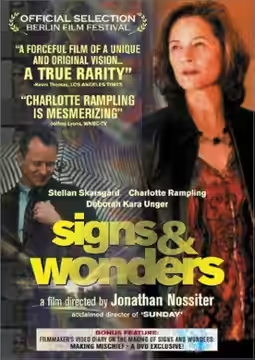
Stellan Skarsgård and Charlotte Rampling give Signs & Wonders emotional force, and Adrian Utley’s music sustains the unease. Jonathan Nossiter’s heavy-handed drama still asks for more patience than it rewards.
Jonathan Nossiter’s Signs & Wonders is a frustrating drama, held together by performances that deserve a less laboured film. Its interest in human behaviour is serious, and its unease has a persistence that makes it difficult to dismiss. The ambition is to make people difficult to judge, which gives the actors something worth attempting. The trouble is the determination to make the significance of it all felt: the film becomes oppressive in ways that do not seem entirely intended.
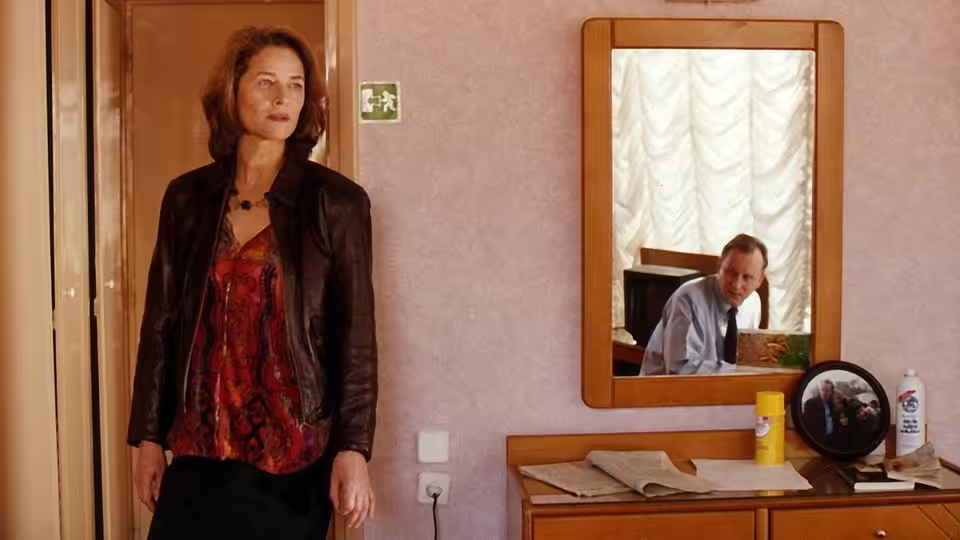
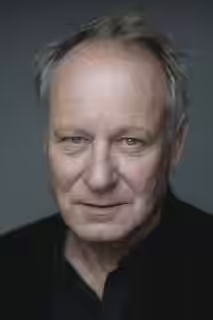
Stellan Skarsgård gives Alec enough sympathy to keep the film from becoming an exercise in disapproval. We felt for Alec because the performance lets a sense of vulnerability survive all the surrounding insistence; that response is the strongest thing the film earns. Charlotte Rampling brings comparable emotional force to Marjorie, making the distress feel substantial even when the writing threatens to overstate it. These are performances worth attending to, and they provide good reasons to persevere through passages that would otherwise be merely wearing.
James Lasdun and Jonathan Nossiter’s screenplay keeps pressing its concerns after we have had ample opportunity to grasp them. The lecturing becomes a problem because it leaves so little room for the uncertainty that the actors can suggest. We do not need every idea softened or every character made agreeable, but we do need the freedom to reach a judgement without feeling prodded towards it. Here the emphasis grows tiresome, and the human difficulties begin to feel overexplained.
Giorgos Arvanitis’s cinematography contributes to the discomfort, though the limitations of the digital-video images are sometimes distracting. There is a roughness that can serve this material, but it is not consistently expressive enough to make the visual shortcomings seem necessary. Adrian Utley’s ambient score is more effective, sustaining an eerie atmosphere without giving the drama another layer of insistence. The music helps the tension persist through the less convincing passages, and it is one of the film’s clearest craft strengths.
Madeleine Gavin’s editing has the difficult job of holding these performances and emphatic ideas together. The film does not always feel coherent, and its 105 minutes become more demanding than the running time might suggest. That is chiefly a problem with the writing: tightening a passage cannot remove the feeling that its point has already been made. There is enough atmosphere to keep the drama going, but the concentration it asks for is not reliably rewarded by greater insight into the people.
A psychological drama can leave much unresolved and still make its characters compelling company. Here, the strength of the acting makes the heavy-handedness especially frustrating, since these performers plainly have enough to offer without so much emphasis around them. The director creates unease, but the pleasure of watching the cast work has to carry too much of the evening. Admirers of the leading actors may find it worthwhile; everyone else should be prepared to sit through a good deal of lecturing.