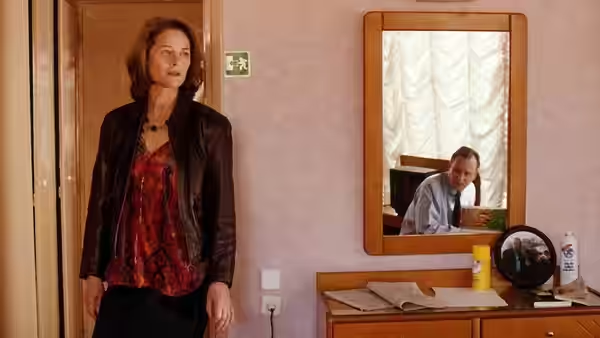
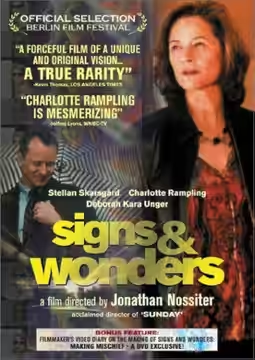
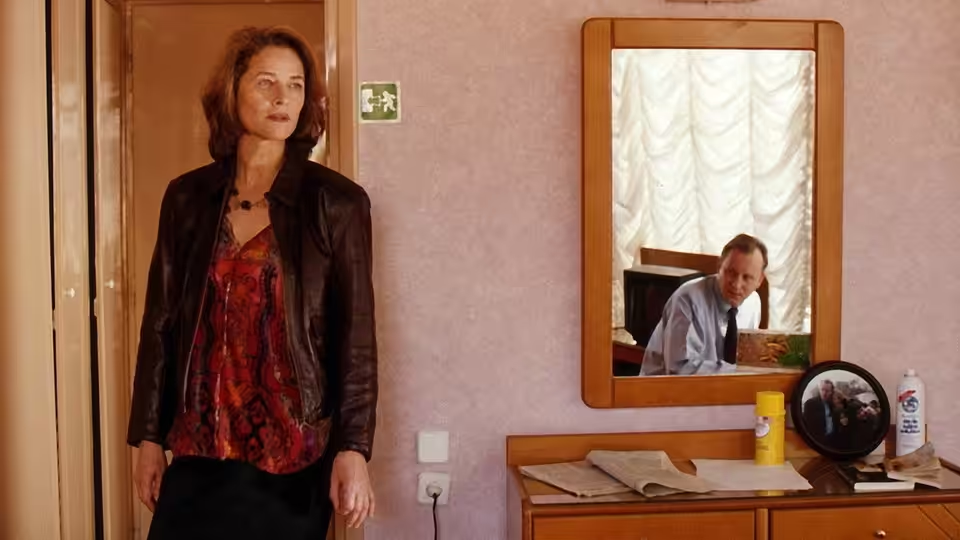
A woman stands beside a dresser as a man appears in the mirror behind her
Film review

Signs & Wonders

2001 · Directed by Jonathan Nossiter · 1h 45m

In a sentenceStellan Skarsgård and Charlotte Rampling keep being interesting in a film that would rather give a lecture

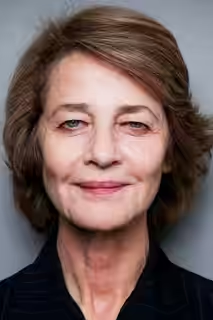
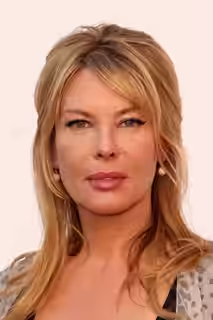
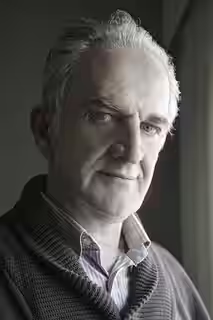
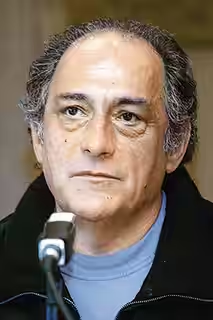
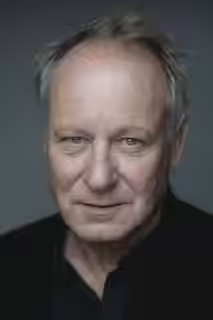
Alec (Stellan Skarsgård), Marjorie (Charlotte Rampling) and Katherine (Deborah Kara Unger) are the principal characters in Signs & Wonders, a drama directed by Jonathan Nossiter. The cast also includes Dimitris Katalifos as Andreas, Ashley Remy as Siri and Dave Simonds as Kent. Alexandros Mylonas plays the Police Captain, Arto Apartian the Police Interpreter and Dimitris Kaberidis Sotiris. The screenplay is by James Lasdun and Jonathan Nossiter, from a story by James Lasdun. The 2001 film runs for 105 minutes, with cinematography by Giorgos Arvanitis and music by Adrian Utley.

Fi1m review

Stellan Skarsgård and Charlotte Rampling give Signs & Wonders emotional force, and Adrian Utley’s music sustains the unease. Jonathan Nossiter’s heavy-handed drama still asks for more patience than it rewards.

Jonathan Nossiter’s Signs & Wonders is a frustrating drama, held together by performances that deserve a less laboured film. Its interest in human behaviour is serious, and its unease has a persistence that makes it difficult to dismiss. The ambition is to make people difficult to judge, which gives the actors something worth attempting. The trouble is the determination to make the significance of it all felt: the film becomes oppressive in ways that do not seem entirely intended.

Stellan Skarsgård gives Alec enough sympathy to keep the film from becoming an exercise in disapproval. We felt for Alec because the performance lets a sense of vulnerability survive all the surrounding insistence; that response is the strongest thing the film earns. Charlotte Rampling brings comparable emotional force to Marjorie, making the distress feel substantial even when the writing threatens to overstate it. These are performances worth attending to, and they provide good reasons to persevere through passages that would otherwise be merely wearing.

James Lasdun and Jonathan Nossiter’s screenplay keeps pressing its concerns after we have had ample opportunity to grasp them. The lecturing becomes a problem because it leaves so little room for the uncertainty that the actors can suggest. We do not need every idea softened or every character made agreeable, but we do need the freedom to reach a judgement without feeling prodded towards it. Here the emphasis grows tiresome, and the human difficulties begin to feel overexplained.

Giorgos Arvanitis’s cinematography contributes to the discomfort, though the limitations of the digital-video images are sometimes distracting. There is a roughness that can serve this material, but it is not consistently expressive enough to make the visual shortcomings seem necessary. Adrian Utley’s ambient score is more effective, sustaining an eerie atmosphere without giving the drama another layer of insistence. The music helps the tension persist through the less convincing passages, and it is one of the film’s clearest craft strengths.

Madeleine Gavin’s editing has the difficult job of holding these performances and emphatic ideas together. The film does not always feel coherent, and its 105 minutes become more demanding than the running time might suggest. That is chiefly a problem with the writing: tightening a passage cannot remove the feeling that its point has already been made. There is enough atmosphere to keep the drama going, but the concentration it asks for is not reliably rewarded by greater insight into the people.

A psychological drama can leave much unresolved and still make its characters compelling company. Here, the strength of the acting makes the heavy-handedness especially frustrating, since these performers plainly have enough to offer without so much emphasis around them. The director creates unease, but the pleasure of watching the cast work has to carry too much of the evening. Admirers of the leading actors may find it worthwhile; everyone else should be prepared to sit through a good deal of lecturing.
Critical consensus AI synthesised

3 of 6
Positive
1
Mixed
1
Negative
1
Los Angeles Times
6 April 2001 · KEVIN THOMAS
90*

Thomas praises the film as a forceful, sophisticated exploration of human nature. He singles out the taut atmosphere and the wrenching performances by Stellan Skarsgard and Charlotte Rampling.

Read the full review →
The AV Club
19 April 2002 · Scott Tobias
62*

Tobias finds the film ambitious and atmospheric but weighed down by heavy-handed polemics and limitations of its digital-video format. He particularly praises its eerie tone and texture, supported by Adrian Utley’s ambient score.

Read the full review →
Variety
21 February 2000 · festival review · Joe Leydon
10*

Leydon pans the film as pretentious, muddled, and unlikely to find an audience. He singles out Stellan Skarsgard for bringing surprising sympathy and depth to his character.

Read the full review →

Straight answers AI written, from our review

Is Signs & Wonders worth watching?
Signs & Wonders is worth considering for admirers of Stellan Skarsgård and Charlotte Rampling, but we score it 54 for performances and atmosphere undermined by heavy-handed writing. The leads give the drama emotional force, and Adrian Utley’s music sustains the unease; neither quite compensates for the repeated lecturing or the patience it demands.
How long is Signs & Wonders, and what is it rated?
Signs & Wonders runs 1h 45m. It is a drama film.
Where can I watch Signs & Wonders in Finland?
Signs & Wonders is not on any streaming or rental service in Finland at the moment. Availability is checked daily.
How does Signs & Wonders compare to The Conversation?
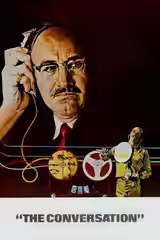
Signs & Wonders is the less rewarding choice beside The Conversation, which we recommend for its gripping suspense and Gene Hackman’s affecting loneliness. Both concern interpretation, suspicion and the danger of certainty, but Coppola makes repeated listening compelling where Nossiter overexplains his concerns. Skarsgård and Rampling give the latter emotional force, though we find the writing too insistent.
What should I watch after Signs & Wonders?
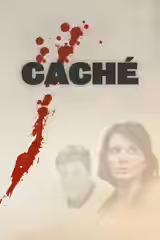
After Signs & Wonders, try The Conversation (1974, Fi1m 92): For another drama concerned with interpretation, suspicion and the danger of certainty. Then Caché (2005, Fi1m 88): Domestic unease and disputed responsibility, with little comfort in the answers; and 45 Years (2015, Fi1m 88): Charlotte Rampling gives marital doubt a patient, painfully precise treatment.

Cast

If you liked this, try…

  1. The Conversation (1974, Fi1m 92)For another drama concerned with interpretation, suspicion and the danger of certainty.

  2. Caché (2005, Fi1m 88)Domestic unease and disputed responsibility, with little comfort in the answers.

  3. The Headless Woman (2008) · not on Fi1m yetA troubling study of uncertainty, privilege and what people choose to overlook.

  4. 45 Years (2015, Fi1m 88)Charlotte Rampling gives marital doubt a patient, painfully precise treatment.

  5. Take Shelter (2011, Fi1m 83)An unsettling domestic drama about premonitions and the cost of believing them.

Signs & Wonders (2001) review: strong acting in a laboured drama (Finland) | Fi1m