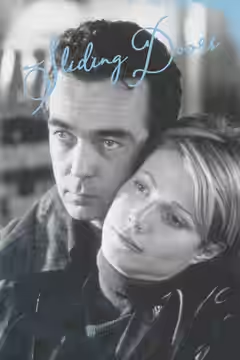
Peter Howitt’s romantic comedy splits Gwyneth Paltrow’s life in two at a Tube door and gets a charming John Hannah out of one half. The other half belongs to a boyfriend the film cannot make interesting, and it shows.
Peter Howitt writes and directs a romantic comedy built on one trick: one woman, one train, two lives. Helen either catches the train or misses it, and for 99 minutes the film runs both versions side by side, cutting between them whenever one strand has a good line or the other a bad day. It is a neat idea, neatly worked, and it carries two likeable performances. It is also flatly directed and saddled with a boyfriend so feeble that half the film has nowhere to go. Decent, then; worth an evening if the genre is already yours, and not much more.
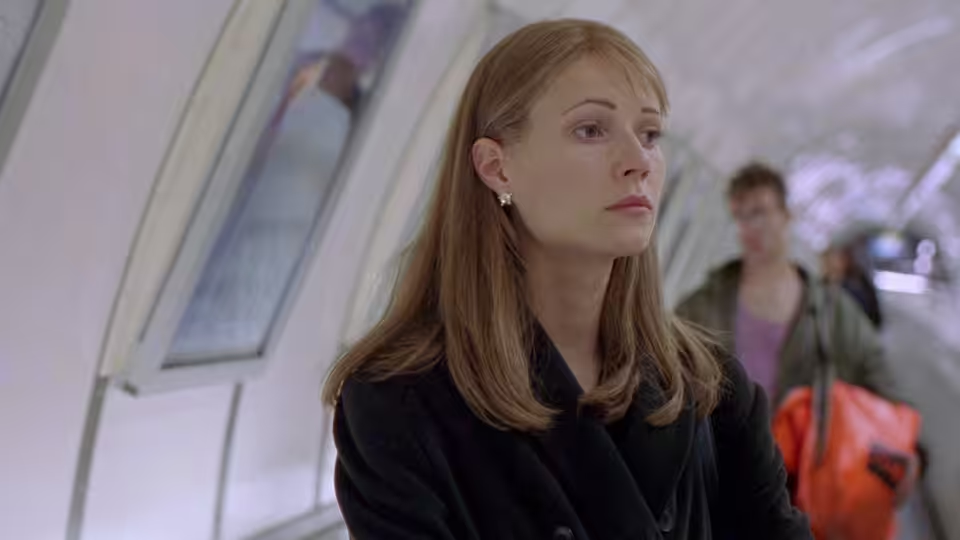
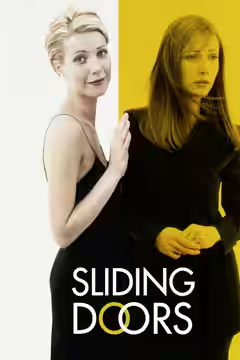
The trick is handled better than its reputation suggests. Howitt tells the two strands apart by the simplest means, a haircut: the Helen who caught the train crops and bleaches, the one who missed it keeps her long brown hair and her job delivering sandwiches. John Smith, the editor, cuts the strands on rhymes, the same doorway, the same telephone, one Helen laughing where the other is in tears. Twice the two nearly pass each other, and the film has the sense not to underline it. Those crossings gave us a small, real shiver, more than the romance did, because for a second the gimmick felt like something the film believed in.
Paltrow, an American, does an English accent carefully and does everything else easily. She is funny with almost nothing: a look at Gerry’s unfinished pages, a flat “right” into a phone. Hannah’s James is the reason people remember the film. He talks. He quotes Monty Python on a stalled train to a woman who has just been sacked, he explains rowing when nobody asked, and Hannah plays him so that the chatter is plainly a shy man’s way of not leaving. We laughed out loud at the Python routine and slightly resented how easily he had managed it. Their scenes together, in pubs and along the river, are the film, and there are not enough of them.
The trouble is the other strand, and it is a structural trouble rather than a passing one. Gerry is a novelist who has not written anything and cannot choose between two women, and Howitt has written him so that every scene is the same scene: Gerry lies, Gerry panics, Gerry confesses to his friend Russell (Douglas McFerran) over a pint. John Lynch plays it with damp eyes and a weak mouth, and he does it honestly, but a film with two timelines has to make us care about both, and one of them is spent watching a man we would not lend a pen to. Jeanne Tripplehorn’s Lydia is written as a monster, all cigarettes and ultimatums, and she is directed to play it as written. The scenes between Gerry and Lydia are where we looked at the clock.
The craft is competent and no more. Remi Adefarasin shoots London in a soft grey light that flatters everyone and distinguishes nothing; the film has no visual idea to match its structural one, and the two strands look the same when they might have been given different weathers. Maria Djurkovic gives Gerry a writer’s flat that is plausibly untidy and gives James’s world little at all. David Hirschfelder’s score is polite piano and strings that arrive when someone is sad and leave when they are not. Howitt directs like a writer: the camera stands wherever it can hear the dialogue.
Set against the other double-life films of its decade, this is the friendly one. Kieślowski’s Blind Chance, made in 1981, used the same device, a man running for a train, to ask what one life is worth under three different fates; Tom Tykwer’s Run Lola Run, released the same year as this, used it as a game. Howitt uses it to ask whether Helen would be happier with a nicer man, and the answer is never in doubt. That is no crime in a romantic comedy. It does mean the second half has one plot doing the work of two.
It runs 99 minutes and carries a 15 certificate. See it for Hannah and Paltrow, at home, on a wet evening, with someone who will forgive you for talking over Gerry. And do not let anyone tell you which Helen gets the better deal; the film has one more thought about that, late on, and it is the best one it has.