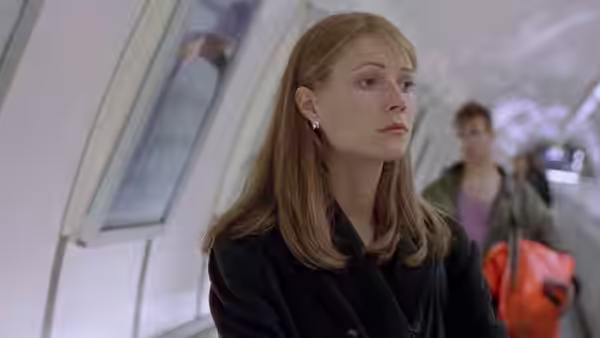
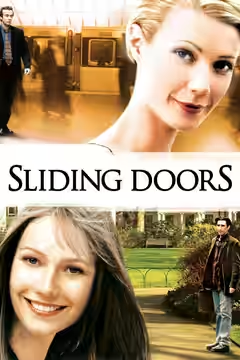
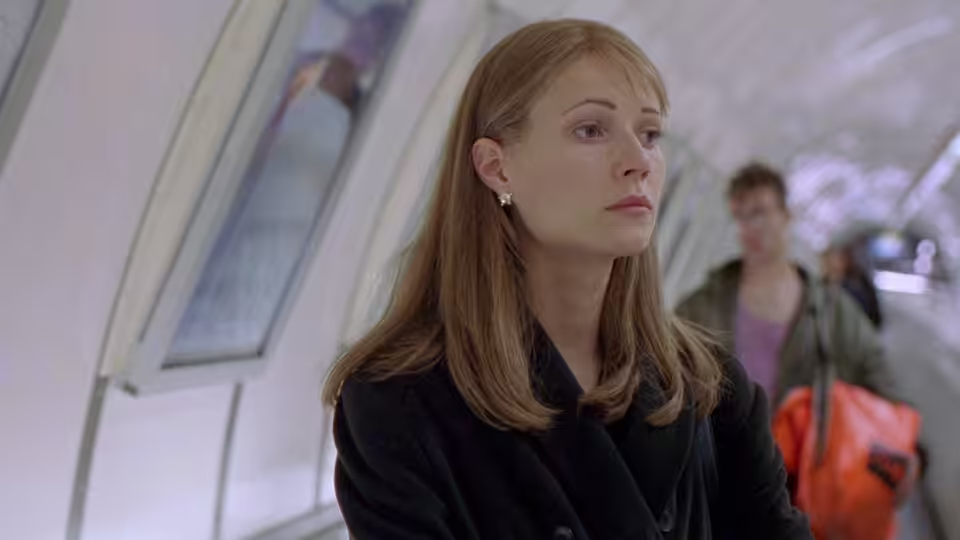
Helen Quilley (Gwyneth Paltrow) waits in an underground station as commuters pass behind her
Film review

Sliding Doors

1998 · Directed by Peter Howitt · 1h 39m

In a sentenceMiss the train and keep the boyfriend; catch it and get John Hannah and a haircut

London, one weekday morning. Helen Quilley (Gwyneth Paltrow), a publicist, is sacked for taking a few bottles of company vodka and sent home with her things in a box. She runs for an Underground train and, at the sliding doors, the film splits. In one version she catches it, sits beside James Hamilton (John Hannah), a talkative Scot quoting Monty Python, and gets home early enough to find her boyfriend Gerry (John Lynch), a novelist who has not finished his novel, in bed with his ex, Lydia (Jeanne Tripplehorn). In the other she misses it, is mugged, ends up in hospital and arrives home after Lydia has gone. From then on the two Helens run side by side, with her friend Anna (Zara Turner) on hand in both.

Plays from YouTube when you press play; nothing loads from them until then.

Fi1m review

Peter Howitt’s romantic comedy splits Gwyneth Paltrow’s life in two at a Tube door and gets a charming John Hannah out of one half. The other half belongs to a boyfriend the film cannot make interesting, and it shows.

Peter Howitt writes and directs a romantic comedy built on one trick: one woman, one train, two lives. Helen either catches the train or misses it, and for 99 minutes the film runs both versions side by side, cutting between them whenever one strand has a good line or the other a bad day. It is a neat idea, neatly worked, and it carries two likeable performances. It is also flatly directed and saddled with a boyfriend so feeble that half the film has nowhere to go. Decent, then; worth an evening if the genre is already yours, and not much more.

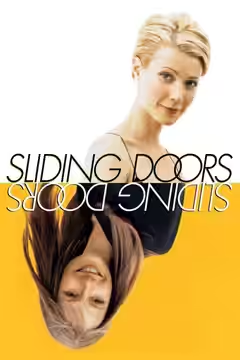
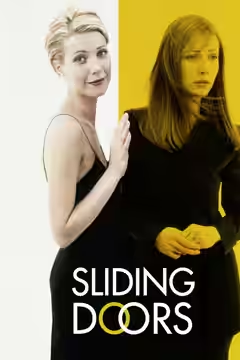
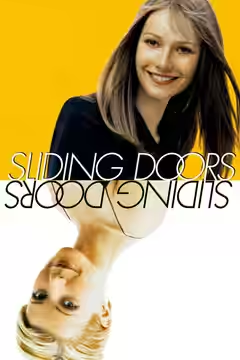
The trick is handled better than its reputation suggests. Howitt tells the two strands apart by the simplest means, a haircut: the Helen who caught the train crops and bleaches, the one who missed it keeps her long brown hair and her job delivering sandwiches. John Smith, the editor, cuts the strands on rhymes, the same doorway, the same telephone, one Helen laughing where the other is in tears. Twice the two nearly pass each other, and the film has the sense not to underline it. Those crossings gave us a small, real shiver, more than the romance did, because for a second the gimmick felt like something the film believed in.

Paltrow, an American, does an English accent carefully and does everything else easily. She is funny with almost nothing: a look at Gerry’s unfinished pages, a flat “right” into a phone. Hannah’s James is the reason people remember the film. He talks. He quotes Monty Python on a stalled train to a woman who has just been sacked, he explains rowing when nobody asked, and Hannah plays him so that the chatter is plainly a shy man’s way of not leaving. We laughed out loud at the Python routine and slightly resented how easily he had managed it. Their scenes together, in pubs and along the river, are the film, and there are not enough of them.

The trouble is the other strand, and it is a structural trouble rather than a passing one. Gerry is a novelist who has not written anything and cannot choose between two women, and Howitt has written him so that every scene is the same scene: Gerry lies, Gerry panics, Gerry confesses to his friend Russell (Douglas McFerran) over a pint. John Lynch plays it with damp eyes and a weak mouth, and he does it honestly, but a film with two timelines has to make us care about both, and one of them is spent watching a man we would not lend a pen to. Jeanne Tripplehorn’s Lydia is written as a monster, all cigarettes and ultimatums, and she is directed to play it as written. The scenes between Gerry and Lydia are where we looked at the clock.

The craft is competent and no more. Remi Adefarasin shoots London in a soft grey light that flatters everyone and distinguishes nothing; the film has no visual idea to match its structural one, and the two strands look the same when they might have been given different weathers. Maria Djurkovic gives Gerry a writer’s flat that is plausibly untidy and gives James’s world little at all. David Hirschfelder’s score is polite piano and strings that arrive when someone is sad and leave when they are not. Howitt directs like a writer: the camera stands wherever it can hear the dialogue.

Set against the other double-life films of its decade, this is the friendly one. Kieślowski’s Blind Chance, made in 1981, used the same device, a man running for a train, to ask what one life is worth under three different fates; Tom Tykwer’s Run Lola Run, released the same year as this, used it as a game. Howitt uses it to ask whether Helen would be happier with a nicer man, and the answer is never in doubt. That is no crime in a romantic comedy. It does mean the second half has one plot doing the work of two.

It runs 99 minutes and carries a 15 certificate. See it for Hannah and Paltrow, at home, on a wet evening, with someone who will forgive you for talking over Gerry. And do not let anyone tell you which Helen gets the better deal; the film has one more thought about that, late on, and it is the best one it has.

Critical consensus AI synthesised

58
Positive
2
Mixed
3
Negative
1

Most critics find the parallel-lives premise clever and the film pleasant company, though the reviews lean mixed rather than warm. Praise clusters on Gwyneth Paltrow and John Hannah, who are found charming across both versions of Helen’s life, and on Howitt’s script, which several reviews call witty. The interweaving of the two timelines is generally admired as neatly handled.

The reservations gather around the supporting characters and the plotting. Gerry and Lydia are called clumsy or laboured by nearly every critic who mentions them, and Empire finds the parallel plots grow contrived and tiresome as the film goes on. The spread is wide, from a clear recommendation in the Los Angeles Times to a firm dismissal in Variety, which also faults the direction as flat and the whole as lightweight. Nobody calls it brilliant; the argument is over whether its charm is enough.

Los Angeles Times
24 April 1998 · JACK MATHEWS
75*

Mathews praises the film as a cleverly conceived, smoothly executed romantic comedy with two parallel versions of Helen’s life. He singles out the interwoven storytelling for praise, while criticizing the Gerry and Lydia characters and their performances.

Read the full review →
The New York Times
25 April 1998 · Janet Maslin
70*

Maslin finds the film’s parallel-life premise engaging and its romantic outlook appealing. She singles out Gwyneth Paltrow’s performance as a particular strength.

Read the full review →
RogerEbert.com
64*

The page was blocked by a browser check, so the critic’s verdict cannot be established. No praise or complaint from the review is available to summarize.

Read the full review →
Total Film
1 May 1998 · ★★★ · Total Film
60

The review finds the romantic comedy engaging despite its flaws, but says it falls short of brilliance. It praises Howitt’s witty script and the winning performances from Gwyneth Paltrow and John Hannah.

Read the full review →
Empire
1 January 2000 · Angie Errigo
45*

Errigo finds the film’s clever premise appealing but says its increasingly contrived parallel plots become tiresome. She praises Gwyneth Paltrow and John Hannah as lovely, while the villains’ laboured ghastliness drags the film down.

Read the full review →
Variety
15 January 1998 · festival review · Todd McCarthy
35*

McCarthy finds it a charming but lightweight romantic comedy undermined by flat direction and clumsy supporting characters. He praises the witty dialogue and John Hannah’s appealingly charming performance.

Read the full review →

Straight answers AI written, from our review

Is Sliding Doors worth watching?
Sliding Doors is worth an evening if romantic comedy is already your genre, and we scored it 63. Gwyneth Paltrow and John Hannah are funny together and the two-lives trick is neatly worked, but the half of the film spent with Helen's feeble boyfriend has nowhere to go. Watch it at home with someone who will forgive you for talking over Gerry.
How long is Sliding Doors, and what is it rated?
Sliding Doors runs 1h 39m. It is a comedy and drama film.
Where can I watch Sliding Doors in Ecuador?
Sliding Doors is not on any streaming or rental service in Ecuador at the moment. It is available in 12 other countries; change your country at the top of the page to see where. Availability is checked daily.
How violent or frightening is Sliding Doors, and is it suitable for children?
Sliding Doors carries a 15 certificate in the UK and is a romantic comedy with little in it to frighten anyone. One version of Helen is mugged and ends up in hospital, and the plot turns on her boyfriend's affair, so the adult content is infidelity, drinking and swearing rather than violence. It is fine for older teenagers, and too slow and talky for children.
How does Sliding Doors compare to Run Lola Run?
Run Lola Run is the better film, and the livelier one: it runs a single twenty-minute dash three times with an energy Sliding Doors keeps in reserve. Howitt's film uses its double-life device to ask whether Helen would be happier with a nicer man, and gets a charming John Hannah out of it. Choose Tykwer's for invention and pace, Howitt's for a wet-evening romance.
What should I watch after Sliding Doors?
After Sliding Doors, try Run Lola Run (1998, Fi1m 82): Twenty minutes, run three times, with the energy this film keeps in reserve. Then The Double Life of Véronique (1991, Fi1m 86): Two women, one soul, and a director who trusts the audience with the mystery; and Groundhog Day (1993, Fi1m 88): The other great high-concept romance of the era, and it earns every repeat.

Cast

Awards

European Film Award for Best Screenwriter, 1998

Won
European Film Award for Best Screenwriter

If you liked this, try…

  1. Blind Chance (1981) · not on Fi1m yetKieślowski’s version of the same train, three lives, and no jokes to soften it.

  2. Run Lola Run (1998, Fi1m 82)Twenty minutes, run three times, with the energy this film keeps in reserve.

  3. The Double Life of Véronique (1991, Fi1m 86)Two women, one soul, and a director who trusts the audience with the mystery.

  4. Groundhog Day (1993, Fi1m 88)The other great high-concept romance of the era, and it earns every repeat.

  5. Russian Doll (2019) · not on Fi1m yetA New York woman keeps dying at her own party; sharper and stranger than it sounds.

Sliding Doors (1998) review: lovely leads, thin plotting (Ecuador) | Fi1m