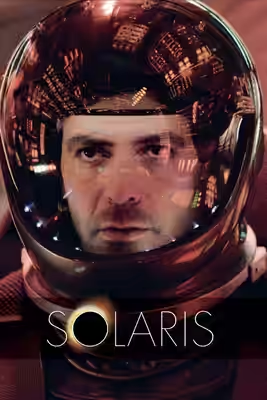
Solaris poster

Solaris

2002 · Directed by Steven Soderbergh
1h 39mDramaScience FictionMystery12A
74
Fi1m score
56
Critics · 7
Audience · not yet

Where to watch in the UK

Checked 10 September at 22:29. Prices and availability change; the service’s page is the last word.

Synopsis

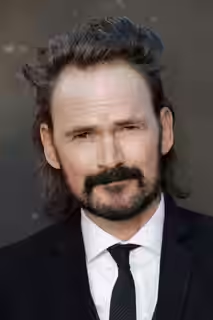
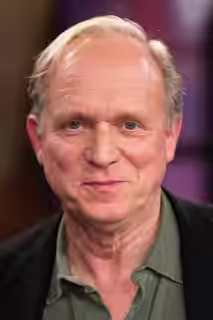
Chris Kelvin (George Clooney), a psychologist living alone in a city where it never stops raining, receives a message from his friend Gibarian (Ulrich Tukur), a scientist aboard a station orbiting the planet Solaris. Something is happening up there that Gibarian will not put into words, and he wants Kelvin, specifically. Kelvin arrives to find Gibarian dead and the two surviving crew, Gordon (Viola Davis) and Snow (Jeremy Davies), frightened, evasive and unwilling to leave. He sleeps. When he wakes, his wife Rheya (Natascha McElhone), who died some years earlier, is lying beside him. Steven Soderbergh directs, writes, shoots and edits, from Stanisław Lem’s novel, in 99 minutes.

Fi1m review

In a sentenceGeorge Clooney travels several light years to have the same argument with his wife

Steven Soderbergh’s version of Stanisław Lem’s novel is a quiet, cold, carefully made film about grief, and it is better than its reputation. Most critics found it chilly; we found it sad, and were still sad the next morning.

Steven Soderbergh’s Solaris takes Stanisław Lem’s novel, which Andrei Tarkovsky filmed in 1972 at close to three hours, and brings it in at 99 minutes. A psychologist called Chris Kelvin (George Clooney) is asked to a space station where the dead have started arriving in the night. Soderbergh wrote it, shot it and cut it himself, and it has the concentration of a film made by one pair of hands. It is a good film, quieter and sadder than most science fiction, and it was met on release with a coolness we do not think it earned.

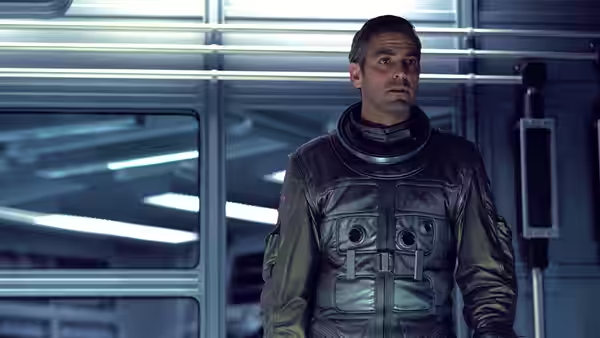
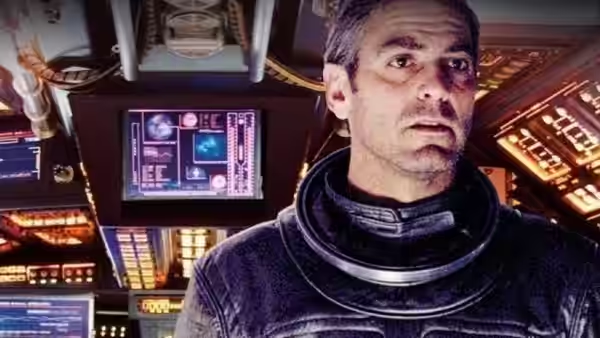
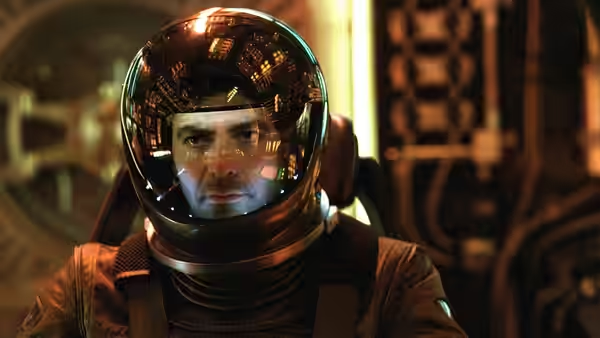
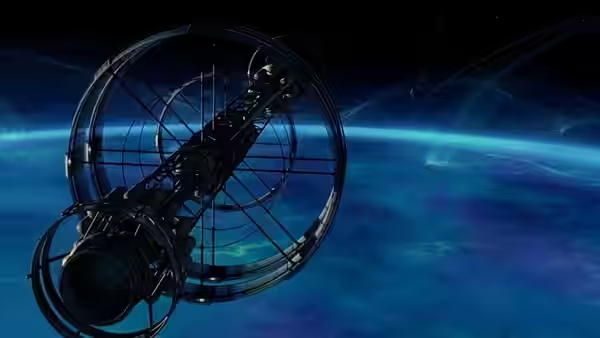
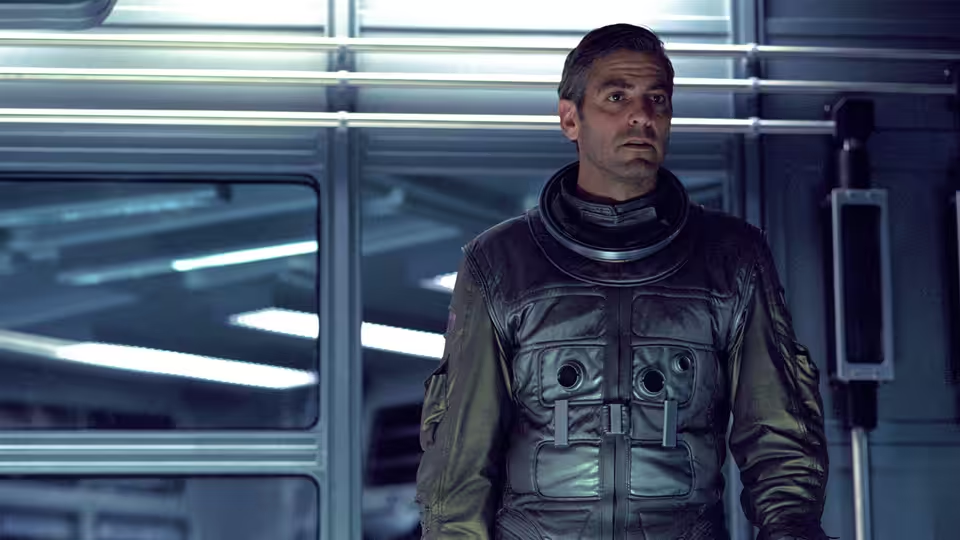
Philip Messina’s station is a ring of dim corridors lit in blue, with round doorways and surfaces that give back reflections, so that people are often seen twice. Soderbergh shoots Earth in rain and in the amber of kitchens and dinner parties, and the station in steel and shadow; you always know which world you are in by the colour of the light. Cliff Martinez’s score is the film’s best decision. Soft pulses, metallic chimes, a rising tone that never quite settles, played under long scenes where nothing is said, doing the work that dialogue does in most films of this size.

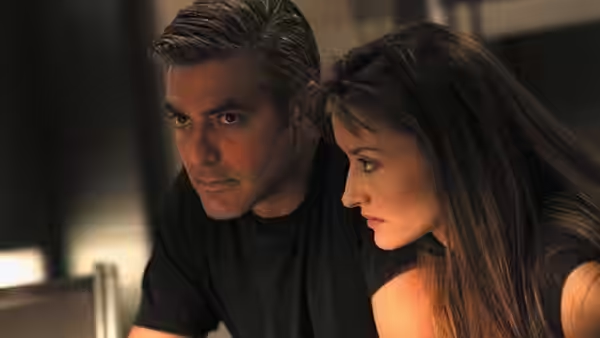
Clooney gives Kelvin almost nothing to do with his face, and that is the performance. He arrives on the station like a man who has already given up and is going through the forms. Natascha McElhone has the harder part. Rheya is a woman who is not sure she is a woman, and McElhone plays her with a frightened hopefulness, watching Kelvin to learn how she is supposed to behave. Viola Davis’s Gordon wants the problem solved by whatever means are to hand and does not soften once. Jeremy Davies’s Snow mumbles, flutters his hands and is either the least or the most frightened person aboard. Ulrich Tukur’s Gibarian has a handful of scenes and a recorded message, and both stay with you.

Here is what got at us. Kelvin remembers meeting Rheya on a train, and Soderbergh hands the whole scene to Martinez and to two faces: she looks, he looks, a door handle, not a word. It is cut into the station scenes so that the memory keeps interrupting the present, which is how memory behaves. We found it moving in a way we had not braced for, and the later memories, the dinner party, the flat, the argument, grew harder to sit through each time they came back, because by then we knew where they led. Grief on film is usually loud. Here it is a man sitting still.

It has faults. The script is the weakest of Soderbergh’s four jobs on it, and there are exchanges about God and consciousness on the station that sound like a seminar and have the effect of one. Snow’s mannerisms are pitched high enough to grate on a second viewing. The film’s Earth is thinly sketched: rain, a train, a kitchen, a hospital corridor, one session with a patient (Kent Faulcon) that tells us Kelvin’s trade and little more. Milena Canonero’s costumes do some of the missing work, dark coats on Earth, soft everyday clothes on the station and no uniforms anywhere, so the crew look like people who happen to be in space.

Most critics did not warm to it, and the reviews divide almost evenly between those who found a tender film about memory and those who found it cold, hollow and short on chemistry between the leads. We think the second group wanted a different film. Kelvin could not love his wife well when she was alive; the story asks whether he can do better with something that looks like her. There is little chemistry between Clooney and McElhone because there was little in the marriage, and the film says so in the memories it keeps returning to.

Tarkovsky’s film spent its length on the planet. Soderbergh spends his on the marriage, and the planet is mostly a light through a window. The last stretch takes a turn we will not describe, which some have called a cheat and we found earned. Watch it at home, late, with the lights off, and do not expect to be told what to think. It carries a 12A and it will not raise your pulse once, which in this case we mean as a recommendation.
Critical consensus AI synthesised

56
Positive
3
Mixed
0
Negative
4

The reviews split down the middle, and the disagreement is about temperature rather than craft. Almost everyone credits Soderbergh’s control, the dislocated editing and photography, and the performances of Clooney and McElhone; several also single out Cliff Martinez’s melancholy score for setting the mood. The quarrel is over what that mood adds up to. The admirers, led by Time Out and The AV Club, find a tender, philosophically serious film that in their view improves on Tarkovsky’s version, and The Guardian agrees it stands on its own. The doubters find the same picture cold, hermetically sealed and short of emotional heft, with Screen Daily and the Los Angeles Times both saying the central relationship never becomes personally involving. Slant goes further and calls the psychology facile and pretentious, while Eye for Film complains of no chemistry between the leads. The spread is wide, with few sitting in the middle; most critics either warm to its restraint or freeze in it.

The AV Club
27 November 2002 · A- · Scott Tobias
90

Soderbergh directs a large-scale studio project with unusual intimacy and restraint, translating Lem's book into a tender, quietly emotional experience with strong philosophical underpinnings. The film comments brilliantly on the slippery nature of memory.

Read the full review →
Time Out
20 June 2014 · GA
90*

Soderbergh's remake surpasses Tarkovsky's version with greater philosophical rigor and emotional force. It stands as the most stylish and cerebrally sophisticated sci-fi film in years, thanks to intelligent direction and strong performances from Clooney and McElhone.

Read the full review →
Los Angeles Times
27 November 2002 · Kenneth Turan
70*

The remake reinforces Soderbergh as a gifted chameleon capable of sophisticated, challenging filmmaking that is elliptical and elusive, with beautifully shot visuals and a haunting mood. It singles out the lack of emotional heft and difficulty in making the core story personally involving as the main shortcoming.

Read the full review →
Slant Magazine
20 November 2002 · Ed Gonzalez
35*

Soderbergh takes Full Frontal into the stratosphere with this prolonged grief-counseling session with a minimalist sci-fi backdrop. Solaris is burdened by an overly facile Psych 101 discourse that’s every bit as heavy and pretentious as his purposefully inscrutable Full Frontal.

Read the full review →
Screen Daily
27 November 2002
30*

The film is curiously lacking in emotion despite its focus on the human heart, remaining cold and intellectually severe. Strong performances from Clooney and McElhone cannot overcome its austere, hermetically sealed tone.

Read the full review →
Empire
· David Hughes

The film is a measured, meditative psychodrama that examines philosophical questions about life, love and grief through a minimalist sci-fi setting. It offers rich rewards for viewers who appreciate its slow, thoughtful pace and strong performances from Clooney and McElhone.

Read the full review →

Cast

Stills

If you liked this, try…

Solaris poster

Solaris

1972 · Tarkovsky’s version, three hours of the same planet and a good deal more of it

Vertigo poster

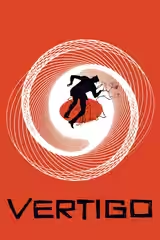
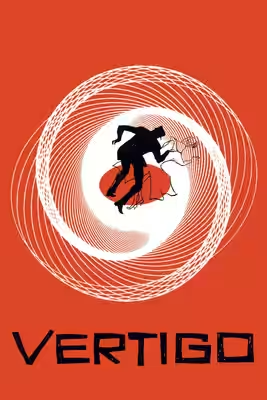
Vertigo

1958 · A man rebuilds a dead woman from memory and does not like what he gets

Don't Look Now poster

Don't Look Now

1973 · Grief cut out of order, in Venice, with the same sense that the dead are near

Arrival poster

Arrival

2016 · First contact as a quiet film about a mother, with the science kept in its place

Moon poster

Moon

2009 · One man, one base, one impossible visitor, made for almost nothing and all the better for it