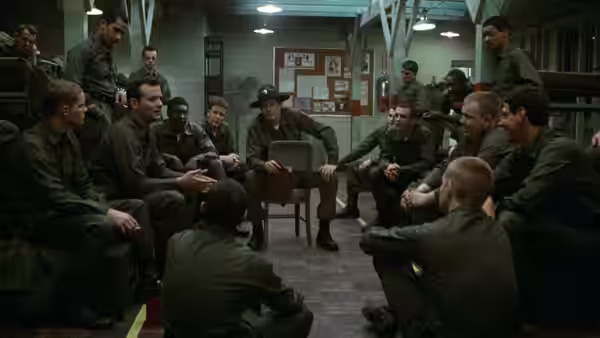
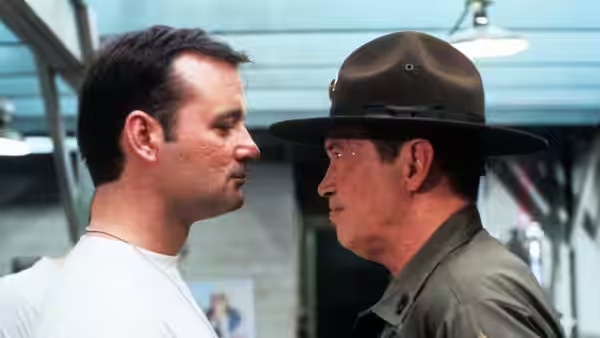
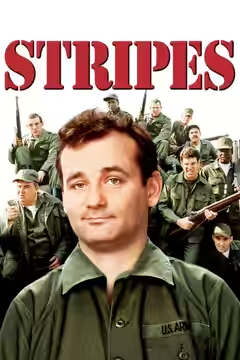
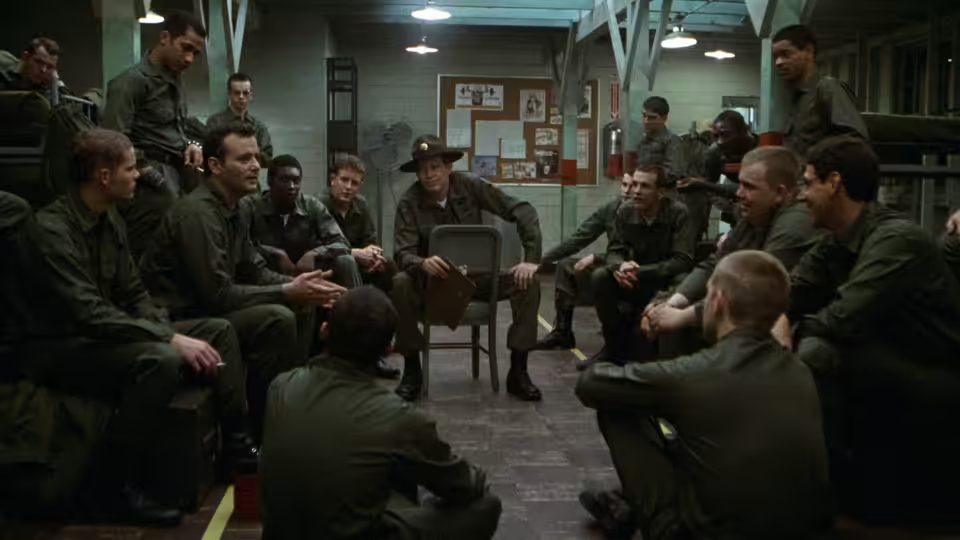
Sgt. Hulka (Warren Oates) sits among recruits gathered in a barracks room
Film review

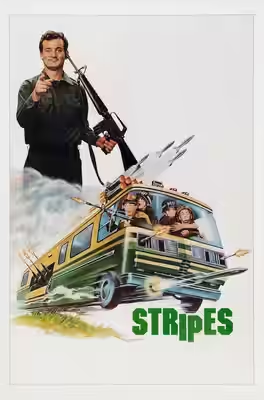
Stripes

1981 · Directed by Ivan Reitman · 1h 46m

In a sentenceWarren Oates bellows at Bill Murray for an hour and we would gladly have skipped the mission

John Winger (Bill Murray) loses his job driving a cab, his car, his flat and his girlfriend Anita (Roberta Leighton) in a single morning. He enlists in the United States Army and talks his friend Russell Ziskey (Harold Ramis), who teaches English to immigrants, into coming with him. At Fort Arnold they join a platoon of misfits, among them the eager, overweight Ox (John Candy) and the menacing Psycho (Conrad Dunn), under the stare of Sergeant Hulka (Warren Oates), a career soldier with no patience for Winger’s attitude. The cowardly Captain Stillman (John Larroquette) commands them from a distance. Winger wants to get through basic training doing as little as possible; two military policewomen, Stella (P. J. Soles) and Louise (Sean Young), give him and Russell a reason to stick around.

Plays from YouTube when you press play; nothing loads from them until then.

Fi1m review

Reitman’s army comedy is at its best when it is just Bill Murray, Warren Oates and a parade ground, and for an hour that is mostly what it is. Then the platoon leaves the base, and the jokes thin out as the hardware arrives.

John Winger (Bill Murray) loses his job, his car, his flat and his girlfriend before lunch, and decides the sensible response is to join the Army. He takes his friend Russell Ziskey (Harold Ramis) along for company. Stripes is the film Ivan Reitman built around that idea, and for an hour it is one of the easiest comedies of its period to sit through: a slob, a drill sergeant and a parade ground. It is good, with one plain caveat. When the film leaves the base, most of what was funny about it stays behind.

Murray plays Winger as a man who has never once done what he was told and is mildly curious to find out what happens if he does. Warren Oates, as Sergeant Hulka, is the casting that makes it work. He plays the man entirely straight, a tired professional with no interest in being liked, and the comedy comes from Murray trying to get a rise out of him and failing, scene after scene. Nothing in the second half is as funny as their first exchange on the parade ground.

The platoon is well stocked. John Candy’s Ox announces that he has joined up to lose weight and is the film’s most generous presence. Conrad Dunn’s Psycho warns the barracks what he will do to anyone who touches his things, and Murray’s reply has outlived the film. John Larroquette’s Captain Stillman is a coward with a telescope and the only officer in sight. Ramis, who wrote the script with Len Blum and Daniel Goldberg, gives himself the sane one and underplays him so far he nearly vanishes, so the film has no second lead to speak of. P. J. Soles and Sean Young, as the military policewomen Stella and Louise, are quick and bright and asked to do almost nothing except take an interest in the recruits.

Bill Butler shoots it flat and bright, hard daylight on a great deal of khaki, and the barracks have the yellow cast of institutional lighting. James H. Spencer’s base is breeze block, chain link and painted stones, and Richard Bruno puts the recruits in fatigues that fit nobody. The best of the craft is Elmer Bernstein’s score, which plays the brass and snare drum of a recruiting film without a trace of a wink, so that every time the platoon shambles into frame the music insists they are heroes. A good deal of the laughter lives in that gap.

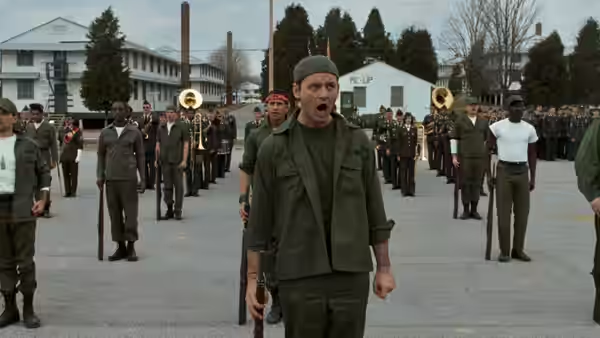
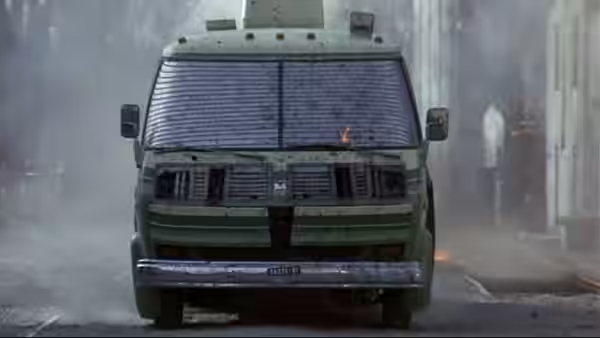
We laughed hardest at the graduation parade. The platoon, with no sleep and almost no training, marches onto the field to a routine that is half drill and half dance number, Murray calling the steps like a man leading a conga, while Reitman holds on the reviewing stand as the brass try to decide whether they are watching a disaster or a triumph. It is the high point, and it is also, more or less, the end of the film we had been enjoying. The last forty minutes take the platoon off the base on an errand we will not describe, and the comedy that had been coming from people now has to come from vehicles. Three editors are credited, Michael Luciano, Harry Keller and Eva Ruggiero, and the last act looks cut in a hurry: scenes start late, end early and are joined mostly by cutting to the next thing that moves. We found ourselves checking the time, and then slightly cross that a film which had made us laugh so freely had decided we would rather watch a chase.

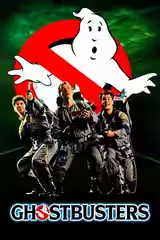
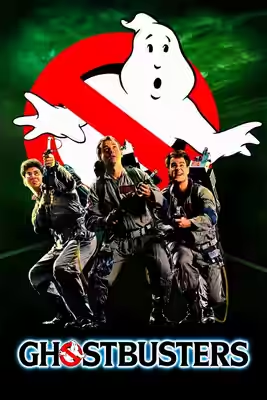
The shape is the trouble, and it is the genre’s. Service comedies tend to run out of road once the recruits graduate. Stripes tries to become a caper instead, and Murray’s gift is that he visibly does not care about the plot, which is a fine quality in a recruit and a fatal one in an action hero. Reitman had already made a cheerful, shapeless comedy with Murray in Meatballs (1979); three years later, with Murray and Ramis again, he would make Ghostbusters (1984). This one sits between them.

It runs 106 minutes and carries a 15 certificate. Watch it with people who can quote it, or with someone who has never seen Murray this young and this unbothered. Stay for the parade. What follows is an acceptable way to fill the time, and the film plainly thinks it is the point, but we were still on the parade ground, and we were happy there.

Critical consensus AI synthesised

63
Positive
2
Mixed
3
Negative
1
Empire
1 January 2000 · William Thomas
85*

The review regards the film as an often hilarious, successful comedy and a classic early big-screen showcase for its cast. It especially praises Bill Murray’s transition from television and his laid-back screen persona.

Read the full review →
Variety
31 December 1980 · Variety Staff
70*

The review finds the comedy cheerful and amiable, with little artistic subtlety but an overall successful effect. It singles out Bill Murray, Harold Ramis, John Candy, and Warren Oates for their comic performances.

Read the full review →
RogerEbert.com
64*

The page does not reveal the critic’s verdict because access is blocked. No praise or complaint from the review is available to identify.

Read the full review →
Time Out
· RM
64*

The available page identifies this as a review but provides no critic verdict. Its description outlines Murray’s impulsive decision to join the Army, without a specific point of praise or complaint.

Read the full review →
Radio Times
★★★ · John Ferguson
60

Ferguson says Murray’s charisma makes up for the comedy’s formulaic plotting, though the film falters in its finale. He singles out Murray’s sparring with Warren Oates as a constant delight.

Read the full review →
Vulture
20 May 2018 · Alden Ford
35*

Ford finds Stripes amiable but not very funny, criticizing its uneven structure and wasted comic potential. He singles out the late Czech-rescue sequence as the film’s only imaginative stretch, though it arrives too late to make up for the long boot-camp section.

Read the full review →

Straight answers AI written, from our review

Is Stripes worth watching?
Stripes is worth watching for its first hour, when it is Bill Murray needling Warren Oates on a parade ground, and we scored it 70. The last forty minutes take the platoon off the base and swap the comedy of people for the comedy of vehicles, and the jokes thin out. Stay for the graduation parade; what follows is filler.
How long is Stripes, and what is it rated?
Stripes runs 1h 46m. It is an action and comedy film.
Where can I watch Stripes in the UAE?
Stripes is not on any streaming or rental service in the UAE at the moment. It is available in 26 other countries; change your country at the top of the page to see where. Availability is checked daily.
How violent or frightening is Stripes, and is it suitable for children?
Stripes carries a 15 certificate in the UK and an R in the US, so it is not for children. The review mentions nothing frightening; the certificate reflects adult language and sexual content rather than violence, and the last act is a caper with chases, not a bloody one. Older teenagers who like Bill Murray will be fine with it.
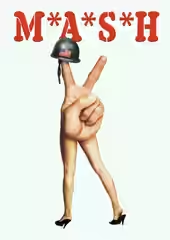
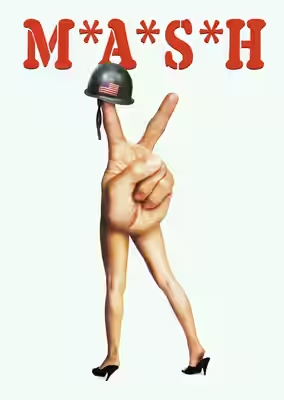
How does Stripes compare to M*A*S*H?
Stripes is the gentler and slighter of the two; *M*A*S*H* is crueller and funnier, and nobody in it salutes anything. Reitman's film is a slob versus a sergeant on a parade ground, while Altman's is a bloody war comedy whose surgeons bully people in ways that make some laughter hard to share. Choose Stripes for an easy evening, MASH* for the better film.
What should I watch after Stripes?
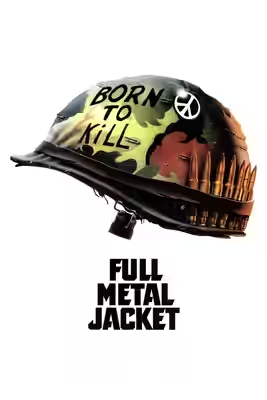
After Stripes, try *M*A*S*H* (1970, Fi1m 72): Altman’s army is crueller and funnier, and nobody in it salutes anything. Then Private Benjamin (1980, Fi1m 64): Goldie Hawn enlists for the wrong reasons too, and gets a sharper film about it; and Full Metal Jacket (1987, Fi1m 81): The same parade ground with the jokes removed, and nobody laughing at the sergeant.

Cast

If you liked this, try…

  1. M*A*S*H (1970, Fi1m 72)Altman’s army is crueller and funnier, and nobody in it salutes anything.

  2. Private Benjamin (1980, Fi1m 64)Goldie Hawn enlists for the wrong reasons too, and gets a sharper film about it.

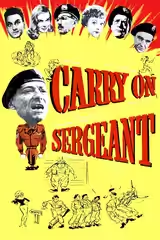
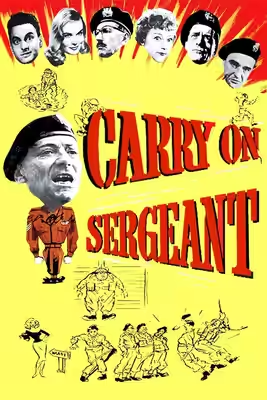
  3. Carry On Sergeant (1958) · not reviewed yetThe British version: a hopeless platoon, a despairing sergeant and a passing-out parade.

  4. Full Metal Jacket (1987, Fi1m 81)The same parade ground with the jokes removed, and nobody laughing at the sergeant.

  5. Ghostbusters (1984, Fi1m 80)Reitman, Murray and Ramis again, this time with a script that knows where it is going.

Free account

Know what to watch tonight

Two lists that know where things are streaming, collections you can share, your own score beside ours, and Discover that remembers what you have seen.

  • Want to see, sorted by what is streaming now
  • Seen, with your score out of ten
  • No adverts, ever