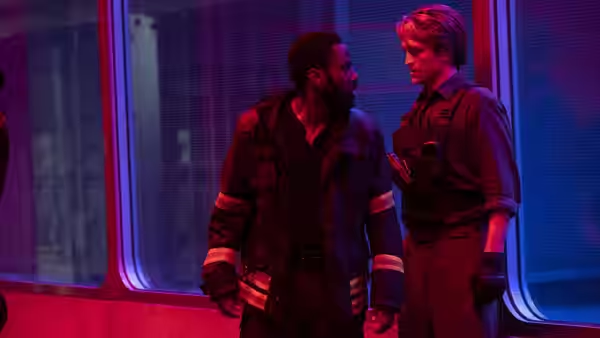
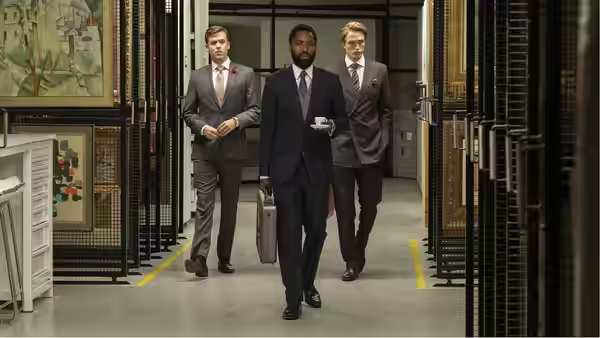
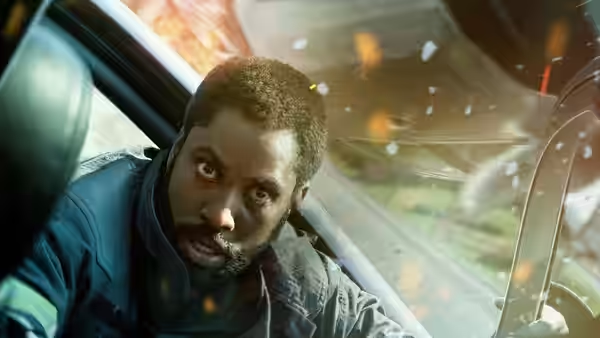
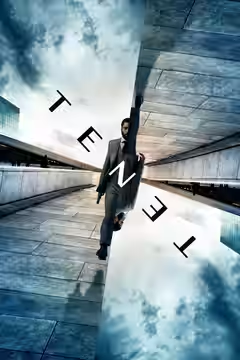
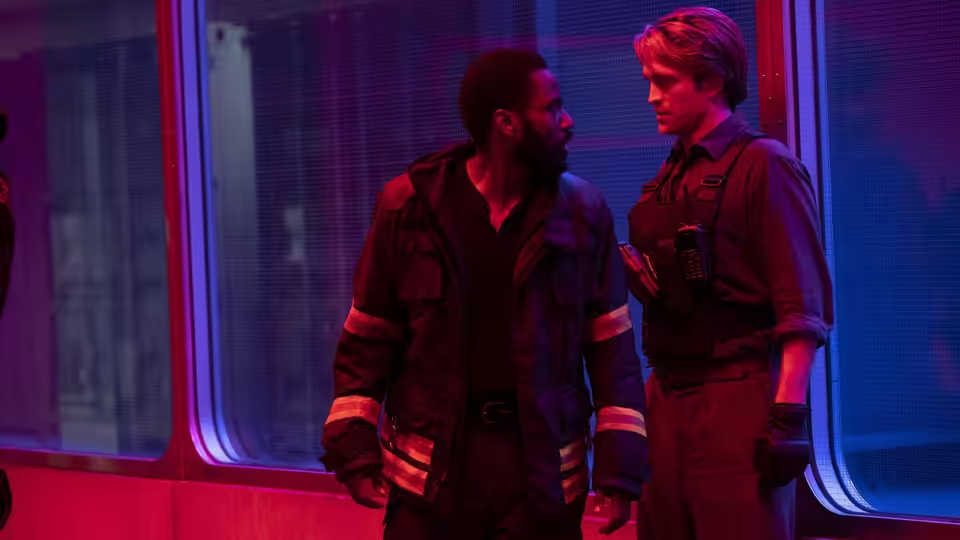
Protagonist (John David Washington) and Neil (Robert Pattinson) facing each other by large windows
Film review

Tenet

2020 · Directed by Christopher Nolan · 2h 30m · MPA PG-13

In a sentenceBeautifully tailored men save the world in both directions and forget to introduce themselves

A CIA agent known only as the Protagonist (John David Washington) is sent into a hostage siege at the Kyiv opera house, is captured, and swallows what he believes is a cyanide pill. He wakes to learn it was a test, and that he has passed. His only instruction is a word, Tenet. A scientist, Barbara (Clémence Poésy), shows him bullets that have been fired backwards through time, and the trail leads to Mumbai, where the arms dealer Priya (Dimple Kapadia) names Sator (Kenneth Branagh), a Russian oligarch trading with the future. With a new partner, Neil (Robert Pattinson), the Protagonist goes to London to get close to Sator’s estranged wife Kat (Elizabeth Debicki), who is trapped by a forged painting her husband holds over her.

Plays from YouTube when you press play; nothing loads from them until then.

Fi1m review

Christopher Nolan has built a spy thriller that runs in two directions at once, and the engineering is remarkable. What is missing is anyone to care about: the people are instructions in good coats, and the sound mix swallows half of what they say.

Christopher Nolan writes, directs and produces Tenet, a spy thriller in which objects, and eventually people, can be made to travel backwards through time while everything around them carries on forwards. Most directors would spend a whole film explaining that. Nolan spends a whole film explaining it and stages a heist, a chase and a war at the same time. The result runs 150 minutes and carries a 12A, and it is the most elaborate machine he has built. It is also the first of his films we found hard to care about.

The idea works best when Nolan shows it. In a customs warehouse in Oslo, a man in a suit fights a masked figure who is moving the wrong way through time, and Hoyte van Hoytema keeps the camera wide and level so that we can see all of it and check for cheating. There is none. A motorway chase later does the same with cars, and a saloon un-crashing itself across three lanes is the strangest and most pleasing picture Nolan has yet put on a screen. Nathan Crowley gives him hard, clean places to do it in: the freeport’s white corridors and turnstiles, a yacht that looks like a bank, a wind farm out at sea.

Ludwig Göransson’s score is the film’s engine, a low grinding pulse that never quite stops and rises to a siren whenever the film wants our hearts to go with it. It is often the most exciting thing in the film, and it is mixed so high that whole lines vanish under it. This is a film made of lines. When a man is telling us why the world is about to end and we are listening to a bass drum, that is a mistake, and it is repeated. Jennifer Lame cuts to the beat and never lets a scene run a second past its last piece of information.

The trouble is in the script, and Nolan wrote it alone. His hero has no name, no past and no wish of his own; he is called the Protagonist and behaves like the definition of one. Almost every conversation is an instruction. Barbara (Clémence Poésy) explains inversion. Priya (Dimple Kapadia) explains Sator. Crosby (Michael Caine) explains Sator’s wife. Neil explains what the others meant. John David Washington is a graceful, contained physical actor who carries the suits and the fights well, but he has been asked to play a job description, and there is nothing behind the eyes because nothing was written there.

Robert Pattinson is the one enjoying himself, playing Neil as an amiable public-school drinker who knows far more physics than he lets on, and the film brightens whenever he walks in. Elizabeth Debicki’s Kat is the only character with a want we recognise, her son and her freedom, and she plays her as a woman who has been frightened for so long it has settled into her posture. Kenneth Branagh gives Sator a Russian accent and a temper and little else. Dimple Kapadia is drily sharp in her few scenes. Himesh Patel and Aaron Taylor-Johnson are brisk and likeable as a fixer and a soldier.

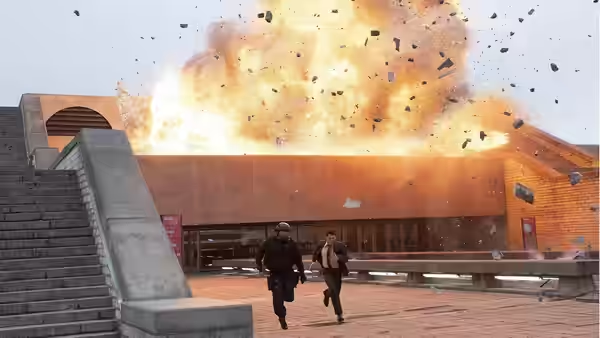
Here is what we felt. When the masked figure first came through the turnstile and moved the wrong way, we sat forward; we did not know what we were looking at and we wanted to. Two hours later, in a final battle the film has spent an hour arranging, we caught ourselves admiring the timetable. Soldiers ran through a ruined town and we could not have said which of them we minded losing. We were not bored, and we were not moved, and the second matters more in a film about the end of everything.

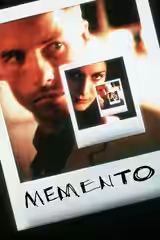
Nolan has made time misbehave before and got away with it. Memento (2000) ran backwards and nobody was lost, because one man’s grief was in every scene. Inception (2010) had dreams inside dreams and a father who wanted to go home. Tenet has a man who wants to complete the mission, and a mission is not a person.

It opened in UK cinemas on 26 August 2020, and the size of the screen is a fair part of the case for it. At home the pictures survive and the plot gets no clearer. See it for the warehouse and the motorway, take somebody with a good memory, and do not expect to feel much until Debicki is on screen, which is not often enough.

Critical consensus AI synthesised

73
Positive
13
Mixed
8
Negative
0

Most critics like Tenet, and nearly all of them like the same things about it. The praise lands on the practical action set pieces, staged at a scale several reviewers say justifies a cinema seat, and on the inverted-time sequences that run forwards and backwards at once. Robert Pattinson is the performer most often singled out, with Elizabeth Debicki and John David Washington close behind, and the score gets repeated mention.

The reservations are just as consistent. Almost every review, including the warm ones, complains of too much exposition, dialogue lost under the sound mix, and characters kept at a distance, so the film is admired more than felt. The spread is wide: The Times, The Guardian and The Telegraph give it full marks, while IndieWire calls it joyless and Vulture finds a puzzle box with nothing inside. Nobody dismisses it outright; the argument is over whether the machinery is enough.

The Guardian
25 August 2020 · ★★★★★ · Peter Bradshaw
100

The critic calls the film a gigantically confusing yet entertaining metaphysical action thriller that succeeds as superb cinema despite its preposterous premise. They single out its steroidal energy, imagination, and practical spectacle, including symmetrically recurring action sequences.

Read the full review →
The Telegraph
26 April 2021 · ★★★★★ · Robbie Collin
100

The critic describes it as an icily glamorous, time-bending thriller that rewards surrender to its sensory assault and complex plotting. They single out its practical action set pieces, performances (especially Pattinson and Debicki), and the way it unfolds like a palindrome.

Read the full review →
The Times
28 August 2020 · ★★★★★ · Kevin Maher
100

The critic hails it as a delightfully convoluted masterpiece and the year’s first mainstream one, with a classic spy story at its heart. They single out its globe-trotting practical stunts and effects, including a structurally audacious climactic battle, and Washington’s action-hero turn.

Read the full review →
Evening Standard
26 August 2020 · Charlotte O'Sullivan
85*

The critic calls the film an eye-popping, ground-breaking blast and a dream for film-goers, highlighting its commitment to the big screen and thrilling sequences. They note some quibbles with the physics exposition and villain but overall celebrate its ambition and timeliness.

Read the full review →
Empire
21 August 2020 · Alex Godfrey
80*

The critic praises the film's bold action set pieces, globetrotting espionage thrills and inventive time-bending spectacle as a big-screen experience. They single out the complex, often baffling plotting as a potential barrier to full emotional engagement.

Read the full review →
Radio Times
★★★★ · Emma Simmonds
80

The review praises Tenet as a slick, globetrotting sci-fi adventure that is frequently as exciting as cinema gets, with spectacular set pieces and a bristling score masking any confusion from its complex concepts. It highlights the intense lead performance and showmanship in direction.

Read the full review →

Straight answers AI written, from our review

Is Tenet worth watching?
Tenet is worth watching for anyone who wants to see Christopher Nolan stage a fight, a chase and a battle running backwards and forwards at once, and we scored it 65. The engineering is remarkable and the warehouse and motorway sequences are the best things he has filmed. The people are instructions in good coats, and the sound mix swallows half of what they say.
How long is Tenet, and what is it rated?
Tenet runs 2h 30m and is rated PG-13 by the MPA in the US. It is an action and thriller film.
Where can I watch Tenet in the US?
Tenet is available to rent from Amazon Prime Video and Apple TV from $5.99. Availability is checked daily; the links above go straight to each service.
How violent or frightening is Tenet, and is it suitable for children?
Tenet carries a 12A certificate in the UK, so it is a spy thriller with fights, gunfire, car crashes and a large final battle, but nothing graphic. Younger children are more likely to be lost than frightened, since the plot is dense and much of the dialogue is hard to hear. Older children who enjoy action should manage; a scene of a husband holding power over his frightened wife is the darkest thread.
How does Tenet compare to Memento?
Tenet is the bigger and more elaborate of the two, and Memento is the better film, because it puts one grieving man at the centre of its backwards structure and never loses him. Tenet has a hero with no name, no past and no wish of his own, so the spectacle has nobody to hang on. Choose Tenet for scale and stunts, Memento if you want to feel something.
What should I watch after Tenet?
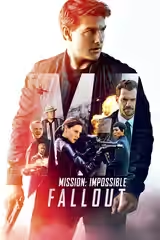
After Tenet, try Memento (2000, Fi1m 88): Nolan running time backwards with one grieving man at the centre, and it works. Then Primer (2004, Fi1m 79): Made for almost nothing, harder to follow than Tenet, and the people in it matter; and Mission: Impossible – Fallout (2018, Fi1m 87): Practical stunts on a similar scale, attached to a hero who visibly wants things.

Cast

If you liked this, try…

  1. Memento (2000, Fi1m 88)Nolan running time backwards with one grieving man at the centre, and it works.

  2. Primer (2004, Fi1m 79)Made for almost nothing, harder to follow than Tenet, and the people in it matter.

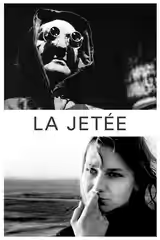
  3. La Jetée (1962) · not on Fi1m yetTwenty-eight minutes of still photographs that say more about time than most features.

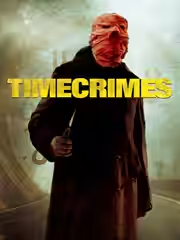
  4. Timecrimes (2007) · not on Fi1m yetA small Spanish loop of a film where every loose end is a man’s own fault.

  5. Mission: Impossible – Fallout (2018, Fi1m 87)Practical stunts on a similar scale, attached to a hero who visibly wants things.