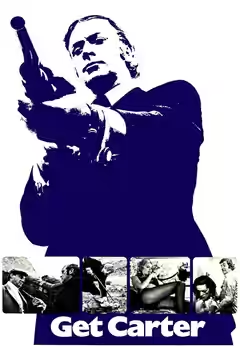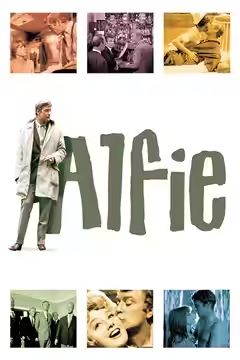
Michael Caine can make a man listening more troubling than a man making threats. We rate his economy: in Get Carter, he holds our attention without asking us to find something decent underneath the menace.
Fi1m perspective
Jack Carter asks questions in Get Carter (1971), and Caine leaves us watching for what he might do next. He gives no sign that violence requires a change of mood, much less a struggle with his conscience. We were unnerved by his calm because there was nothing in it to suggest he needed to work himself up to hurting someone. This is Caine at his most persuasive: he lets us understand the man without trying to make him tolerable.
The familiar Cockney voice can distract from how carefully Caine listens and reacts. He broke through with Zulu (1964), The Ipcress File (1965) and Alfie (1966). In Educating Rita (1983), his natural delivery and attention to the other performer make conversation feel spontaneous. The same habit of attending to someone else becomes threatening in Carter, where his watchfulness gives us time to worry.
Mike Hodges gives that performance room in Get Carter, and editor John Trumper keeps the pressure on while allowing Caine's watchfulness to become oppressive. Roy Budd's inviting score makes Carter's coolness attractive, which is effective and slightly suspect. We would not excuse the film's treatment of women, or pretend Hodges is immune to the pleasure of watching his leading man take charge. Caine's achievement is to sustain our interest without supplying a kindly streak to make the evening easier.
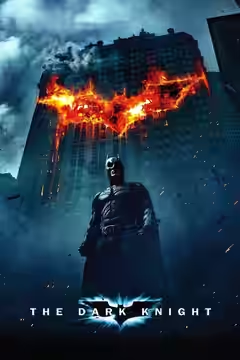
Christopher Nolan became a regular collaborator in the later career, starting with Caine's Alfred Pennyworth in Batman Begins (2005) and continuing with films including Inception (2010). Those collaborations brought a revival from the mid-2000s, though familiarity also carries a risk for an actor this recognisable. Across his prolific career, the films vary in quality and Caine sometimes seems to be playing a version of himself. Knowing the voice before the character has finished a sentence is a pleasure, but it is not enough on its own.
For us, the useful test is whether a film lets that familiar manner become something specific. Carter's composure passes it: even his dry humour gives us little reassurance, and Caine never needs to advertise the danger. Start with Get Carter, but leave it for another night if what is wanted is reassurance.
Biography
Michael Caine is an English actor. Born Maurice Joseph Micklewhite Jr. on 14 March 1933 in Rotherhithe, London, he has appeared in more than 160 films across a career spanning seven decades.
He first gained prominence in the 1960s with roles in films including Zulu (1964), The Ipcress File (1965), Alfie (1966) and The Italian Job (1969). In 1971 he starred as Jack Carter in Get Carter, on which he also served as an uncredited co-producer, and later played Sir Michael Crosby in Tenet (2020).
Caine is known for his performances as Alfred Pennyworth in Christopher Nolan's Batman films (Batman Begins (2005), The Dark Knight (2008) and The Dark Knight Rises (2012)), and for roles in Inception (2010), Interstellar (2014) and Dunkirk (2017). He has received two Academy Awards for Best Supporting Actor.