Film review

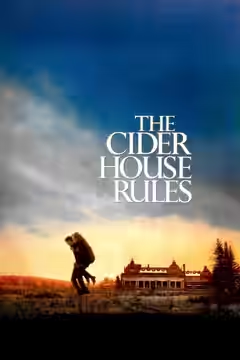
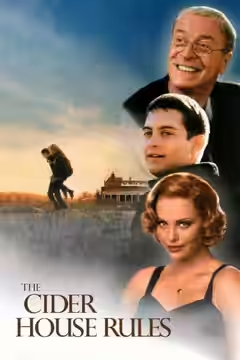
The Cider House Rules

1999 · Directed by Lasse Hallström · 2h 06m · MPA PG-13

In a sentenceEveryone is kind, the leaves are golden and Rachel Portman’s piano never once lets you forget it

Drama

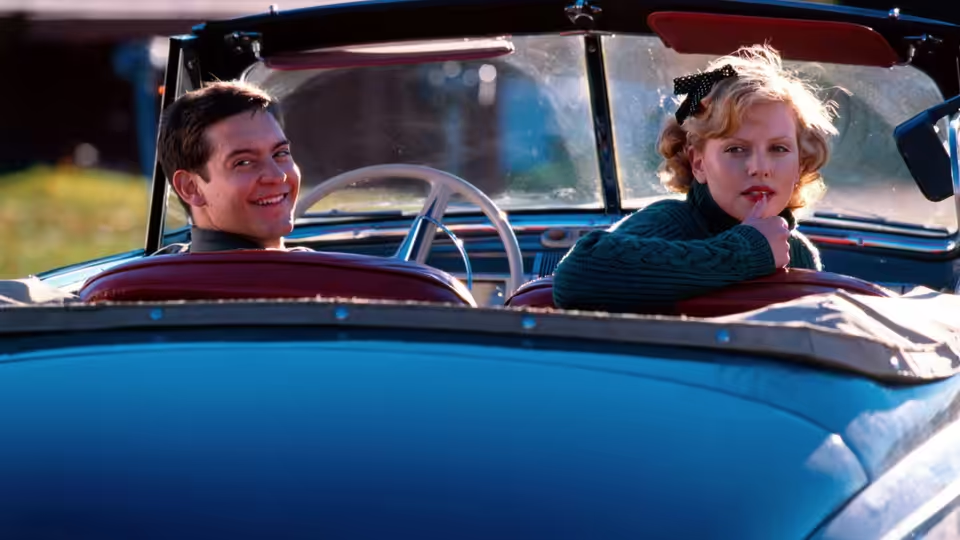
Maine, during the Second World War. Homer Wells (Tobey Maguire) has grown up at St. Cloud’s, an orphanage run by Dr. Wilbur Larch (Michael Caine), who delivers babies, performs the abortions the law forbids and takes ether at night. Larch has trained Homer as a doctor without a diploma and means him to take over. Homer will deliver babies but will not do abortions, and he wants to see the world outside. When Candy Kendall (Charlize Theron) arrives with her pilot boyfriend Wally Worthington (Paul Rudd) for a procedure, Homer leaves with them for the Worthington apple orchard, picks apples alongside Arthur Rose (Delroy Lindo) and his crew, and sleeps in the cider house, where the rules are pinned to a wall none of the pickers can read.

Fi1m review

Lasse Hallström’s version of John Irving’s novel is handsomely built and gently acted, and Michael Caine is the best thing in it. But it wraps every hard subject in autumn light and a warm piano until it stops being hard, and the orchard hour drifts.

Lasse Hallström, working from John Irving’s own script of his novel, has made a film about an orphanage that performs illegal abortions, a boy who leaves it, and an apple harvest. It is handsome, kind and well acted, and in 126 minutes it never raises its voice. That is the film’s manner and also its problem. Several hard things happen in it, each arrives with the light low and the piano up, and by the end we remembered the light and the piano better than the things.

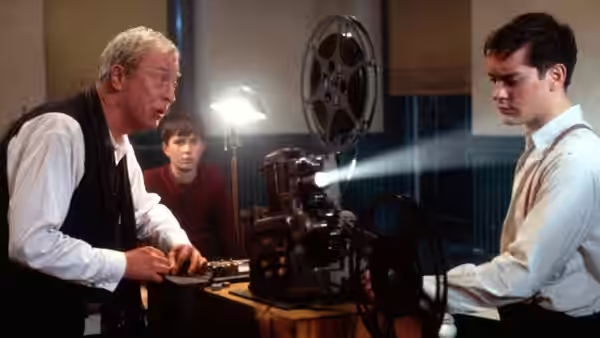
The orphanage is the best of it. David Gropman builds the orphanage out of iron bedsteads, brown wallpaper and a dispensary with a rack of ether bottles, and Oliver Stapleton lights it with lamps and grey window light. Michael Caine plays Dr. Larch with a soft New England voice, a dry line for everything and a rag he puts to his face when the day is over. He is a good man doing an illegal thing because he has seen what happens when nobody does it, and Caine never asks us to admire him. Jane Alexander and Kathy Baker, as the nurses who run the place with him, make plain competence look like affection.

Tobey Maguire plays Homer as a boy who watches, which suits him. For the first forty minutes his stillness reads as a young man deciding what he thinks. Once he has left for the orchard it reads as an actor waiting for something to do. Charlize Theron is warm and direct as Candy, Paul Rudd is decent as Wally, and neither part has much in it beyond being nice to Homer. Kate Nelligan, as Wally’s mother Olive, gets one good scene about running a farm with the men gone.

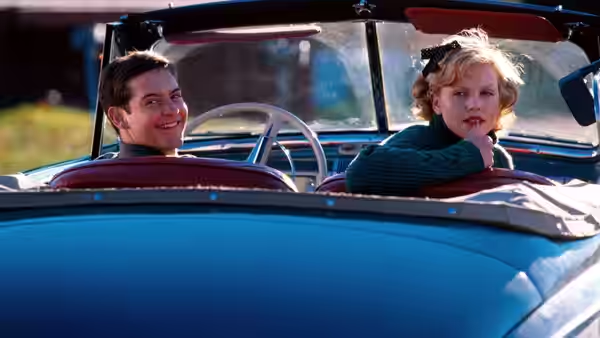
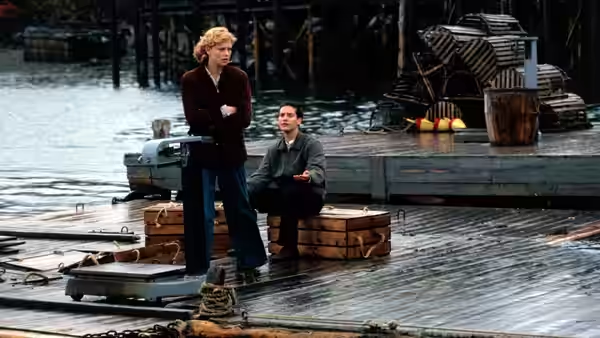
The orchard hour is where the film drifts. Stapleton shoots the trees in gold and the sea in flat blue, Renee Ehrlich Kalfus puts everyone in worn wool and canvas, and Lisa Zeno Churgin cuts the picking as a slow round of ladders, crates and cider presses, so that the season passes without incident. We looked at it the way you look out of a train window. Delroy Lindo, as Mr Rose, the head of the picking crew, is the exception: courteous, quick with a knife, a man who has decided which rules apply to him, and the film wakes up whenever he speaks. Erykah Badu, as his daughter Rose Rose, does much with a handful of lines.

Rachel Portman’s score is the trouble in miniature. It is piano and strings, and it sits under nearly everything: the goodnight blessing, the picking, the first kiss, the letters home. It is a good tune. Played this often it becomes an instruction, always the same one: feel something now. Abortion, a war offscreen, a family with a secret do not need the help, and every time the piano comes in they get a little smaller.

We should say what got through. Larch’s goodnight to the boys, “goodnight, you princes of Maine, you kings of New England”, said into a dark room of iron beds, moved us more than we were prepared for. Caine plays it without a flicker of performance, as a man saying words he has said a thousand times, and that is why it lands.

The second half takes a turn involving the Rose family that we will not describe. The film handles it the way it handles everything, gently and with the strings up, and a subject that should have shaken it settles in instead. Hallström’s My Life as a Dog (1985) and What’s Eating Gilbert Grape (1993) were gentle too, and both had something sharp underneath. This one has had it sanded down.

See it for Caine, for Lindo and for the orphanage. Watch it at home on a wet evening, which is the weather it was made for, and do not be surprised if your attention wanders when the ladders come out. Most critics sit where we do; we suspect the ones who loved it were watching the light and the ones who hated it were listening to the piano.

Critical consensus AI synthesised

62
Positive
4
Mixed
3
Negative
2

Most critics are warmly disposed, if not unreserved. The praise gathers on the cast and above all on Michael Caine’s ether-addicted Dr Larch, named again and again as the reason to watch; Tobey Maguire, Charlize Theron and Delroy Lindo get their mentions too. Several reviewers call it the most successful screen version of Irving yet, and the New England locations and Hallström’s gentle, old-fashioned manner are admired for their simple integrity.

The reservations settle on shape and tone. Even admirers note the film wants more dramatic muscle, that the romantic middle section drifts, and that as a story it arrives nowhere in particular. The spread is wide: the two outright dissenters, Sight and Sound and The Guardian, find the gentleness closer to blandness and the sentiment glutinous, arguing that abortion, race and incest are handled so tearfully as to become incoherent. Nobody calls it ugly or dull to look at; the argument is whether it adds up.

Radio Times
★★★★★ · Neil Smith
100

The film is a rich, evocative period piece with simple integrity that makes the most of its New England locations. Michael Caine's scene-stealing performance as the ether-addicted Dr Larch stands out.

Read the full review →
The New York Times
10 December 1999 · Stephen Holden
85*

Hallström's lovely adaptation is the finest film realization of an Irving novel, a gentle fable about a young man's journey, loss of innocence and earned wisdom.

Read the full review →
Variety
7 September 1999 · festival review · David Rooney
75*

A touching, old-fashioned charmer that ultimately satisfies despite needing more dramatic muscle, with strong performances from Maguire and Caine.

Read the full review →
The New Yorker
6 December 1999 · Anthony Lane
60*

The movie has charm in its inconsequential moments and a keen eye for the happily adrift, but as a meditation on growing up it loses its grip, with adult performances standing out most.

Read the full review →
Time Out
· TCh
60*

Hallström's adaptation is the most successful screen version of Irving yet, though still problematic. It succeeds best in the first and last acts and a strong supporting turn from Delroy Lindo, while the romantic middle section feels less engaging.

Read the full review →
RogerEbert.com
17 December 1999 · Roger Ebert
55*

The film is absorbing in parts with strong turns from Michael Caine and Charlize Theron, but unfocused overall and arrives nowhere in particular as a story.

Read the full review →

Cast

Awards

Academy Awards, 2000

Nominated
Best Director
Nominated
Best Film Editing
Nominated
Best Original Score
Nominated
Best Picture
Nominated
Best Production Design
Won
Best Supporting Actor
Won
Best Writing, Adapted Screenplay

If you liked this, try…

My Life as a Dog poster

My Life as a Dog

1985 · Hallström’s Swedish childhood film, gentler still, and with the hard edge this one lacks.

Vera Drake poster84

Vera Drake

2004 · Mike Leigh on a backstreet abortionist in 1950s London; no piano, no comfort.

The World According to Garp poster

The World According to Garp

1982 · Another Irving adaptation, odder and braver, with Robin Williams and Glenn Close.

Days of Heaven poster85

Days of Heaven

1978 · Malick’s harvest-time drama, if what you liked here was the fields at dusk.

Kes poster88

Kes

1969 · Ken Loach on a boy with nowhere to go and one thing that is his.