A woman in sailing gear turns toward the camera aboard a boat at sea
Film review

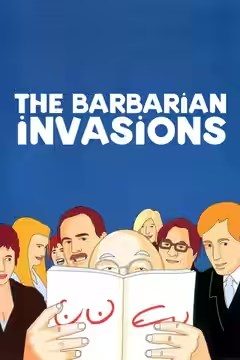
The Barbarian Invasions

2003 · Directed by Denys Arcand · 1h 39m

In a sentenceThe professor is dying; the conversation is going to need considerably longer

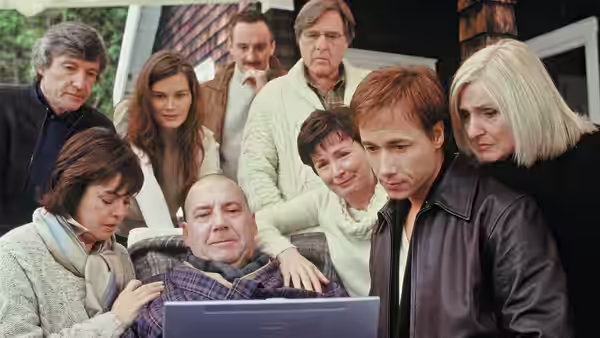
Rémy (Rémy Girard), a dying professor, has a lifetime of opinions and relationships to reconsider. His son Sébastien (Stéphane Rousseau) faces the question of what a child owes a difficult parent. Around Rémy are friends and family, with Louise (Dorothée Berryman) among those caught up in his illness. As talk turns to sex, friendship and the life he has led, Rémy wants to be understood by the people he will leave behind. Father and son try to find a way of speaking to each other while those around them weigh affection against old grievances.

Fi1m review

Denys Arcand finds warmth and sharp comedy in a dying professor’s difficult relationships. The talk can grow smug, and the social criticism is blunt, but the father and son give The Barbarian Invasions enough feeling to make it worth an evening.

The Barbarian Invasions earns an evening through its humour and its attention to a difficult father and son. Denys Arcand has written and directed a comedy-drama about a dying professor whose family and friends have to decide what they owe him. Rémy has opinions, appetites and a strained relationship with his son; illness gives everyone another problem to negotiate. The film finds something affecting in their efforts, though its fondness for this company sometimes makes it too willing to indulge them.

Rémy Girard makes Rémy’s appetite for conversation entertaining without making him especially easy company. The professor’s reflections on his life keep exposing how little having plenty to say helps him understand another person. Stéphane Rousseau, as Sébastien, gives the father-son scenes a necessary resistance to all that talk. We were moved by their attempts to reach each other, because the affection has to survive Rémy’s habit of making himself the most important person present.

Denys Arcand’s dialogue gives the ensemble plenty to enjoy, especially when affection and irritation share the same conversation. The jokes about sex have a wearisome habit of congratulating the people making them, and their ease with one another does not guarantee our delight in their company. Still, the humour matters: it prevents illness from turning every exchange into a solemn declaration of love. These people can be tiresome, and their friends have evidently had considerable practice at putting up with them.

Guy Dufaux’s cinematography keeps the performances prominent, and François Séguin’s production design is suitably unobtrusive around such talkative people. Isabelle Dedieu’s editing gives the exchanges room to develop, although it cannot remove the sense of speeches written for an appreciative audience. Pierre Aviat’s music is most persuasive when it allows the actors to supply the emotion. The presentation is assured throughout; the difficulty is how readily the film accepts its characters’ estimate of their own importance.

The wider social criticism is less convincing. Denys Arcand lets the characters’ certainty do work that the writing ought to do, and their pronouncements too often pass without a convincing objection. The jokes are frequently strong enough to distract from how little has been established about the society being criticised. There is a recurring suggestion that their education entitles them to our sympathy, and the film does not examine that assumption nearly as closely as it examines what they feel about dying.

Within the illness drama, the film’s useful question is how much generosity a difficult person can reasonably expect. The writing is alert to the pressure to forgive, and some of its strongest passages concern the obligations of the people doing the forgiving. Family loyalty is allowed to be tiring; friendship involves tolerating another round of the same opinions. The scenes between Rémy and Sébastien give those obligations a personal cost, and neither actor needs the surrounding discussion to tell us why the relationship matters.

It runs 99 minutes, and there is enough comic friction to keep its failings from taking over the evening. Anyone looking for a searching account of society will find the talk too easy on itself. Choose it when there is time afterwards to argue about how much a parent is owed.

Critical consensus AI synthesised

58
Positive
5
Mixed
3
Negative
5

The reviews are sharply divided, with praise centred on the dialogue, the cast’s comic chemistry and the handling of family, friendship and mortality. Admirers find Arcand’s writing witty without sacrificing seriousness, and see the father-son relationship as a source of feeling rather than an excuse for sentimentality. Even some detractors acknowledge the film’s emotional control: IndieWire finds its social analysis facile and its dialogue theatrical, but credits the quieter treatment of mortality with saving it.

The main disagreement is over whether the characters’ talk offers insight or merely congratulates them on their own sophistication. Reservations cluster around broad social criticism, shallow characterisation and awkward plotting, while the warmer reviews find tenderness and an argument for tolerance. The spread is wide, with little shared middle ground in the available assessments. The Guardian rejects the appeal for sympathy outright, finding the characters conceited and the sexual politics reactionary.

Variety
21 May 2003 · festival review · Lisa Nesselson
90*

Nesselson finds the film funny, sharply written, and genuinely touching. She praises its polished repartee and its tender, irreverent handling of family, friendship, and mortality.

Read the full review →
Evening Standard
10 April 2012 · Nina Caplan
80*

Caplan considers the film more profound than its predecessor and ultimately an argument for tolerance. She praises Arcand’s exquisite, witty dialogue, which she says also handles serious issues.

Read the full review →
Radio Times
★★★★ · Brian Pendreigh
80

The review gives the film a positive assessment, comparing its premise to Big Fish. It singles out the dying professor’s reflections on his life and reconciliation with his son.

Read the full review →
Total Film
20 February 2004 · ★★★★ · Total Film
80

The review finds the film moving and cerebral, balancing its themes with emotional depth. It singles out the father-son relationship and the cast’s comic chemistry for praise.

Read the full review →
The New Yorker
16 November 2003 · David Denby
78*

Denby finds The Barbarian Invasions a tender, moving meditation on death, friendship, and what one generation passes to another. He especially praises Arcand’s exquisite tenderness in the final connection between Rémy and Nathalie.

Read the full review →
RogerEbert.com
66*

The page is identified as a review, but its content is blocked. The critic’s verdict and any specific praise or complaint cannot be determined.

Read the full review →

Straight answers AI written, from our review

Is The Barbarian Invasions worth watching?
The Barbarian Invasions is worth watching for its sharp humour and affecting father-son relationship, and we score it 71 out of 100. We recommend it to anyone drawn to talkative family dramas, with a reservation: the sexual jokes can grow smug, and the social criticism is less searching than the conversations about what children owe difficult parents.
How long is The Barbarian Invasions, and what is it rated?
The Barbarian Invasions runs 1h 39m. It is a comedy and drama film.
Where can I watch The Barbarian Invasions in Azerbaijan?
The Barbarian Invasions is not on any streaming or rental service in Azerbaijan at the moment. It is available in 2 other countries; change your country at the top of the page to see where. Availability is checked daily.
How does The Barbarian Invasions compare to Ikiru?
The Barbarian Invasions is the more conversational, family-centred choice beside Ikiru, though we recommend Ikiru more strongly for its treatment of a dying man’s fear of wasted time. Both can labour their social criticism; choose Arcand’s film for comic friction between relatives and friends, or Kurosawa’s for a more painful examination of what a life amounts to.
What should I watch after The Barbarian Invasions?
After The Barbarian Invasions, try Ikiru (1952, Fi1m 92): A dying man considers what his life has amounted to, without easy reassurance. Then Wild Strawberries (1957, Fi1m 88): Another difficult older man finds that intelligence offers limited protection against regret; and The Farewell (2019, Fi1m 84): Family duty and concealed illness produce awkward comedy without making grief tidier.

Cast

Awards

Academy Awards, 2004

Nominated
Best Writing, Original Screenplay
Won
Best International Feature Film

Academy of Canadian Cinema and Television Award for Best Motion Picture, 2004

Won
Academy of Canadian Cinema and Television Award for Best Motion Picture

César Award for Best Director, 2004

Won
César Award for Best Director

César Award for Best Film, 2004

Won
César Award for Best Film

César Award for Best Original Screenplay or Adaptation, 2004

Won
César Award for Best Original Screenplay or Adaptation

International Submission to the Academy Awards, 2004

Nominated
International Submission to the Academy Awards

European Film Award for Best Non-European Film, 2003

Won
European Film Award for Best Non-European Film

Toronto International Film Festival Award for Best Canadian Film, 2003

Won
Toronto International Film Festival Award for Best Canadian Film

If you liked this, try…

  1. Ikiru (1952, Fi1m 92)A dying man considers what his life has amounted to, without easy reassurance.

  2. Wild Strawberries (1957, Fi1m 88)Another difficult older man finds that intelligence offers limited protection against regret.

  3. Still Walking (2008) · not on Fi1m yetFamily conversation carries old resentments through a gathering nobody finds entirely comfortable.

  4. The Savages (2007) · not on Fi1m yetAdult children face a parent’s decline with prickly humour and inadequate preparation.

  5. The Farewell (2019, Fi1m 84)Family duty and concealed illness produce awkward comedy without making grief tidier.