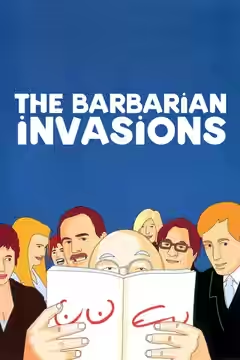
Denys Arcand finds warmth and sharp comedy in a dying professor’s difficult relationships. The talk can grow smug, and the social criticism is blunt, but the father and son give The Barbarian Invasions enough feeling to make it worth an evening.
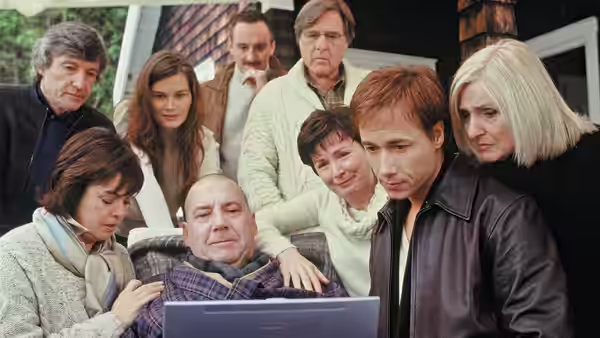
The Barbarian Invasions earns an evening through its humour and its attention to a difficult father and son. Denys Arcand has written and directed a comedy-drama about a dying professor whose family and friends have to decide what they owe him. Rémy has opinions, appetites and a strained relationship with his son; illness gives everyone another problem to negotiate. The film finds something affecting in their efforts, though its fondness for this company sometimes makes it too willing to indulge them.
Rémy Girard makes Rémy’s appetite for conversation entertaining without making him especially easy company. The professor’s reflections on his life keep exposing how little having plenty to say helps him understand another person. Stéphane Rousseau, as Sébastien, gives the father-son scenes a necessary resistance to all that talk. We were moved by their attempts to reach each other, because the affection has to survive Rémy’s habit of making himself the most important person present.
Denys Arcand’s dialogue gives the ensemble plenty to enjoy, especially when affection and irritation share the same conversation. The jokes about sex have a wearisome habit of congratulating the people making them, and their ease with one another does not guarantee our delight in their company. Still, the humour matters: it prevents illness from turning every exchange into a solemn declaration of love. These people can be tiresome, and their friends have evidently had considerable practice at putting up with them.
Guy Dufaux’s cinematography keeps the performances prominent, and François Séguin’s production design is suitably unobtrusive around such talkative people. Isabelle Dedieu’s editing gives the exchanges room to develop, although it cannot remove the sense of speeches written for an appreciative audience. Pierre Aviat’s music is most persuasive when it allows the actors to supply the emotion. The presentation is assured throughout; the difficulty is how readily the film accepts its characters’ estimate of their own importance.
The wider social criticism is less convincing. Denys Arcand lets the characters’ certainty do work that the writing ought to do, and their pronouncements too often pass without a convincing objection. The jokes are frequently strong enough to distract from how little has been established about the society being criticised. There is a recurring suggestion that their education entitles them to our sympathy, and the film does not examine that assumption nearly as closely as it examines what they feel about dying.
Within the illness drama, the film’s useful question is how much generosity a difficult person can reasonably expect. The writing is alert to the pressure to forgive, and some of its strongest passages concern the obligations of the people doing the forgiving. Family loyalty is allowed to be tiring; friendship involves tolerating another round of the same opinions. The scenes between Rémy and Sébastien give those obligations a personal cost, and neither actor needs the surrounding discussion to tell us why the relationship matters.
It runs 99 minutes, and there is enough comic friction to keep its failings from taking over the evening. Anyone looking for a searching account of society will find the talk too easy on itself. Choose it when there is time afterwards to argue about how much a parent is owed.