Film review

The Blind Side

2009 · Directed by John Lee Hancock · 2h 09m · MPA PG-13

In a sentenceA boy with nowhere to sleep gets a bedroom, a truck and a film about the woman who paid for them

Drama

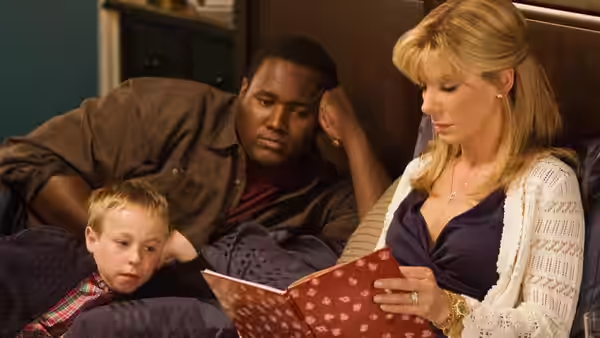
In Memphis, Michael Oher (Quinton Aaron), a huge, near-silent teenager from the Hurt Village project, is admitted to a private Christian school because Coach Cotton (Ray McKinnon) wants him for the football team. He has no address and reads well below his age. One night Leigh Anne Tuohy (Sandra Bullock), an interior decorator married to Sean (Tim McGraw), sees Michael walking to the school gym in a T-shirt and shorts and takes him home for the night. Her children S.J. (Jae Head) and Collins (Lily Collins) take to him at different speeds. Leigh Anne wants him fed, schooled and on the field; the school and Michael’s silence stand in the way.

Fi1m review

Sandra Bullock is sharp, quick and funny as the Memphis mother who takes a homeless teenager into her house, and John Lee Hancock’s film is so grateful to her that it forgets to be curious about him. Pleasant, well made and thin.

John Lee Hancock writes and directs a 129-minute film about Michael Oher (Quinton Aaron), a homeless teenager from the Memphis projects who is taken in by a wealthy white family and turns out to be good at football. It is a warm, uncomplicated account of a good deed, told from the side of the people who did it, and on those terms it succeeds. Whether they are the right terms, it never asks.

Sandra Bullock is the reason it holds together. Daniel Orlandi puts Leigh Anne Tuohy in white jeans, fitted blazers and sunglasses pushed up into blow-dried hair, and Bullock walks into every room as if she owns the lease. She plays her without asking us to like her, which is why we do; the scene where she marches onto the practice field and reorganises the offensive line in front of Coach Cotton (Ray McKinnon) is properly funny. Tim McGraw plays Sean as a man who gave up winning arguments years ago. Jae Head’s small S.J. is the comic relief, and there is more of it than we wanted.

We were moved, more than the film’s manner led us to expect, by the scene that starts it all. Leigh Anne spots Michael on a dark November road in a T-shirt and shorts and asks where he is going. He says the gym, because it is warm. Aaron plays it without a plea in it; he simply answers the question. The next morning she comes downstairs to find the borrowed bedding folded on the couch and the boy gone. It is the film’s best minute, with almost no dialogue and no music.

After that morning the film loses interest in what Michael thinks. Hancock’s script gives him perhaps a dozen lines of any length. His past arrives through a caseworker’s file and one visit to his mother Denise (Adriane Lenox), devastating in her one scene. He is fed, dressed, tutored by Kathy Bates’s Miss Sue, coached, driven about and talked about, and the camera keeps returning to the people doing it. When he finally plays well, it is because Leigh Anne has walked onto the field and told him to think of the team as his family. We were cross about that, because Aaron is plainly capable of carrying a scene on his own and is almost never asked to.

The craft is polished, and it does the film’s thinking for it. Alar Kivilo shoots the Tuohy house in soft golden light, all cream walls and tall glass, and Michael Corenblith designs it as a showroom. Hurt Village is shot cooler and greyer, with a handheld wobble, so that the moral geography is settled before anyone speaks. Carter Burwell’s score stays unusually mild. Mark Livolsi’s cutting of the football is the real skill on show: the film opens with Leigh Anne explaining the left tackle’s job over slowed footage, and every later play is built so a newcomer can see the block land.

Hancock’s The Rookie, from 2002, was also a true sports story about an unlikely body arriving late to a game, and it trusted the sport more than this does. Here the sport is a route to a family portrait, better dressed and better acted than most of its kind. The reviews split three ways, and we sit with the mixed group: too well made to dismiss, too incurious to recommend.

See it if Bullock in full sail is the evening you want; she is on screen for most of the 129 minutes and wastes none of them. It carries a 12 certificate and will not trouble anyone. At home it settles into a comfortable Sunday piece with a large young man at its centre whom it never quite gets round to asking anything.


Critical consensus AI synthesised

53
Positive
6
Mixed
6
Negative
8

The reviews split almost evenly, but nearly all of them agree on one thing: Sandra Bullock. Critics who dislike the film still describe her Leigh Anne Tuohy as forceful, energetic and the reason to watch, and several say she carries a picture that would otherwise sink. The warmer notices, mostly from the American trade press and the more populist British sites, take it as old-fashioned comfort food with a few funny supporting scenes and solid football sequences.

The reservations cluster on race. Many critics find the film sugar-coated and simplistic, but the sharper objection is that it turns a true story into a tale of white charity, leaving the Black teenager at its centre as a cipher with little agency. The AV Club and Slant Magazine are harshest on this point. The spread is wide, running from warm recommendations to outright dismissal, and The Guardian dissents even on Bullock, finding her almost insufferable.

Los Angeles Times
20 November 2009 · Betsy Sharkey
85*

The review praises the film as an old-style, hopeful story full of heart and humor that succeeds as a satisfying success tale. Bullock's sassy, empathetic lead performance is singled out as the standout element.

Read the full review →
Radio Times
★★★★ · Karen Krizanovich
80

This heartfelt drama shows how good deeds change lives at all levels through the story of a wealthy woman sheltering a homeless teen. It avoids melodrama to deliver a charming and inspiring tale.

Read the full review →
Variety
15 November 2009 · Joe Leydon
80*

The critic calls it an uplifting, entertaining feel-good sports drama that remains involving and emotionally honest despite some sugar-coating. It is praised for its insightful take on racial and political realities in the South.

Read the full review →
Evening Standard
10 April 2012
65*

The review calls the film sentimental but effective as an inspirational Hollywood drama, highlighting Bullock's freewheeling performance and the solid football scenes while noting some dramatic licence.

Read the full review →
The Hollywood Reporter
15 November 2009 · Michael Rechstshaffen
65*

The film sticks to conventional inspirational sports-movie formulas while sidelining deeper sociological issues, but delivers crowd-pleasing entertainment through strong performances. Bullock shines as the determined Southern mother in this fact-based story.

Read the full review →
Empire
24 February 2010 · Ian Freer
60*

The film is described as a sugar-coated mix of sports clichés and crusading drama that stretches credibility, but Bullock's towering, versatile performance saves it and makes it moving despite the lack of nuance.

Read the full review →

Cast

Awards

Academy Awards, 2010

Nominated
Best Picture
Won
Best Actress

If you liked this, try…

Hoop Dreams poster92

Hoop Dreams

1994 · Two Chicago boys, five years, and a camera that lets them do the talking

Kes poster88

Kes

1969 · A Yorkshire boy nobody expects much of, and a film that expects everything

Entre les murs poster

Entre les murs

2008 · A Paris classroom where the teacher is not always right and the pupils answer back

Undefeated poster

Undefeated

2011 · A Memphis high-school football season, this time with the players in the frame

Moonlight poster89

Moonlight

2016 · A quiet boy from the projects, followed from the inside rather than admired from outside