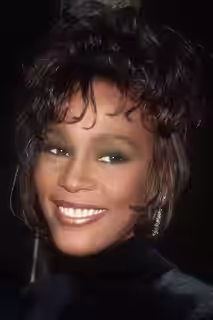
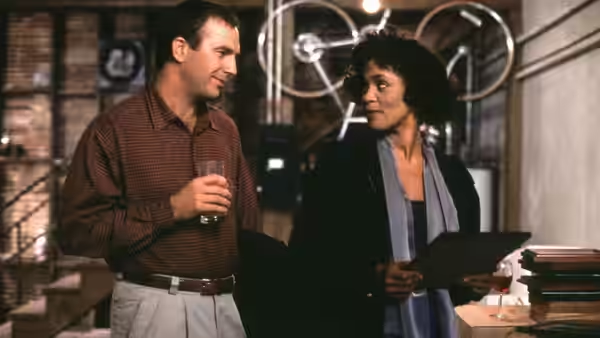
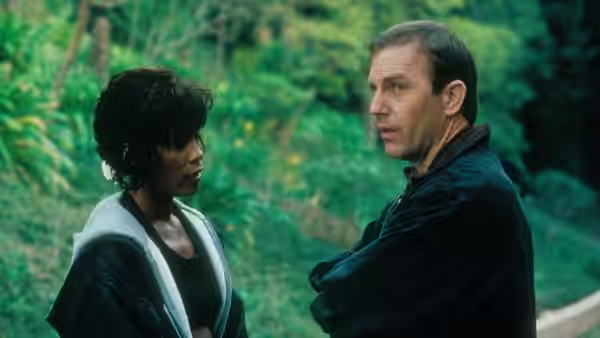
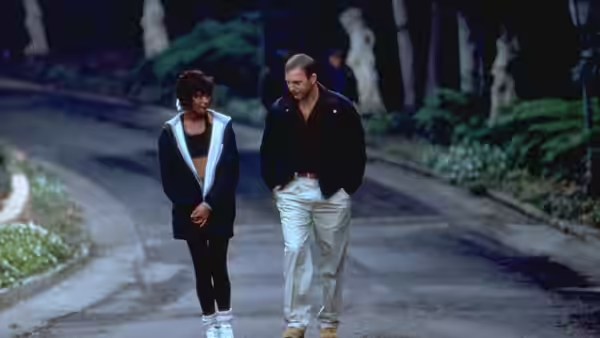
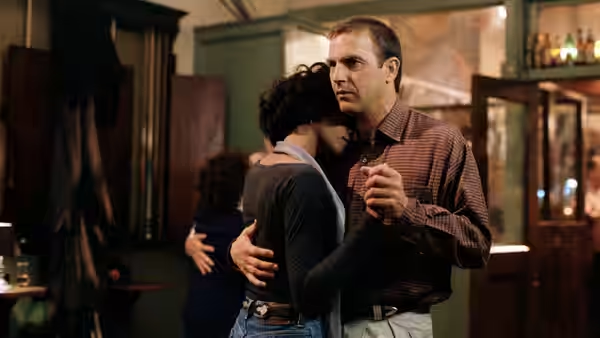
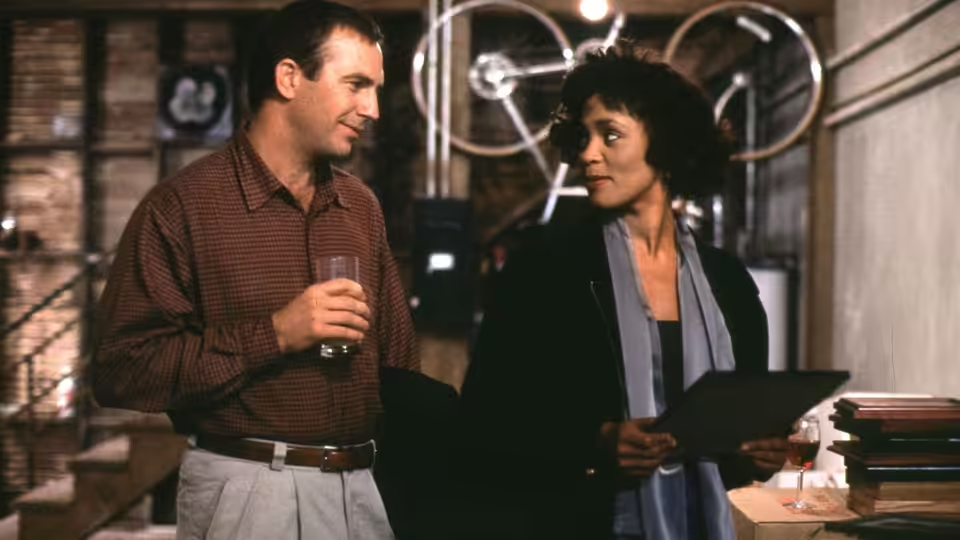
Frank Farmer (Kevin Costner) talks with Rachel Marron (Whitney Houston) in a room with recording equipment
Film review

The Bodyguard

1992 · Directed by Mick Jackson · 2h 09m · IGAC M/12

In a sentenceWhitney Houston sings as though everything depends on it; Kevin Costner looks as though he has already checked the exits

Frank Farmer (Kevin Costner) protects pop star Rachel Marron (Whitney Houston). The job requires constant attention and a professional distance that becomes harder to maintain. Rachel’s life includes Sy Spector (Gary Kemp) and Bill Devaney (Bill Cobbs), while Frank’s priorities narrow to keeping her safe. His protective duties and her independence put them at odds, but their growing attraction threatens to complicate the arrangement further. Frank is supposed to keep Rachel within sight, stay alert and avoid falling in love with her. Working close to her makes the last requirement difficult.

Plays from YouTube when you press play; nothing loads from them until then.

Fi1m review

Whitney Houston makes The Bodyguard worth considering, particularly when she sings. Mick Jackson’s romance has enough appeal to survive some clumsy writing, but the muddled thriller and uneven pace make its 129 minutes feel longer than they should.

The Bodyguard is a flawed romantic thriller worth considering for Whitney Houston. Mick Jackson understands the appeal of putting an uncommunicative protector beside a star accustomed to attention, and the pairing can be enjoyable without being plausible. Lawrence Kasdan’s screenplay, however, asks the attraction to carry a suspense story that never becomes convincing. The singing gives us a reason to stay through stretches when neither the danger nor the conversation is doing enough.

Whitney Houston makes Rachel Marron’s celebrity easy to believe: she holds our attention without seeming to ask for it. Her musical performances express feelings that the dialogue often labours over, and ‘Queen of The Night’ gives her celebrity a force the script takes for granted. We were moved by her singing of lasting love, because she makes the declaration sound like something she needs to say. That directness is welcome in a film whose spoken exchanges can seem so effortful.

Kevin Costner’s Frank Farmer is so firmly restrained that the attraction sometimes has to be taken on trust. We can understand the appeal of a man whose attention is undivided, and Kevin Costner makes that attention feel serious. Yet the guardedness that suits the job also limits what he can offer his partner in a romantic scene. The pairing has moments of warmth, but Whitney Houston supplies much of the energy that keeps it interesting.

Andrew Dunn’s cinematography serves the star performances well, giving them a polish that suits Rachel Marron’s celebrity. Jeffrey Beecroft’s production design contributes to that impression of a life insulated by fame, though the attractive surroundings do little to make the danger convincing. The film is comfortable presenting celebrity and less assured about making it feel vulnerable. Mick Jackson gets more from allowing the performers to hold our attention than from asking us to fear for them.

Alan Silvestri’s score supplies romantic emphasis where Lawrence Kasdan’s writing has not always made the feelings convincing. It does useful work, but the musical performances make the surrounding drama sound thinner than it should. Whitney Houston can communicate longing with a directness that the screenplay struggles to find in conversation. A romance need not be realistic, but we ought to want the next exchange between its lovers as much as the next song.

Donn Cambern and Richard A. Harris face the problem of fitting musical performance, romance and danger into the same rhythm, and the editing never quite solves it. Individual passages can be enjoyable while the transitions leave the story feeling interrupted rather than developed. At 129 minutes, the film gives us ample time to notice how unevenly it moves. The thriller needs greater momentum, especially when the romantic tension is not strong enough to carry a slower stretch.

For a romantic thriller, the basic difficulty is that neither the attraction nor the threat consistently earns our attention. There is pleasure here, particularly in Whitney Houston’s confidence and the occasional warmth that breaks through Kevin Costner’s reserve. We can forgive a fair amount of implausibility for those things, though the patience required should not be underestimated. Choose it when the singing is a substantial part of the attraction, rather than a welcome extra.

Critical consensus AI synthesised

59
Positive
4
Mixed
4
Negative
2

The reviews lean towards a mixed verdict, with praise clustering around Whitney Houston’s singing and screen presence. Her musical performances, particularly “I Will Always Love You”, are a recurring pleasure even for critics who find the story implausible. The more favourable responses enjoy an old-fashioned romantic fantasy whose stars compensate for a predictable script. Houston’s acting also earns substantial support, though enthusiasm for the central romance is less consistent.

The main reservations concern an unconvincing thriller plot, uneven tone and pacing, but judgements range from warm affection to firm disappointment. Collider praises Houston and Kevin Costner’s chemistry and the slow-burning romance. The Los Angeles Times disputes that chemistry, finding the film compulsively watchable largely because its failings become camp entertainment. Variety welcomes Houston’s debut but objects to choppy editing and an overlong climax. The divide is chiefly over how much the stars and songs can excuse.

Empire
1 January 2000 · Barry McIlheney
70*

The critic finds the film entertaining despite its preposterous, predictable story. Whitney Houston’s performance and singing are singled out for praise.

Read the full review →
The Guardian
3 November 2022 · Peter Bradshaw
70*

Bradshaw finds the film an irresistible, hokey romantic fantasy that still charms as innocent popcorn entertainment. He singles out Whitney Houston’s powerhouse musical numbers, especially her performance of “I Will Always Love You.”

Read the full review →
The Hollywood Reporter
20 November 1992 · Duane Byrge
70*

Byrge finds the film an appealing, old-fashioned opposites-attract romance, despite uneven emotional tone. He particularly praises Whitney Houston’s graceful, forceful screen presence and performances.

Read the full review →
The New York Times
25 November 1992 · Janet Maslin
64*

The page text is inaccessible, so the critic’s verdict cannot be determined reliably. The URL headline frames the story as a clash between a tragic flaw and a pampered pop star, but offers no clear praise or complaint.

Read the full review →
Time Out
· CM
64*

The page identifies this as a film review, but the critic’s verdict is unavailable. The accessible metadata names the performances and setup but gives no praise or complaint.

Read the full review →
Radio Times
★★★ · Sue Heal
60

Heal says the film’s stars overcome the limitations of its daft script. She praises the well-staged set-pieces and Houston’s acting debut, as well as her rendition of “I Will Always Love You.”

Read the full review →

Straight answers AI written, from our review

Is The Bodyguard worth watching?
The Bodyguard is worth considering for Whitney Houston’s singing and star presence; we score it 63 out of 100. We find occasional warmth in her pairing with Kevin Costner, but the unconvincing danger and uneven pace make this a better choice for those drawn to the songs than those seeking a gripping romantic thriller.
How long is The Bodyguard, and what is it rated?
The Bodyguard runs 2h 09m and is rated M/12 by the IGAC in Portugal. It is an action and drama film.
Where can I watch The Bodyguard in Portugal?
The Bodyguard is available to rent from Amazon Prime Video from €2.99. Availability is checked daily; the links above go straight to each service.
How violent or frightening is The Bodyguard, and is it suitable for children?
The Bodyguard carries a UK 15 certificate, so it is not suitable for children under 15. We find its thriller danger less convincing than its musical performances, but that judgement does not establish how mild its violence or scares are; the certificate remains the useful guide for younger viewers.
How does The Bodyguard compare to Notorious?
The Bodyguard is the weaker romantic thriller beside Notorious, which we recommend for its more persuasive danger and exceptionally tense treatment of duty and desire. Houston’s musical performances give The Bodyguard a separate appeal, but we favour Notorious when suspense matters most, with the caveat that its cruel romance offers little uncomplicated comfort.
What should I watch after The Bodyguard?
After The Bodyguard, try Notorious (1946, Fi1m 92): Duty and desire complicate a romance with far more persuasive danger. Then Diva (1981, Fi1m 80): A singer, an admirer and a thriller with a stranger temperament; and In the Mood for Love (2000, Fi1m 91): For the attraction held back by propriety, with patience amply rewarded.

Cast

Awards

Golden Raspberry Award for Worst Picture, 1993

Nominated
Golden Raspberry Award for Worst Picture

If you liked this, try…

  1. Notorious (1946, Fi1m 92)Duty and desire complicate a romance with far more persuasive danger.

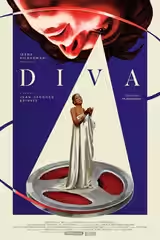
  2. Diva (1981, Fi1m 80)A singer, an admirer and a thriller with a stranger temperament.

  3. Beyond the Lights (2014) · not on Fi1m yetCelebrity and romance give a singer reasons to question her public life.

  4. In the Mood for Love (2000, Fi1m 91)For the attraction held back by propriety, with patience amply rewarded.

  5. Witness (1985, Fi1m 84)Protection becomes intimacy in a thriller that gives its silences purpose.