Danny Flynn and Maggie Hamill walk together along the shoreline
Film review

The Boxer

1997 · Directed by Jim Sheridan · 1h 54m · MPA R

In a sentenceDaniel Day-Lewis says about forty words and most of them are to a punchbag

Belfast. Danny Flynn (Daniel Day-Lewis) walks out of prison after fourteen years served for the IRA and tells the men who sent him there that he wants nothing more to do with them. He wants to box. With his old trainer Ike Weir (Ken Stott), a drinker who let the Holy Family gym fall to ruin, he sweeps the place out and reopens it to boys from both communities. Still in the district is Maggie Hamill (Emily Watson), the girl he left behind, now the wife of a jailed comrade and mother to a young son, Liam. Her father, Joe Hamill (Brian Cox), commands the local IRA and is trying to sell a ceasefire to men like Harry (Gerard McSorley), who would rather keep fighting. Prisoners’ wives are not to be touched, and everyone is watching Danny.

Plays from YouTube when you press play; nothing loads from them until then.

Fi1m review

Jim Sheridan’s third film with Daniel Day-Lewis is sober, decent and finely acted, strongest when the IRA argues with itself and weakest in the ring. The love story it is built on gets looks where it needed scenes.

Jim Sheridan has made three films with Daniel Day-Lewis, and this is the quietest. After My Left Foot (1989) and In the Name of the Father (1993), the two go back to Belfast. Danny Flynn served fourteen years for the IRA and tells them on release that he is finished. He wants to box, and to be left alone. The Boxer is well made, well acted and sincere, and it is at its best when men are arguing in back rooms. The love story at its centre is thinner than it needs to be, and the fights are no more than competent.

Day-Lewis plays Danny with almost nothing. He keeps his head down and his hands in his pockets, speaks when spoken to, and lets everyone guess what he will do. The IRA men want to know whose side he is on, and Maggie Hamill, whom he left behind when he went inside, would rather not know. Emily Watson plays her as a woman who has made her peace with a small life and is angry to find she might have to unmake it. She is married to one of Danny’s old comrades, still in prison, and in this district a prisoner’s wife is not to be looked at.

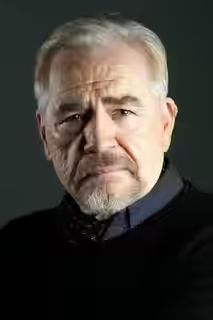
The politics are the film’s strongest suit. Brian Cox plays Maggie’s father Joe Hamill, the local commander, trying to hold a ceasefire together among men who have buried too many friends to want one. Cox gives him a heavy, patient tiredness, a man who has argued every point before. Gerard McSorley’s Harry is the man he argues with, and McSorley plays him not as a villain but as someone whose grief has set hard. Sheridan and Terry George write their scenes as people who know each other too well, and the film is more interested in this quarrel than in the one with the British.

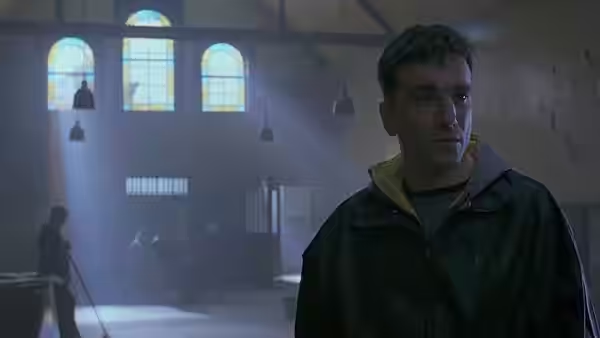
Chris Menges shoots Belfast in flat daylight and sodium orange, and lights the gym with bare bulbs that leave the corners dark. Brian Morris makes the Holy Family club look shut for years, plaster on the floor and the ring stripped to its frame, so that sweeping it out becomes the film’s first act of hope. Joan Bergin keeps Danny in one jacket, right for a man who owns nothing. Gerry Hambling and Clive Barrett cut the political scenes slowly and the fights fast, and the fights look like every other boxing film: gloves in close-up, a roaring crowd, a bell. Maurice Seezer and Gavin Friday’s music stays out of the way, for which we were grateful.

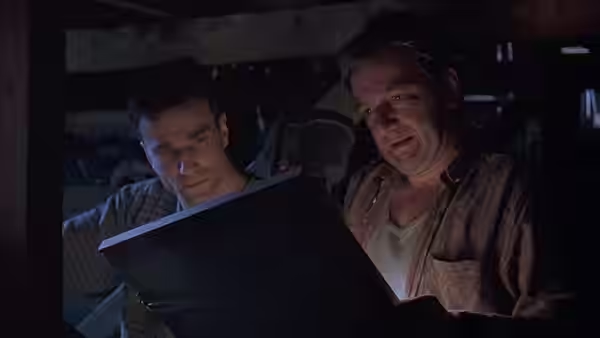
We were moved most where we least expected, by Ken Stott. His Ike Weir, Danny’s old trainer, is a drunk who let the gym rot, and the scene where the two men stand in the dust and he looks at what he allowed to happen is the most honest thing in the film. Stott plays a man ashamed of himself and trying, in short sentences, to deserve another go. When the club starts taking boys from both sides of the divide, it was his face we watched.

What does not work is the romance, and the film is built on it. We are told Danny and Maggie loved each other before he went inside, and the two actors look at each other with great concentration, but the script gives them little to say and less to do. Sheridan trusts the looking to carry it. By the midpoint we wanted one scene in which they talked like people rather than like a problem, and it never came. The last stretch tidies things more neatly than the film had earned, and we will leave it there.

In the Name of the Father was angry and this one is patient, and patience suits Sheridan less. There the injustice was plain and the film could run at it; here everyone is partly right, so the film sits with them instead. That is honourable, and a little dull in stretches. See it for Day-Lewis, Cox and Stott, and for the back rooms. It runs 114 minutes and carries a 15.


Critical consensus AI synthesised

72
Positive
5
Mixed
4
Negative
0

The reviews lean warm, and nobody dislikes it. Most critics praise Daniel Day-Lewis above all, for a restrained and committed performance that holds the film together, and Emily Watson is given credit for matching him. The other point of agreement is the handling of the politics: critics find Jim Sheridan even-handed, unsentimental about the IRA and the splits within it, and careful not to turn the film into a lecture. Several call it moving; one calls it courageous.

The reservations are about how conventional it is. Radio Times finds the drama admirable but familiar, and Variety calls it involving but prosaic, with the central romance underwritten. Total Film thinks the boxing itself is the least convincing part, and Empire objects to Sheridan’s shorthand direction and a message that ends up too cosy. The spread is narrow, from respectful three-star notices to outright enthusiasm, and the warmest reviews come from critics writing some years after release.

The AV Club
11 April 2002 · Keith Phipps
85*

Phipps finds the film thoroughly engrossing and praises how it avoids becoming heavy-handed or one-sided. He singles out Day-Lewis and Watson’s quietly fiery performances and the story’s depth and complexity.

Read the full review →
Total Film
20 February 1998 · ★★★★ · Total Film
80

The review calls the film intelligent, moving, and masterfully told, praising its balanced portrayal of a society struggling with change. It singles out Daniel Day-Lewis’s restrained performance and the interwoven love story, while finding the boxing scenes less convincing.

Read the full review →
Empire
1 January 2000 · Ian Nathan
75*

Nathan finds the film powerful and resonant despite Sheridan’s shorthand direction and overly cosy message. He particularly praises the performances and the unforgettable scene of Liam at the army cordon.

Read the full review →
RogerEbert.com
16 January 1998 · ★★★/4 · Roger Ebert
75

Ebert gives the film a positive but measured assessment. He singles out the performances and the restrained handling of its political and personal conflicts.

Read the full review →
The New York Times
31 December 1997
64*

The headline frames the film as seeking hope amid Ulster’s suffering. The review text is inaccessible, so its verdict and specific praise or complaint cannot be determined.

Read the full review →
Time Out
· GA
64*

The available page identifies this as a review but does not reveal the critic’s verdict. Its metadata describes Flynn’s return to Belfast after prison and the hostility he faces.

Read the full review →

Straight answers AI written, from our review

Is The Boxer worth watching?
The Boxer is worth watching for anyone with an interest in Daniel Day-Lewis, the Troubles or back-room political argument, and we scored it 68. It is sober, decent and finely acted, strongest when the IRA quarrels with itself and weakest in the ring. The love story it is built on gets looks where it needed scenes, and the final stretch tidies things too neatly.
How long is The Boxer, and what is it rated?
The Boxer runs 1h 54m and is rated R by the MPA in the US. It is a drama and romance film.
Where can I watch The Boxer in the US?
The Boxer is available to rent from Amazon Prime Video and Apple TV from $3.99. Availability is checked daily; the links above go straight to each service.
How violent or frightening is The Boxer, and is it suitable for children?
The Boxer carries a 15 certificate in the UK and an R in the US, which puts it beyond children. It is a quiet, adult drama about the IRA, a released prisoner and a ceasefire, and the boxing is shot the way most boxing films shoot it, gloves in close-up and a bell. The threat comes from men in back rooms rather than from gore or jump scares.
How does The Boxer compare to In the Name of the Father?
The Boxer is the quieter and more patient of Jim Sheridan's two Belfast films with Daniel Day-Lewis, and In the Name of the Father is the better one. The earlier film had a plain injustice to run at and the anger to do it; here everyone is partly right, so the film sits with them, honourably and a little dully. Start with the earlier film, then come to this for Brian Cox and Ken Stott.
What should I watch after The Boxer?
After The Boxer, try In the Name of the Father (1993, Fi1m 83): Sheridan and Day-Lewis a few years earlier, angrier and the better for it. Then Hunger (2008, Fi1m 86): Steve McQueen’s Maze prison film says in silence what Sheridan says in speeches; and Fat City (1972, Fi1m 73): John Huston’s boxing film about men who were never going to make it, and know it.

Cast

If you liked this, try…

  1. In the Name of the Father (1993, Fi1m 83)Sheridan and Day-Lewis a few years earlier, angrier and the better for it.

  2. Hunger (2008, Fi1m 86)Steve McQueen’s Maze prison film says in silence what Sheridan says in speeches.

  3. Cal (1984) · not reviewed yetAn earlier Ulster romance across the same lines, sadder and more frank about guilt.

  4. Fat City (1972, Fi1m 73)John Huston’s boxing film about men who were never going to make it, and know it.

  5. '71 (2014, Fi1m 82)One lost soldier, one Belfast night, and a city where every street is a trap.