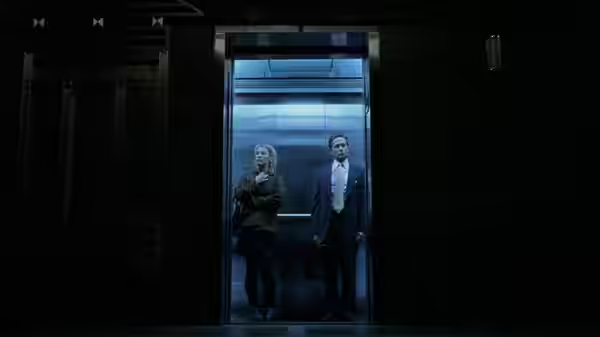
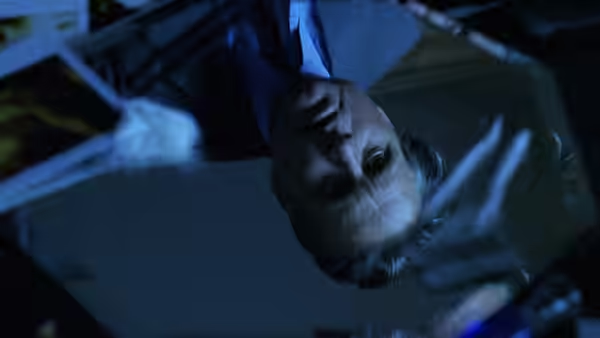
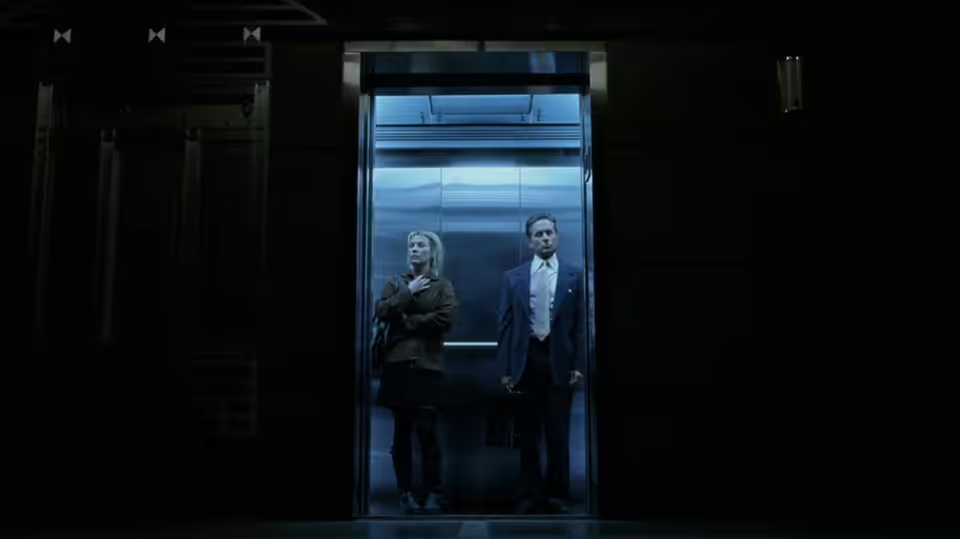
Nicholas Van Orton (Michael Douglas) and a woman stand inside a brightly lit elevator
Film review

The Game

1997 · Directed by David Fincher · 2h 09m

In a sentenceMichael Douglas has everything, so his brother buys him a nervous breakdown

San Francisco. Nicholas Van Orton (Michael Douglas), an investment banker, turns 48 alone in the mansion he grew up in, the age his father was when he jumped from its roof. His housekeeper Ilsa (Carroll Baker) bakes him a cake. His younger brother Conrad (Sean Penn) takes him to lunch and hands him a gift voucher for a company called Consumer Recreation Services. At its offices Jim Feingold (James Rebhorn) puts him through a day of tests and promises an experience tailored to him. Nicholas wants only to be left to his work and his routines. Then a clown doll turns up on his driveway, a newsreader addresses him from his own television, and a waitress called Christine (Deborah Kara Unger) spills a drink on him.

Plays from YouTube when you press play; nothing loads from them until then.

Fi1m review

David Fincher’s follow-up to Seven takes a rich man’s life apart one courtesy at a time, and for two hours it is as controlled and unnerving as anything he has made. The last ten minutes ask for more faith than they have earned.

Two years after Seven, David Fincher made a thriller with no killer, almost no blood and one idea: what do you get for the man who has everything? The answer is a game, bought by his brother from a company that will not say what it sells. Nicholas Van Orton (Michael Douglas) is an investment banker who has everything, and for two hours The Game takes it from him a piece at a time. Then it has to stop, and how it stops is where every argument about the film begins. We think it survives its ending, narrowly.

The script by John Brancato and Michael Ferris gives Douglas nothing to hide behind. Nicholas eats dinner alone at one end of a long table while his housekeeper Ilsa (Carroll Baker) keeps to the kitchen. He pushes his late father’s friend Anson Baer (Armin Mueller-Stahl) out of his own publishing firm without raising his voice. Douglas plays him with the jaw set and the eyes patient, and the performance is in how slowly that face gives way. By the second hour he is sweating through his shirt and asking strangers for help, and he never once asks us to like him for it.

Harris Savides shoots the Van Orton house so that the dark is most of the picture and the lamps and the panelling are the rest, and Nicholas moves through it like a guest. Jeffrey Beecroft builds it as a house for a large family with one man in it, and sets against it the offices of Consumer Recreation Services, glass and fluorescent light, where Jim Feingold (James Rebhorn) sells Nicholas an experience he declines to describe. Michael Kaplan puts Douglas in grey suits so well cut that we notice every mark the film leaves on them.

Howard Shore scores it quietly, piano and low strings under scenes rather than over them, and leaves the big moments alone. James Haygood cuts the first act at a banker’s pace and shortens the shots as Nicholas’s grip goes. The game’s first move is a clown doll left on the driveway, and we laughed at it. We stopped laughing that evening, when a newsreader on Nicholas’s own television turned from the autocue, looked straight at him and said his name. It is plainly absurd, and it is done so calmly that we felt it in the back of the neck anyway.

Sean Penn is on screen for perhaps a quarter of an hour as Conrad, the younger brother, all nerves and bad jokes, the one person Nicholas cannot sack. Deborah Kara Unger’s Christine, a waitress who spills a drink on him and keeps turning up, is played flat and unreadable, which is what the part needs. Anna Katarina has a single phone call as the ex-wife Elizabeth and tells us more about the marriage than the script manages elsewhere.

The faults are real. The middle hour is a list of indignities, and by the eighth or ninth we could see the next one coming; the film has one move, which is to make things worse. The plot also needs the game’s organisers to know things no company could know. Most of this we forgave in the dark. The ending is another matter. We will not describe it, except to say that it asks for a leap we were not sure we could make, and that we were still arguing with ourselves in the car park. Most critics split the same way, praising Douglas and the look and complaining about the last act. We come down, just, on the side of the ending, because of what Douglas does with his face in the final two minutes.

Against Fincher’s own work this is the small, clean one. Seven (1995) had something to say about the city and said it; Fight Club (1999) would have more ideas than it could carry. See it once knowing as little as possible, in a dark room with the phone off. See it a second time to watch how the trick is done; it holds up, which is more than most tricks do. It runs 129 minutes and carries a 15 certificate.

Critical consensus AI synthesised

71
Positive
5
Mixed
6
Negative
0

Most critics like The Game without quite loving it: five positive, six mixed, none hostile. The praise lands in two places. Michael Douglas is singled out repeatedly, as a cold man played with full commitment or a desperate pawn well cast. Fincher’s direction draws nearly as much approval: the clinical precision, the haunting atmosphere of a waking nightmare, the careful, darkly funny pacing of the twists as Nicholas Van Orton’s controlled life comes apart.

The reservations gather round the ending. Several reviews call the finale implausible; the question is whether that is a flaw or the point. Radio Times finds the film turns glossy and trivial after a fascinating setup; Empire cannot decide whether it is gloriously or irritatingly unbelievable; Variety admires the puzzle more than it warms to it. The later reviews are kinder: The AV Club argues the implausible finale earns its emotional release, and the Los Angeles Times says repeat viewings make the conclusion easier to accept. Nobody dismisses it.

Slant Magazine
25 September 2012 · ★★★★½ · Chris Cabin
90

Cabin praises The Game as an inventive, challenging film and calls the Criterion release a welcome presentation of a masterpiece. He especially singles out Michael Douglas’s performance and the disc’s image and sound quality.

Read the full review →
The AV Club
13 March 2012 · Mike D'Angelo
90*

D’Angelo passionately argues that the film’s implausible finale delivers profound emotional catharsis. He especially praises Fincher’s visual direction and Michael Douglas’s committed performance as a cold, unsympathetic man.

Read the full review →
Total Film
10 October 1997 · ★★★★ · Total Film
80

The critic calls the film a compelling, excellent and unusually challenging ride, though its surreal approach may not suit everyone. They praise Michael Douglas’s performance and Fincher’s darkly funny, carefully paced handling of the twists.

Read the full review →
Los Angeles Times
29 September 2012 · Dennis Lim
70*

Lim argues that the film remains an absorbing, surprising experience, and that repeat viewings make its implausible conclusion easier to accept. He especially praises its immersive waking-nightmare atmosphere and the pleasure of its elaborate game, while acknowledging the ending’s anticlimax.

Read the full review →
RogerEbert.com
65*

The URL identifies a RogerEbert.com review of the 1997 film. The page only displays a browser-check message, so its verdict and specific praise or complaint cannot be verified.

Read the full review →
Variety
14 September 1997 · Todd McCarthy
65*

McCarthy finds the film intellectually intriguing and technically impressive, though its puzzle-like focus makes it easier to admire than embrace. He particularly praises Fincher’s clinical precision and the unnerving way the film shows Nicholas’s controlled life being eroded.

Read the full review →

Straight answers AI written, from our review

Is The Game worth watching?
The Game is worth watching for anyone who likes a thriller that takes its time, and we scored it 76. David Fincher and Michael Douglas take a rich man apart one courtesy at a time, and for two hours it is controlled and unnerving. The last ten minutes ask for a leap of faith; we made it, narrowly, and some viewers will not.
How long is The Game, and what is it rated?
The Game runs 2h 09m. It is a drama and thriller film.
Where can I watch The Game in Croatia?
The Game is not on any streaming or rental service in Croatia at the moment. It is available in 42 other countries; change your country at the top of the page to see where. Availability is checked daily.
How violent or frightening is The Game, and is it suitable for children?
The Game carries a 15 certificate in the UK and is a thriller of dread rather than gore, with almost no blood and no killer. The unease comes from a man’s life being dismantled around him, and a newsreader turning from the screen to say his name is the sort of calm absurdity that got under our skin. It is too unsettling for children and best left to older teenagers and adults.
How does The Game compare to Vertigo?
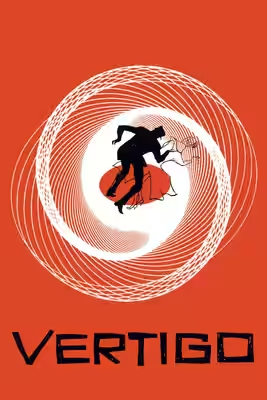
The Game and Vertigo are both San Francisco films about a man led by the nose, and Vertigo is the better of the two. Hitchcock’s is a slow, uncomfortable romance with a far-fetched mystery and more patience than most thrillers; Fincher’s is the cleaner machine, a two-hour run of indignities with a divisive ending. Watch The Game for control and Douglas’s face, Vertigo for the deeper disquiet.
What should I watch after The Game?
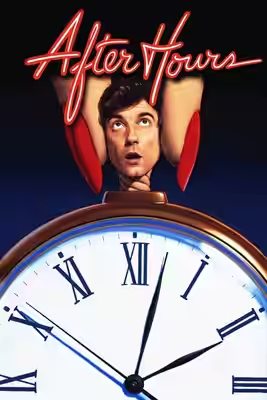
After The Game, try Vertigo (1958, Fi1m 92): The other San Francisco film about a man led by the nose. Then After Hours (1985, Fi1m 80): Scorsese sends a dull man into one bad night; funnier, just as cruel; and Caché (2005, Fi1m 88): Someone is sending Daniel Auteuil videotapes; Haneke never says who, and needn’t.

Cast

If you liked this, try…

  1. Seven (1995) · not reviewed yetFincher’s previous film, with more blood and something it wanted to say.

  2. Vertigo (1958, Fi1m 92)The other San Francisco film about a man led by the nose.

  3. After Hours (1985, Fi1m 80)Scorsese sends a dull man into one bad night; funnier, just as cruel.

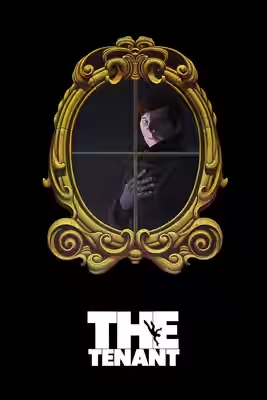
  4. The Tenant (1976) · not reviewed yetPolanski moves into a Paris flat and the building turns on him.

  5. Caché (2005, Fi1m 88)Someone is sending Daniel Auteuil videotapes; Haneke never says who, and needn’t.

Free account

Know what to watch tonight

Two lists that know where things are streaming, collections you can share, your own score beside ours, and Discover that remembers what you have seen.

  • Want to see, sorted by what is streaming now
  • Seen, with your score out of ten
  • No adverts, ever