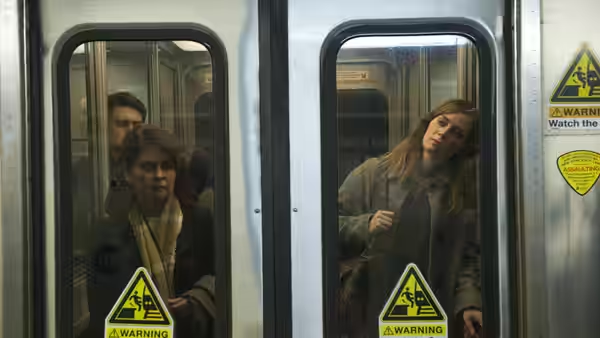
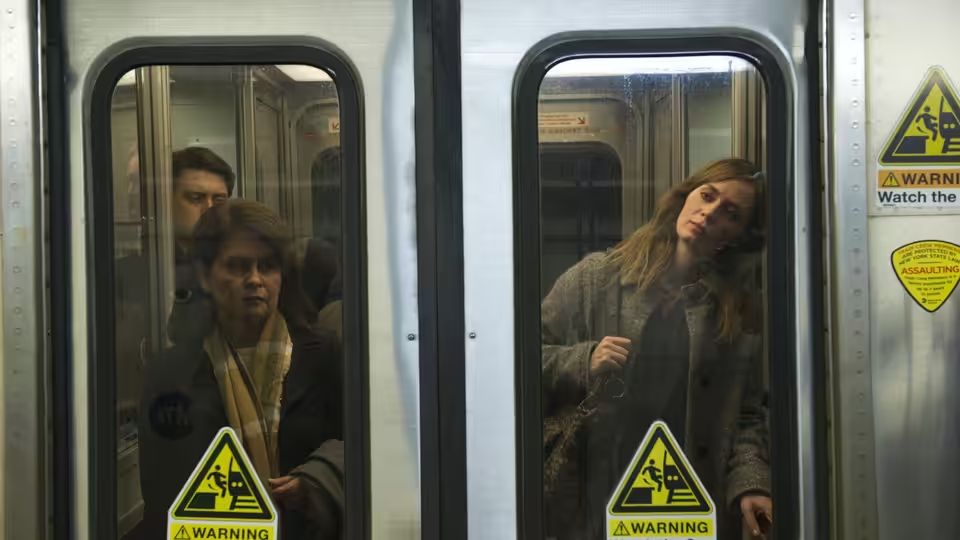
Rachel Watson (Emily Blunt) stands inside a train beside its doors
Film review

The Girl on the Train

2016 · Directed by Tate Taylor · 1h 52m

In a sentenceThree unhappy women, one commuter train and a mystery you could solve from the platform

Rachel Watson (Emily Blunt) rides a commuter train twice a day, and it slows at the same bend beside a row of houses backing onto the line. One was hers; her ex-husband Tom (Justin Theroux) lives there now with his new wife Anna (Rebecca Ferguson) and their baby. A few doors down live Megan Hipwell (Haley Bennett) and her husband Scott (Luke Evans), strangers Rachel has decided are happy. Rachel is drinking and has lost her job. Then she sees Megan on her balcony with a man who is not Scott. Next morning Rachel wakes bruised, with no memory of the night, and Megan is missing.

Plays from YouTube when you press play; nothing loads from them until then.

Fi1m review

Emily Blunt is careful and unglamorous as a woman drinking herself out of her life, and deserves a better mystery than this tidy, glum one, solvable before the police arrive. Watch her, not the plot.

Tate Taylor’s film of Paula Hawkins’s novel is built around three women who live, or used to live, on the same stretch of suburban railway. Rachel Watson (Emily Blunt) rides past their houses twice a day and makes up lives for the people inside. Erin Cressida Wilson’s screenplay keeps the book’s three narrators and its hopping about in time, and it keeps the mystery, which is where the trouble starts. Blunt is worth your evening on her own. The film around her is tidy, glum and solvable from a long way off.

Blunt plays Rachel as a woman who has not stopped drinking so much as stopped noticing that she drinks. She tips vodka into a water bottle, sketches on a napkin, and tells her flatmate Cathy (Laura Prepon) about a working day she has not had in a year. Her eyes are red at the rims and she holds them quite still, as drunks do when they want to look sober. In a flashback she arrives at her ex-husband’s door, unsteady and too loud, and Blunt shows us the exact moment Rachel sees what she looks like to the people watching. We winced for her, and it is the one thing in the film we did not need to be asked to feel.

Michael McCusker and Andrew Buckland cut between Rachel, Megan Hipwell (Haley Bennett) and Anna Watson (Rebecca Ferguson), with captions telling us whose scene it is and how many months ago. Charlotte Bruus Christensen shoots nearly everything in close-up and shallow focus, so faces fill the frame and the backgrounds dissolve; for Rachel’s blackouts she lets the image smear and lurch, which works the first time and is a habit by the fourth. The intention is that we are as lost as Rachel. The result, often, is that we are unsure what day it is.

The mystery does not survive an attentive viewer. Megan vanishes, Rachel wakes bruised with a hole where the evening should be, and Detective Sgt. Riley (Allison Janney) starts asking questions. We had our answer at about the forty-minute mark and spent the rest wanting to be wrong. The men do not help. Justin Theroux as Tom, Luke Evans as Scott and Édgar Ramírez as Dr. Kamal Abdic are each given one temperature and asked to hold it. Janney is brisk and sceptical and could have used three more scenes. Lisa Kudrow, as Martha, gets one, and makes more of it than most of the cast get to make of the whole film.

Danny Elfman’s score is the surprise. He has set aside the carnival brass he is known for and written something low and electronic, a pulse under the dialogue, and in the stretches when the film goes quiet it does more work than the plot. Kevin Thompson’s production design gives the houses by the track big glass backs, so every kitchen is lit for anyone passing on the train. Ann Roth and Michelle Matland put Rachel in a grey coat that does not quite fit and Anna in the pale knitwear of a woman with nothing to do all day. All of it is more thoughtful than the story it serves.

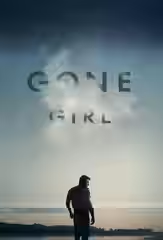
Wilson wrote Secretary, which knew how perverse it wanted to be, and Taylor made The Help, which knew how respectable. This film sits between them and commits to neither. Hawkins’s book was sold as the next Gone Girl, and David Fincher’s film of that one is the obvious comparison; Fincher let the nastiness show, Taylor keeps the lights low and asks for sympathy. The second half takes turns we will not describe. We will say the film uses Rachel’s drinking as a device for not knowing things, while Blunt plays it as an illness that is happening to a person, and the two never quite meet.

Most critics landed in the middle, and so do we, a little above the angrier notices. The 15 certificate covers sex and blood kept mostly off camera. Watch it at home, where you can rewind to check whose month you are in, and watch it for Blunt, who is doing the real thing. Do not watch it for the answer. You will have it before she does.

Critical consensus AI synthesised

46
Positive
2
Mixed
15
Negative
11

Most critics find The Girl on the Train a disappointment, and the reviews lean mixed to negative rather than hostile. Where they agree is on Emily Blunt. Nearly every notice, including the pans, says her performance as Rachel, a fractured alcoholic, is the one thing worth watching, and several credit her with holding the film together. Danny Elfman’s unusual score gets a second, smaller round of praise.

The reservations cluster on the storytelling: a mystery several critics guess early, clumsy shifts between the women’s perspectives, and a plot that grows less convincing as it goes. Critics split on the adaptation itself, some finding it too faithful to the novel, others saying it throws away the book’s sharper ideas. The spread is wide, from Digital Spy’s warm notice to outright pans from Vulture, The New Yorker and the Los Angeles Times. Empire is the lone dissenter on Blunt, calling her casting unconvincing.

Screen Daily
3 October 2016 · Tim Grierson
64*

The accessible page identifies this as a review, but its verdict is behind the paywall. The available text does not reveal what the critic praised or criticized.

Read the full review →
The New York Times
64*

The page content is unavailable, so the critic’s verdict cannot be established. No specific praise or complaint can be verified.

Read the full review →
The AV Club
6 October 2016 · C+ · Ignatiy Vishnevetsky
63

Vishnevetsky finds the film a campy, plot-hole-riddled attempt to emulate Gone Girl that falls short. He praises Emily Blunt’s committed performance but says the polished direction and confused handling of perspective undermine the story.

Read the full review →
Radio Times
★★★ · Stella Papamichael
60

The critic calls it a neat but overly tidy domestic thriller that adds few surprises. Emily Blunt’s casting as Rachel is singled out as its most compelling deviation from the novel.

Read the full review →
The Guardian
9 October 2016 · ★★★ · Mark Kermode
60

Kermode finds the film worthwhile despite its shortcomings, largely because Emily Blunt holds it together. He particularly praises her mesmerising, convincing portrayal of a fractured, alcoholic heroine.

Read the full review →
The i Paper
6 October 2016 · ★★★ · Matthew Turner
60

Turner calls it a serviceable, faithful adaptation that ultimately amplifies the novel’s problems. He praises Emily Blunt and Haley Bennett’s performances, while faulting the easily guessed mystery and inconsistent plotting.

Read the full review →

Straight answers AI written, from our review

Is The Girl on the Train worth watching?
The Girl on the Train is worth watching for Emily Blunt and not much else, and we scored it 52. She plays a woman drinking herself out of her life with care and no glamour, and the mystery around her is tidy, glum and solvable long before the police catch up. Watch it at home, for her, and not for the answer.
How long is The Girl on the Train, and what is it rated?
The Girl on the Train runs 1h 52m. It is a crime and mystery film.
Where can I watch The Girl on the Train in Azerbaijan?
The Girl on the Train is not on any streaming or rental service in Azerbaijan at the moment. It is available in 34 other countries; change your country at the top of the page to see where. Availability is checked daily.
How violent or frightening is The Girl on the Train, and is it suitable for children?
The Girl on the Train is a 15 certificate in the UK and R in the US, and is not suitable for children. The sex and blood are kept mostly off camera, but the film is adult in subject throughout: a missing woman, a violent night nobody remembers, and heavy drinking shown as an illness. It is more grim than frightening, and the squeamish will manage.
How does The Girl on the Train compare to Gone Girl?
The Girl on the Train was sold as the next Gone Girl, and the earlier film is the better one by a distance. David Fincher let the nastiness show and plotted his marriage thriller so it kept its shape; Tate Taylor keeps the lights low, asks for sympathy and gives away his answer early. Choose Gone Girl for the puzzle, this one only for Emily Blunt.
Is The Girl on the Train based on a true story or a book?
The Girl on the Train is based on Paula Hawkins's novel, not on a true story. Erin Cressida Wilson's screenplay keeps the book's three narrators and its hopping about in time, and keeps the mystery, which is where the trouble starts. Readers of the novel will know the answer; everyone else will likely have it by the forty-minute mark anyway.
What should I watch after The Girl on the Train?
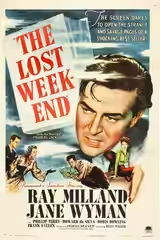
After The Girl on the Train, try Gone Girl (2014, Fi1m 84): The marriage thriller this one was sold as; colder, nastier and far better plotted. Then Rear Window (1954, Fi1m 94): Watching the neighbours from a fixed seat, done once and never bettered; and The Lost Weekend (1945, Fi1m 82): A drinker’s days treated as the subject rather than the alibi; Ray Milland is remarkable.

Cast

If you liked this, try…

  1. Gone Girl (2014, Fi1m 84)The marriage thriller this one was sold as; colder, nastier and far better plotted.

  2. Rear Window (1954, Fi1m 94)Watching the neighbours from a fixed seat, done once and never bettered.

  3. The Lost Weekend (1945, Fi1m 82)A drinker’s days treated as the subject rather than the alibi; Ray Milland is remarkable.

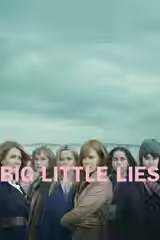
  4. Big Little Lies (2017, Fi1m 78)Three women, one coastline, one body; the long form gives the supporting cast their due.

  5. The Vanishing (1988, Fi1m 88)A disappearance, a man who cannot let it go, and an ending that still unsettles.