Emily Blunt is careful and unglamorous as a woman drinking herself out of her life, and deserves a better mystery than this tidy, glum one, solvable before the police arrive. Watch her, not the plot.
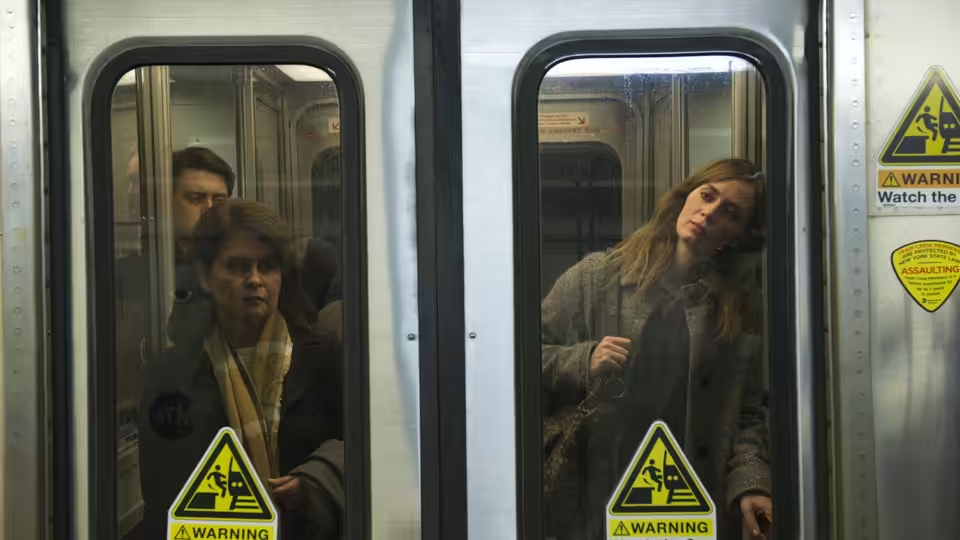
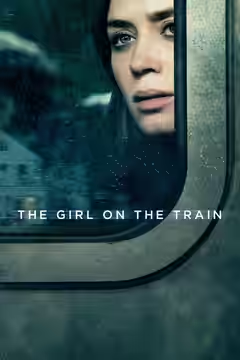
Tate Taylor’s film of Paula Hawkins’s novel is built around three women who live, or used to live, on the same stretch of suburban railway. Rachel Watson (Emily Blunt) rides past their houses twice a day and makes up lives for the people inside. Erin Cressida Wilson’s screenplay keeps the book’s three narrators and its hopping about in time, and it keeps the mystery, which is where the trouble starts. Blunt is worth your evening on her own. The film around her is tidy, glum and solvable from a long way off.
Blunt plays Rachel as a woman who has not stopped drinking so much as stopped noticing that she drinks. She tips vodka into a water bottle, sketches on a napkin, and tells her flatmate Cathy (Laura Prepon) about a working day she has not had in a year. Her eyes are red at the rims and she holds them quite still, as drunks do when they want to look sober. In a flashback she arrives at her ex-husband’s door, unsteady and too loud, and Blunt shows us the exact moment Rachel sees what she looks like to the people watching. We winced for her, and it is the one thing in the film we did not need to be asked to feel.
Michael McCusker and Andrew Buckland cut between Rachel, Megan Hipwell (Haley Bennett) and Anna Watson (Rebecca Ferguson), with captions telling us whose scene it is and how many months ago. Charlotte Bruus Christensen shoots nearly everything in close-up and shallow focus, so faces fill the frame and the backgrounds dissolve; for Rachel’s blackouts she lets the image smear and lurch, which works the first time and is a habit by the fourth. The intention is that we are as lost as Rachel. The result, often, is that we are unsure what day it is.
The mystery does not survive an attentive viewer. Megan vanishes, Rachel wakes bruised with a hole where the evening should be, and Detective Sgt. Riley (Allison Janney) starts asking questions. We had our answer at about the forty-minute mark and spent the rest wanting to be wrong. The men do not help. Justin Theroux as Tom, Luke Evans as Scott and Édgar Ramírez as Dr. Kamal Abdic are each given one temperature and asked to hold it. Janney is brisk and sceptical and could have used three more scenes. Lisa Kudrow, as Martha, gets one, and makes more of it than most of the cast get to make of the whole film.
Danny Elfman’s score is the surprise. He has set aside the carnival brass he is known for and written something low and electronic, a pulse under the dialogue, and in the stretches when the film goes quiet it does more work than the plot. Kevin Thompson’s production design gives the houses by the track big glass backs, so every kitchen is lit for anyone passing on the train. Ann Roth and Michelle Matland put Rachel in a grey coat that does not quite fit and Anna in the pale knitwear of a woman with nothing to do all day. All of it is more thoughtful than the story it serves.
Wilson wrote Secretary, which knew how perverse it wanted to be, and Taylor made The Help, which knew how respectable. This film sits between them and commits to neither. Hawkins’s book was sold as the next Gone Girl, and David Fincher’s film of that one is the obvious comparison; Fincher let the nastiness show, Taylor keeps the lights low and asks for sympathy. The second half takes turns we will not describe. We will say the film uses Rachel’s drinking as a device for not knowing things, while Blunt plays it as an illness that is happening to a person, and the two never quite meet.
Most critics landed in the middle, and so do we, a little above the angrier notices. The 15 certificate covers sex and blood kept mostly off camera. Watch it at home, where you can rewind to check whose month you are in, and watch it for Blunt, who is doing the real thing. Do not watch it for the answer. You will have it before she does.