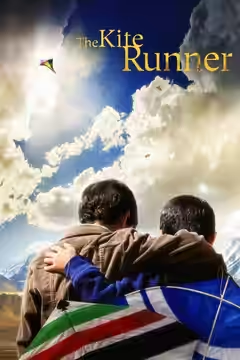
Young Amir flies a red kite against a sunset over the mountains
Film review

The Kite Runner

2007 · Directed by Marc Forster · 2h 08m · MPA PG-13

In a sentenceTwo boys and a kite over Kabul, then a man and a script spending ninety minutes trying to catch up

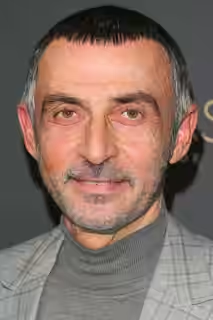
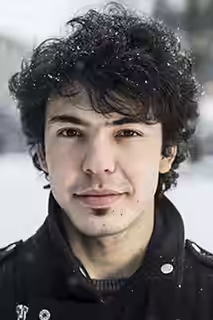
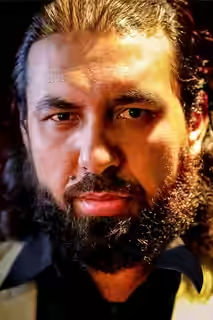
Kabul, 1978. Amir (Zekeria Ebrahimi), the bookish son of the wealthy Baba (Homayoun Ershadi), spends his days with Hassan (Ahmad Khan Mahmoodzada), the son of the family’s Hazara servant Ali (Nabi Tanha). Hassan runs kites for him, defends him from the bully Assef (Elham Ehsas) and would do anything he asked. Amir wants his father’s approval and cannot earn it; Baba’s friend Rahim Kahn (Shaun Toub) is the only adult who takes his stories seriously. The winter kite-fighting tournament is Amir’s chance. He wins, Hassan runs down the last kite, and what Amir sees in an alley afterwards, and does nothing to stop, follows both boys as the Soviets arrive and Baba and Amir flee the country. Years later, in California, the grown Amir (Khalid Abdalla) gets a phone call.

Plays from YouTube when you press play; nothing loads from them until then.

Fi1m review

Marc Forster’s film of Khaled Hosseini’s novel is at its best when it is two boys and a kite over Kabul, and the young actors carry it. Once Amir grows up, the script starts explaining, the score starts insisting, and the film gets smaller.

Marc Forster, who made Finding Neverland and Stranger Than Fiction, has filmed Khaled Hosseini’s novel about a Kabul boy who betrays his friend and spends the rest of his life owing him. The book sold in millions, and the film, adapted by David Benioff, treats it with care: the Kabul scenes are played in Dari with subtitles, which a studio film of this size did not have to do. The result is a decent, often affecting picture with an hour of something better inside it. The hour is the childhood, and it is the children who make it.

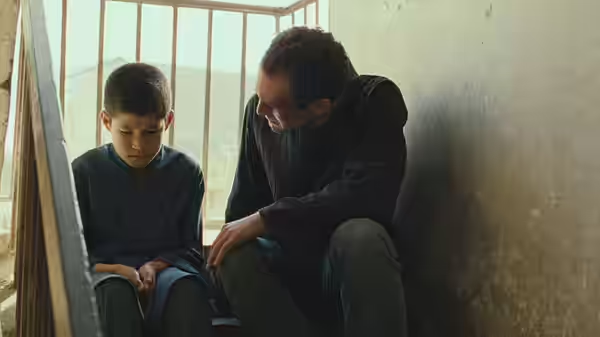
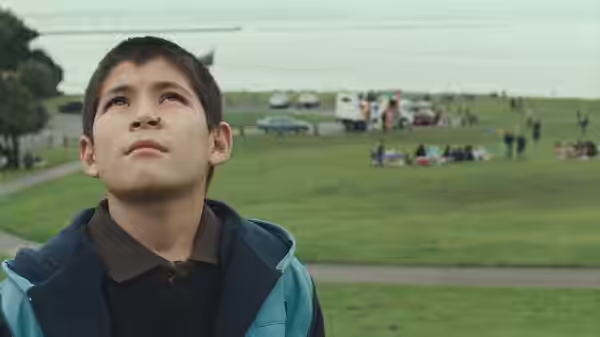
Zekeria Ebrahimi plays young Amir as a boy who already knows he is a coward and hopes nobody else has noticed. Ahmad Khan Mahmoodzada’s Hassan is the more remarkable performance: open, loyal, quick to smile, with a stillness when he is hurt that a trained adult actor would struggle to find. The two of them read under a pomegranate tree, squabble over a story Amir has written, and run through the lanes of old Kabul as if the camera were not there. Homayoun Ershadi gives Baba the weight the part needs, a big man who loves his son and cannot hide that he wishes he were a different boy. Every scene between the two is a small negotiation, and Amir loses all of them.

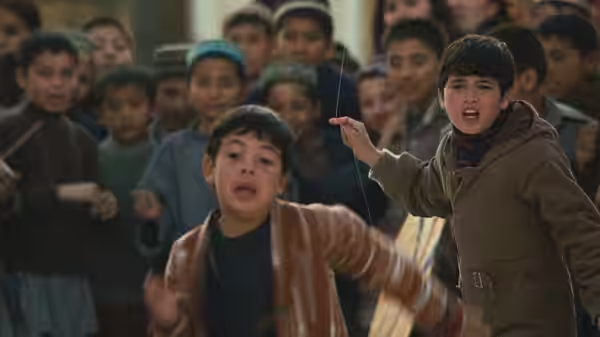
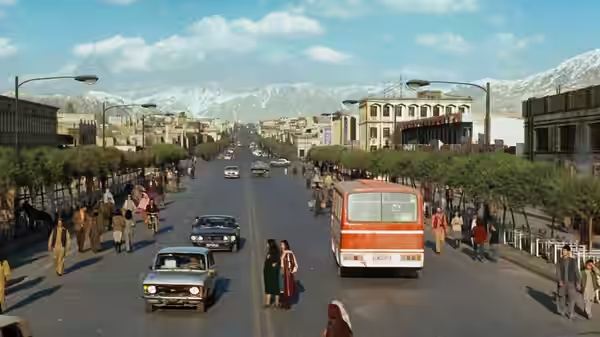
The kite tournament is the sequence people will remember and it deserves to be. Roberto Schaefer shoots the city from the rooftops in dust and low winter light, and Matt Chessé cuts between the boys’ hands on the string, the crowds on the roofs and the kites themselves, which were plainly finished with computers and swoop with a freedom real kites do not have. It does not matter. We were as caught up as the boys were, leaning towards the screen, and when the last kite fell we felt the small, foolish rush of having won something. What happens in the alley afterwards is handled with restraint, mostly off camera and on the faces, and it is the last time the film trusts us to work something out for ourselves.

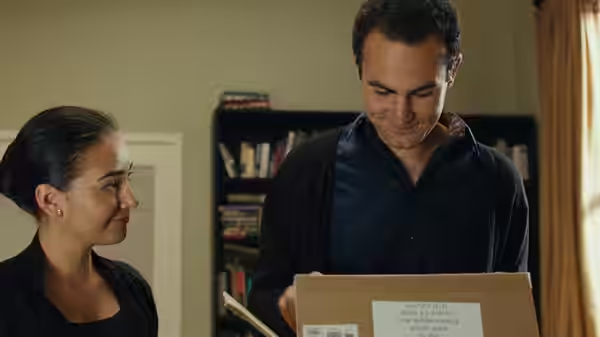
Then the Soviets come, the family flees, and the film moves to California and to Khalid Abdalla as the adult Amir. Abdalla is intelligent and watchful and has little to play: a man who writes novels, marries Soraya (Atossa Leoni) and waits for the plot to telephone. The call comes from Rahim Kahn (Shaun Toub), and the second half takes Amir back to a Taliban-run Afghanistan on an errand we will not describe. Benioff’s script, which compressed the childhood so neatly, now starts stating things. Characters tell each other what they are feeling and why it matters. Alberto Iglesias’s score, which had been gentle under the kites, a reed flute and strings, comes forward and underlines each revelation. By the final half hour it is telling us when to cry, which is the surest way to stop us.

The return to Kabul is also where the film’s judgement goes. Saïd Taghmaoui is good as Farid, the driver who dislikes Amir on sight and says so, and the bleached, flat way Schaefer shoots the ruined city is a real contrast to the amber of the childhood. But the villains are only villains, the coincidences arrive on cue, and a book that was careful about class and guilt becomes a film about a brave man rescuing someone. We felt handled, and we resented it, because the first hour had shown us Forster did not need to do this.

Set against Forster’s earlier films, this is nearer Finding Neverland than Monster’s Ball: handsome, well acted and too sure of what it wants us to feel. Set against the novel, it follows the events closely. Hosseini’s Amir despised himself on every page; the film’s Amir mostly looks sad, which is not the same thing.

See it for the boys, for Ershadi, and for ten minutes of kites over Kabul that we have not forgotten. Watch it at home, where the second half’s insistence is easier to bear and the subtitles easier to read. It runs 128 minutes and carries a 12A, which given what happens in that alley is about as low as it could go.

Critical consensus AI synthesised

58
Positive
7
Mixed
2
Negative
6

The reviews split almost down the middle, and the split is wide. Where they agree is on the children: nearly every critic, including those who dislike the film, praises the young, mostly unknown cast, and the Los Angeles Times singles out Ahmad Khan Mahmoodzada for making the boys’ friendship feel natural. The warmer notices, led by the trade papers, call it a faithful, moving adaptation with understated direction and handsome production design, and find its treatment of guilt and childhood regret affecting.

The reservations gather around what happens once the story leaves childhood. Several critics, the Los Angeles Times among them, find the adult sections less involving, and more than one calls the final stretch rushed. The harsher reviews go further: The AV Club sees Forster pushing too conspicuously for effect, IndieWire finds the adaptation safe and culturally thin, and Slant calls it kitsch with its symbolism overblown. Even admirers mention an insistent score and tidy coincidences.

The Hollywood Reporter
7 October 2007 · The Associated Press
90*

The critic praises the film as a highly effective, faithful adaptation that should earn critical recognition. They single out its naturalistic performances and understated direction, while noting that the final section feels rushed.

Read the full review →
Variety
4 October 2007 · festival review · Alissa Simon
85*

Simon gives the adaptation a strongly positive verdict, praising its emotional power and historical sweep. She especially singles out the nuanced performances and production design, though she finds the score overly insistent.

Read the full review →
Time Out
17 December 2007 · ★★★★ · Wally Hammond
80

The review describes the film as an accessible, deftly directed and moving tale. It singles out the direction and emotional treatment of childhood regret for praise.

Read the full review →
RogerEbert.com
13 December 2007 · ★★★/4 · Roger Ebert
75

Ebert finds the film emotionally affecting despite its difficult subject matter. He singles out its portrayal of friendship and guilt for praise.

Read the full review →
Empire
30 November 2007 · Dan Jolin
70*

Jolin finds the film an engaging melodrama, despite its heavy-handed plot and tidy coincidences. He especially praises the affecting performances of the mostly unknown cast, particularly the young actors.

Read the full review →
Screen Daily
12 October 2007 · Tim Grierson
70*

Grierson finds the adaptation emotionally engaging, though less effective at conveying Afghanistan’s societal traumas. He praises its sensitive characterization and exploration of family and friendship.

Read the full review →

Straight answers AI written, from our review

Is The Kite Runner worth watching?
The Kite Runner is worth watching for its first hour, when two boys and a kite over Kabul carry it, and we scored it 60. The childhood scenes and the kite tournament are strong, but once Amir grows up the script starts explaining and the score starts insisting. See it for the young actors and Homayoun Ershadi, and forgive the second half.
How long is The Kite Runner, and what is it rated?
The Kite Runner runs 2h 08m and is rated PG-13 by the MPA in the US. It is a drama film.
Where can I watch The Kite Runner in the US?
The Kite Runner is streaming on Pluto TV in the US. Availability is checked daily; the links above go straight to each service.
How violent or frightening is The Kite Runner, and is it suitable for children?
The Kite Runner carries a 12A, and we think that is about as low as it could go. There is little blood on screen, but what happens to Hassan in an alley after the tournament, handled mostly off camera and on the faces, is an assault that younger children should not see and older ones may need to talk about. The later Taliban-era scenes are bleak rather than graphic.

How does The Kite Runner compare to Taste of Cherry?
The Kite Runner and Taste of Cherry share Homayoun Ershadi and not much else. Kiarostami's film is slow, spare and far the better: one man driving around Tehran in repeated conversations that test patience and reward it. Forster's is a handsome studio drama that tells you what to feel; choose it for the children's performances, and the other if you can sit with silence.
Is The Kite Runner based on a true story or a book?
The Kite Runner is based on Khaled Hosseini's novel of the same name, not on a true story. David Benioff's script follows the book's events closely, but the novel's Amir despised himself on every page while the film's mostly looks sad. You do not need to have read it to follow the film, though readers will notice what has been softened.
What should I watch after The Kite Runner?
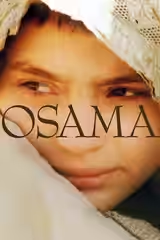
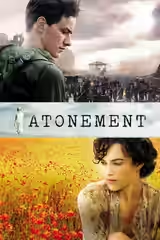
After The Kite Runner, try Taste of Cherry (1997, Fi1m 86): Homayoun Ershadi, younger, driving around Tehran looking for a stranger to bury him. Then Osama (2003, Fi1m 64): Taliban Kabul filmed from the inside, with none of the cushioning and twice the force; and Atonement (2007, Fi1m 83): Another child’s cowardice, another lifetime spent paying for it, with a better second half.

Cast

Awards

Academy Awards, 2008

Nominated
Best Original Score

BAFTA Film Awards, 2008

Nominated
Best Adapted Screenplay
Nominated
Best Film Not in the English Language
Nominated
Best Original Music

Broadcast Film Critics Association Award for Best Film, 2007

Nominated
Broadcast Film Critics Association Award for Best Film

Golden Globes, 2007

Nominated
Best Non-English Language Film
Nominated
Best Original Score

Satellite Award for Best Adapted Screenplay, 2007

Nominated
Satellite Award for Best Adapted Screenplay

Satellite Award for Best Original Score, 2007

Won
Satellite Award for Best Original Score

If you liked this, try…

  1. Taste of Cherry (1997, Fi1m 86)Homayoun Ershadi, younger, driving around Tehran looking for a stranger to bury him.

  2. Osama (2003, Fi1m 64)Taliban Kabul filmed from the inside, with none of the cushioning and twice the force.

  3. Atonement (2007, Fi1m 83)Another child’s cowardice, another lifetime spent paying for it, with a better second half.

  4. Turtles Can Fly (2004) · not on Fi1m yetChildren on the Iraq-Turkey border, played by children, and no adult tells them how to feel.

  5. The Breadwinner (2017, Fi1m 84)An animated girl in Kabul dressing as a boy to feed her family; quieter, braver, sharper.