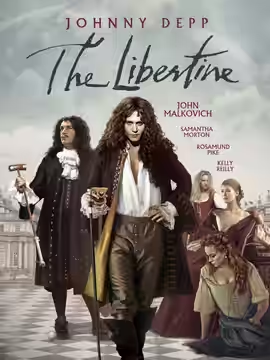
Johnny Depp gives Rochester a performance better than the film around him, and Samantha Morton matches him. But Laurence Dunmore shoots Restoration London so dark and paces it so slackly that the man’s wit never finds a story to live in.
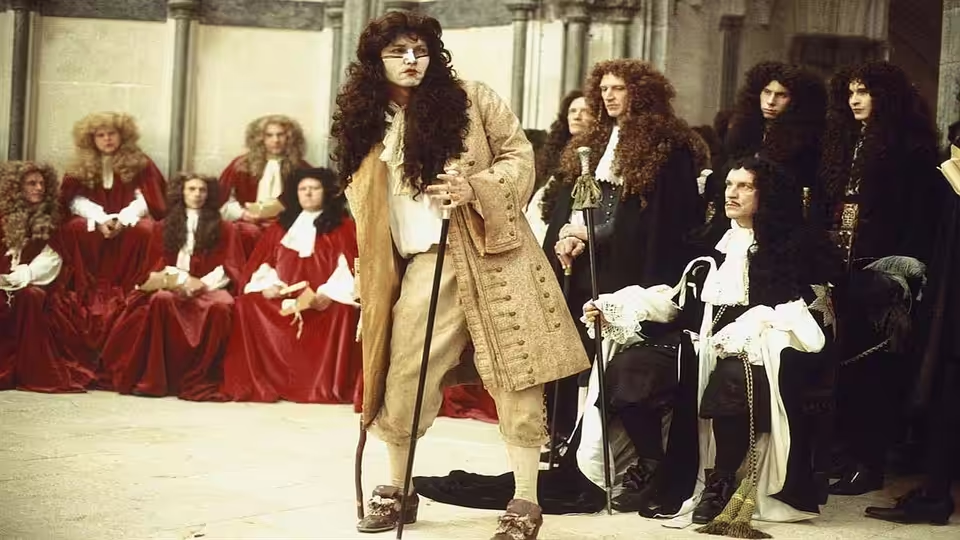
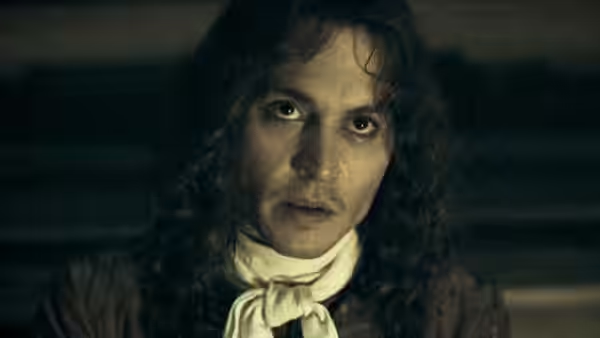
The first thing Johnny Depp does in The Libertine is walk out of the dark, look into the lens and tell us we will not like him. It is a good opening. Stephen Jeffreys has adapted his own stage play, and the speech has a playwright’s nerve: a man announcing his own unpleasantness before we have had a chance to decide for ourselves. Laurence Dunmore’s film is about Rochester, who had wit, rank, a wife and the King’s affection and spent all of them on drink, actresses and giving offence. The question the film sets itself is whether a life like that adds up to anything. It does not manage to answer it.
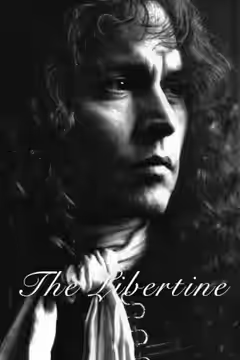
Depp is the reason it nearly does. He plays Rochester low and slow, a man so bored by his own cleverness that he barely bothers to finish his lines, and the verses come out of him as if they cost nothing, which is the point. He is funniest when he is cruel to people who have done nothing to deserve it, and most alive when he finds someone who answers back. That person is Elizabeth Barry (Samantha Morton), an actress he watches being hissed off the stage and decides, on a bet, to make into the best in London.
The playhouse scenes are the film. Rochester makes Barry do a line, then do it again, then stop acting it and simply say it, and Morton lets her face go slack and does it once more, a little different each time, while the camera holds and does not cut. We were moved by this more than we expected to be, and the reason is plain: it is the one stretch of the film in which somebody wants something and we can watch them get it. John Malkovich’s Charles II is a weary manager who likes his wit and cannot afford him; Malkovich plays him quiet, bone-tired and faintly amused, and is better than the part.
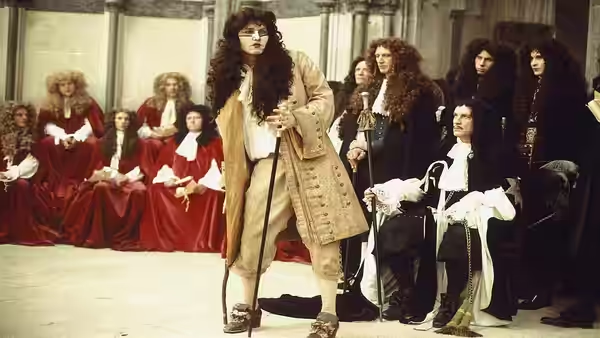
Then there is the look of the thing, which most critics complained about and which we will complain about too. Alexander Melman lights almost everything by candle and window, so the film is brown and grey from the first frame to the last, and Ben van Os’s London is a sewer with a palace on top of it, mud to the hems of Dien van Straalen’s silks. As a decision it is defensible. Rochester’s England was filthy and the film wants us to smell it. But there are whole conversations here in which we could not tell who was speaking, and a film built on talk cannot afford that.
The deeper trouble is shape. Jeffreys’s script gives Rochester a commission from the King and a wife, Elizabeth Malet (Rosamund Pike), waiting in the country, and then lets both drift while he drinks with Etherege (Tom Hollander) and Sackville (Johnny Vegas). Jill Bilcock cuts the scenes so that they end when the talk runs out rather than when something has changed, and after an hour we noticed we were bored, and then we were irritated about it, because the actors are good and the ingredients are all here. Pike gets one scene of a wife’s exhausted patience and plays it well; Hollander gets a few dry lines; Vegas gets a wig. Michael Nyman’s score, strings pushing forward in his usual hard pulse, is the only part of the film with any urgency, and it is often pushing scenes that have nowhere to go.
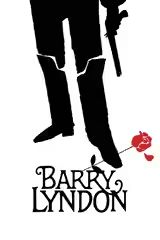
The obvious comparison is Barry Lyndon, which Stanley Kubrick lit by candle in 1975 and which you can see. That film also followed a man of appetite through a century of silk, and it knew where every scene was going. The Libertine has a performance in the middle of it that deserved that kind of care.
See it for Depp and Morton in the playhouse, and sit close. At home, with the lights off, the darkness gets worse, because your own reflection joins the cast.