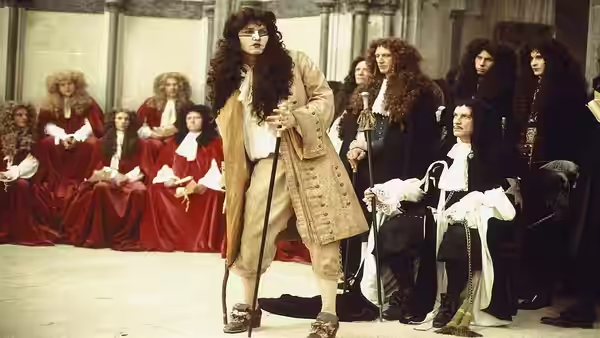
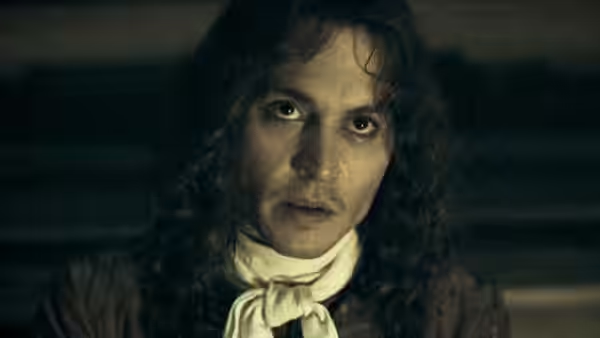
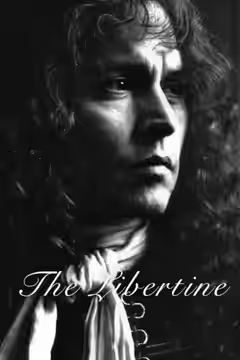
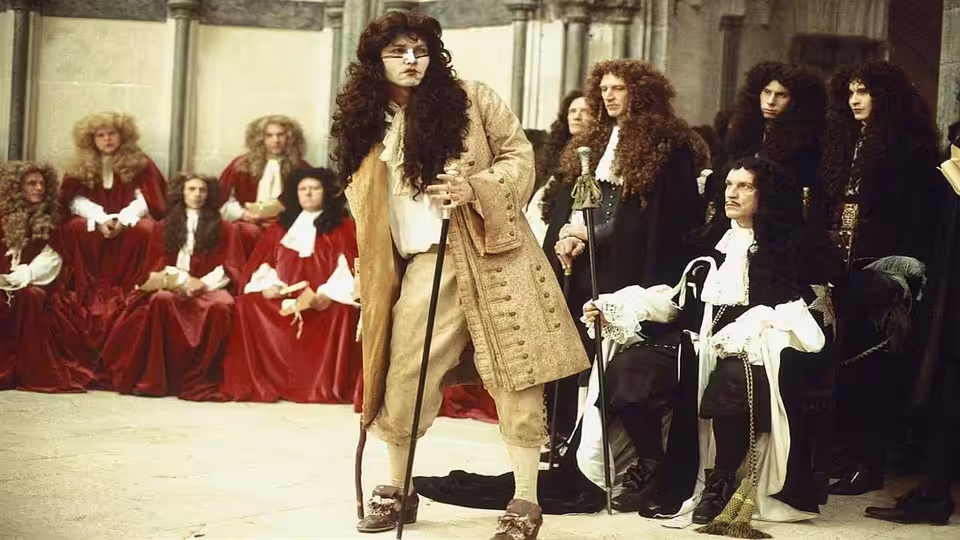
Rochester (Johnny Depp) stands before the seated king and courtiers in a royal chamber
Film review

The Libertine

2004 · Directed by Laurence Dunmore · 1h 54m

In a sentenceTwo hours of wit, mud and candlelight, and you can see about a third of it

Restoration London, in the reign of Charles II (John Malkovich). Rochester (Johnny Depp), an earl, a poet and the worst-behaved man at court, is called back from banishment in the country by a King who wants a great work out of him before the French ambassador arrives. His wife, Elizabeth Malet (Rosamund Pike), stays on the estate; he goes to London and falls back in with Etherege (Tom Hollander), Sackville (Johnny Vegas) and his servant Alcock (Richard Coyle). At the playhouse he watches an actress, Elizabeth Barry (Samantha Morton), get hissed off the stage, and wagers he can make her the finest in the city. Chiffinch (Paul Ritter), the King’s fixer, keeps an eye on all of it. Rochester tells us in his first minute that we will not like him.

Plays from YouTube when you press play; nothing loads from them until then.

Fi1m review

Johnny Depp gives Rochester a performance better than the film around him, and Samantha Morton matches him. But Laurence Dunmore shoots Restoration London so dark and paces it so slackly that the man’s wit never finds a story to live in.

The first thing Johnny Depp does in The Libertine is walk out of the dark, look into the lens and tell us we will not like him. It is a good opening. Stephen Jeffreys has adapted his own stage play, and the speech has a playwright’s nerve: a man announcing his own unpleasantness before we have had a chance to decide for ourselves. Laurence Dunmore’s film is about Rochester, who had wit, rank, a wife and the King’s affection and spent all of them on drink, actresses and giving offence. The question the film sets itself is whether a life like that adds up to anything. It does not manage to answer it.

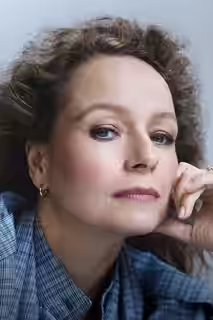
Depp is the reason it nearly does. He plays Rochester low and slow, a man so bored by his own cleverness that he barely bothers to finish his lines, and the verses come out of him as if they cost nothing, which is the point. He is funniest when he is cruel to people who have done nothing to deserve it, and most alive when he finds someone who answers back. That person is Elizabeth Barry (Samantha Morton), an actress he watches being hissed off the stage and decides, on a bet, to make into the best in London.

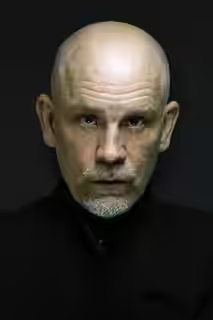
The playhouse scenes are the film. Rochester makes Barry do a line, then do it again, then stop acting it and simply say it, and Morton lets her face go slack and does it once more, a little different each time, while the camera holds and does not cut. We were moved by this more than we expected to be, and the reason is plain: it is the one stretch of the film in which somebody wants something and we can watch them get it. John Malkovich’s Charles II is a weary manager who likes his wit and cannot afford him; Malkovich plays him quiet, bone-tired and faintly amused, and is better than the part.

Then there is the look of the thing, which most critics complained about and which we will complain about too. Alexander Melman lights almost everything by candle and window, so the film is brown and grey from the first frame to the last, and Ben van Os’s London is a sewer with a palace on top of it, mud to the hems of Dien van Straalen’s silks. As a decision it is defensible. Rochester’s England was filthy and the film wants us to smell it. But there are whole conversations here in which we could not tell who was speaking, and a film built on talk cannot afford that.

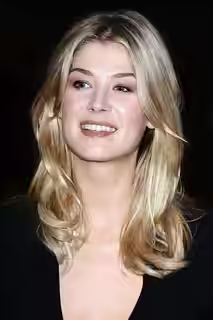
The deeper trouble is shape. Jeffreys’s script gives Rochester a commission from the King and a wife, Elizabeth Malet (Rosamund Pike), waiting in the country, and then lets both drift while he drinks with Etherege (Tom Hollander) and Sackville (Johnny Vegas). Jill Bilcock cuts the scenes so that they end when the talk runs out rather than when something has changed, and after an hour we noticed we were bored, and then we were irritated about it, because the actors are good and the ingredients are all here. Pike gets one scene of a wife’s exhausted patience and plays it well; Hollander gets a few dry lines; Vegas gets a wig. Michael Nyman’s score, strings pushing forward in his usual hard pulse, is the only part of the film with any urgency, and it is often pushing scenes that have nowhere to go.

The obvious comparison is Barry Lyndon, which Stanley Kubrick lit by candle in 1975 and which you can see. That film also followed a man of appetite through a century of silk, and it knew where every scene was going. The Libertine has a performance in the middle of it that deserved that kind of care.

See it for Depp and Morton in the playhouse, and sit close. At home, with the lights off, the darkness gets worse, because your own reflection joins the cast.

Critical consensus AI synthesised

52
Positive
4
Mixed
4
Negative
6

Most critics agree on one thing: Johnny Depp. His Earl of Rochester is praised in nearly every review, including the hostile ones, as charismatic, immersive and convincing even when what surrounds him is not. Samantha Morton draws nearly as much goodwill for her Lizzie Barry, and several reviews single out her scenes with Depp as the film’s centre. John Malkovich’s sardonic Charles II gets a kinder word than most supporting turns, and the grimy London is admired as a corrective to prettier period pictures.

Beyond the cast the reviews split widely, from warm four-star notices to outright dismissals, and the negatives outnumber the positives. The complaints cluster on pace and purpose: a plot that fails to gather momentum, a protagonist whose cynicism leads nowhere, and photography that Empire finds foggy. Radio Times and Total Film are the warmest voices; The New Yorker finds the film unfinished and the Los Angeles Times finds it tiresome.

Radio Times
★★★★ · Tom Hutchinson
80

Hutchinson praises Johnny Depp’s remarkable performance and finds the film’s approach to the Restoration era refreshingly grounded. He also singles out Samantha Morton’s performance and John Malkovich’s intriguing portrayal of Charles II.

Read the full review →
Total Film
18 November 2005 · ★★★★ · Total Film
80

The review calls the film a murky delight, praising its decadent wit and vulgarity despite a plot that struggles to gather momentum. It singles out Johnny Depp’s outrageous, charismatic performance as the film’s greatest strength.

Read the full review →
The Guardian
20 November 2005 · Philip French
75*

French finds the film an intriguing and unusually strong character study, praising Johnny Depp’s powerful performance. He also singles out John Malkovich’s sardonic King Charles and Samantha Morton’s touching portrayal of Lizzie Barry.

Read the full review →
Variety
15 November 2005 · Steve Chagollan
75*

The critic finds the film a fearless, engaging meditation, though its murky cinematography is a significant flaw. He especially praises the performances of Johnny Depp and Samantha Morton, whose scenes together give the film a strong center.

Read the full review →
RogerEbert.com
64*

The page could not be accessed, so the critic’s verdict is unavailable. No specific praise or complaint can be verified.

Read the full review →
Time Out
· TJ
64*

The available metadata frames the review around an audience-baiting opening monologue. The article text is unavailable, so its overall verdict and any further praise or complaint cannot be established.

Read the full review →

Straight answers AI written, from our review

Is The Libertine worth watching?
The Libertine is worth watching only for Johnny Depp and Samantha Morton in the playhouse scenes, and we scored it 56. The performances are better than the film around them: Laurence Dunmore shoots Restoration London so dark we often could not tell who was speaking, and the story drifts once the drinking starts. For patient admirers of Depp, and nobody in a hurry.
How long is The Libertine, and what is it rated?
The Libertine runs 1h 54m. It is a drama and romance film.
Where can I watch The Libertine in Vietnam?
The Libertine is not on any streaming or rental service in Vietnam at the moment. It is available in 10 other countries; change your country at the top of the page to see where. Availability is checked daily.
How violent or frightening is The Libertine, and is it suitable for children?
The Libertine carries an 18 certificate in the UK and an R in the US, and it is not for children. It is not a frightening film; the certificate reflects a portrait of a man who spends his rank and his King's favour on drink, actresses and giving offence, and the film wants us to smell the filth of his London. Teenagers would be bored before they were shocked.
What should I watch after The Libertine?
After The Libertine, try Barry Lyndon (1975, Fi1m 85): Kubrick’s candlelit eighteenth century, for anyone who likes the darkness but wants to see through it. Then Dangerous Liaisons (1988, Fi1m 84): Malkovich as a seducer who gets what he deserves; Stephen Frears keeps every scene sharp; and The Favourite (2018, Fi1m 87): Yorgos Lanthimos’s Queen Anne court, lit by candles and run entirely on spite.

Cast

If you liked this, try…

  1. Barry Lyndon (1975, Fi1m 85)Kubrick’s candlelit eighteenth century, for anyone who likes the darkness but wants to see through it.

  2. Quills (2000) · not reviewed yetGeoffrey Rush as de Sade, another filthy genius, in a film that knows where it is going.

  3. Stage Beauty (2004) · not reviewed yetThe Restoration playhouse again, from the actors’ side, with Claire Danes and Billy Crudup.

  4. Dangerous Liaisons (1988, Fi1m 84)Malkovich as a seducer who gets what he deserves; Stephen Frears keeps every scene sharp.

  5. The Favourite (2018, Fi1m 87)Yorgos Lanthimos’s Queen Anne court, lit by candles and run entirely on spite.