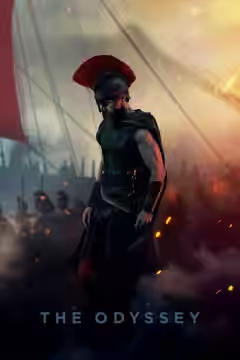
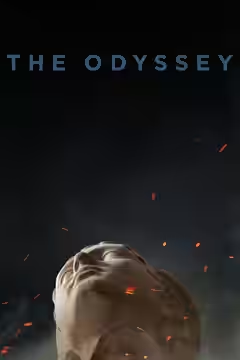
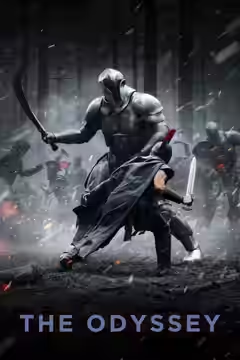
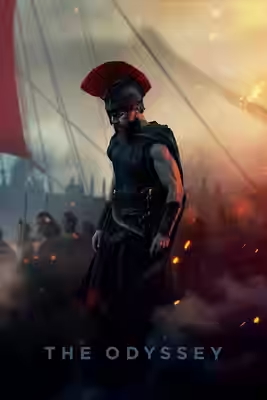
The Odyssey poster

The Odyssey

2026 · Directed by Christopher Nolan
2h 53mAdventureActionFantasy15
83
Fi1m score
90
Critics · 12
Audience · not yet

Where to watch in the UK

Not streaming, renting or buying in the UK at the last check.

Plays from YouTube when you press play; nothing loads from them until then.

Synopsis

The war at Troy is over and Odysseus (Matt Damon) has still not come home. On Ithaca his wife Penelope (Anne Hathaway) keeps a hall full of suitors waiting, the loudest of them Antinous (Robert Pattinson), while their son Telemachus (Tom Holland) grows up on stories about a father he cannot remember. The swineherd Eumaeus (John Leguizamo) keeps faith at the edge of the estate. Out at sea, Odysseus and his second-in-command Eurylochus (Himesh Patel) lead what is left of the crew through islands, caves and the company of Calypso (Charlize Theron), who would rather he stayed. Christopher Nolan writes and directs, with a bard (Travis Scott) telling parts of the tale. It runs 173 minutes and carries a 15 certificate.

Fi1m review

In a sentenceHomer with the gods sent home early and a tired man left to do the rowing

Christopher Nolan’s Homer is a war film about what happens after the war, shot enormous and acted quietly, and for long stretches it is as good as anything he has made. It is also nearly three hours, and in the middle you feel every one of them.

Christopher Nolan, who wrote, directed and produced this with Emma Thomas, has decided that The Odyssey is not a story about monsters. It is about a man who has been at a war and cannot find his way back from it; the monsters are what he meets on the road. It is a Nolan hero: a job, a family, and no way to hold both. The gods are pushed to the edges. What is left is a soldier, a boat, and a house that has stopped expecting him.

Our verdict is that it works, and works best when it is smallest. The scenes on Ithaca, where Anne Hathaway’s Penelope runs a household under siege with a politeness that is a weapon, are the finest in the film. Tom Holland’s Telemachus is a boy who has been told all his life that he looks like someone, and Holland plays the resentment without saying it. Robert Pattinson’s Antinous is not the brute of the poem but a man who has worked out that patience is also a kind of force. John Leguizamo’s Eumaeus gets the least screen time of them all and stayed with us longest.

Matt Damon plays Odysseus tired. Not heroically tired but tired the way people are after a long illness: slow to answer, quick to anger, embarrassed by both. It is a good performance and an unglamorous one. Himesh Patel’s Eurylochus is the crewman who has stopped believing the captain and cannot say so, and Charlize Theron’s Calypso knows exactly what she is offering and what it will cost him to refuse. Travis Scott appears as a bard, there to remind us that all of this has been told before.

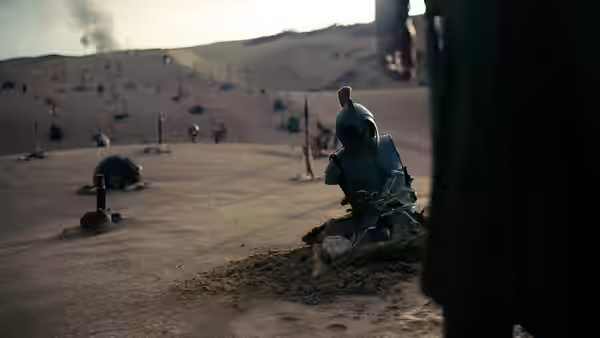
Hoyte van Hoytema shoots the sea as an enormous empty room. The boat is small in the frame and the horizon is high, and there are long passages of nothing but weather, and we did not want them to end. Ruth De Jong’s production design keeps Ithaca dusty and low-ceilinged, a farm with pretensions rather than a palace, and Ellen Mirojnick dresses everyone in cloth that looks salted and slept in. Ludwig Göransson’s score, credited with Rosa Fragorapti and Callum Armstrong, is mostly low brass and drums held back for a long time; when it lets go it does so once, and earns it.

We were frightened in the Cyclops’s cave, properly frightened, because Nolan keeps the creature out of the light and lets the sound of it breathing and shifting stone do the work. Jennifer Lame’s editing here is the opposite of frantic: long shots, held, so that you are trapped in there with the crew and cannot look away to find the exit. It is the best set piece in the film and it comes early enough that nothing afterwards matches it.

That is one problem. The other is the shape. Homer’s poem is a string of episodes and Nolan has kept the string, so the middle hour is one island, then another, each well made, each slightly shorter of breath than the last. At 173 minutes the film sags between the cave and the return. Nolan has also sanded down his hero. The Odysseus of the poem is a liar and a boaster; this one is mostly sorry. It makes him easier to like and less interesting, and it lets the film blame a war for everything, which is a modern idea and a smaller one.

Most critics have gone further than us, and we understand why: it is enormous, serious, and not a sequel to anything. We think it is a fine film with a slack middle and a hero who has had his teeth filed. Nolan has done war before in Dunkirk, where the point was getting home. Here the point is what home does to you when you get there, and on that subject it is close to the best of him.

See it in a cinema, on the largest screen within reach, because the sea will not survive a living room. Take someone who knows the poem and someone who does not, and listen to which is more surprised.

Critical consensus AI synthesised

90
Positive
12
Mixed
0
Negative
0
Radio Times
15 July 2026 · ★★★★★ · James Mottram
100

Nolan delivers a visceral, grounded take on Homer’s epic that blends fantasy with the horrors of war and the pain of homecoming. The film excels through its spectacular IMAX imagery, strong female performances, and a masterful score, marking Nolan at his finest.

Read the full review →
The Guardian
15 July 2026 · ★★★★★ · Peter Bradshaw
100

Nolan reinvents the Homeric legend as a colossal story of postwar disillusion and the true cost of war, with an epic cast and film-making of thrilling ambition. The critic singles out the gasp-inducing IMAX landscapes of loneliness and full-tilt battle sequences for praise.

Read the full review →
The Telegraph
17 July 2026 · ★★★★★ · Robbie Collin
100

Nolan has turned one of the great legends into a blockbuster for the ages, stripping the epic of antique trappings to expose its soul with grandeur and intimacy. The critic singles out the thrillingly all-over-the-place tonal palette and technical brilliance of sequences like the Cyclops cave for praise.

Read the full review →
Time Out
15 July 2026 · ★★★★★ · Phil de Semlyen
100

Nolan’s ambitious adaptation stands as his most formidable work, combining epic spectacle with intimate emotional detail and trauma themes in a groundbreaking 70mm IMAX production. Standout performances, especially from the female cast, and an extraordinary score elevate this Homeric tale.

Read the full review →
Empire
15 July 2026 · John Nugent
90*

The critic calls it a monumental piece of work and a worthy new translation of the ancient text. They single out the ambitious scale of filmmaking, seamless integration of practical effects and other techniques in the set pieces, and Nolan's thematic focus on human folly, war, and flawed heroes.

Read the full review →
Vulture
15 July 2026
70*

Odysseus emerges as the quintessential Nolan protagonist, torn between vocation and family in a sprawling, spectacle-driven epic that feels like a career endpoint. Damon's weary performance and sequences like the Circe encounter are praised, though the film stays intellectually distant from deeper emotion.

Read the full review →

Cast

Stills

If you liked this, try…

The Return poster

The Return

2024 · The same homecoming with no monsters at all, and Ralph Fiennes doing the rowing.

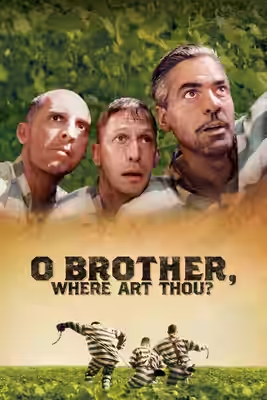
O Brother, Where Art Thou? poster

O Brother, Where Art Thou?

2000 · Homer in Depression-era Mississippi, with singing convicts and a one-eyed Bible salesman.

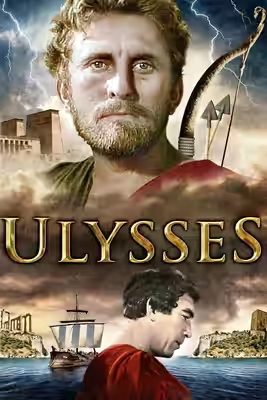
Ulysses poster

Ulysses

1954 · Kirk Douglas takes the voyage in Technicolor, with more confidence and less guilt.

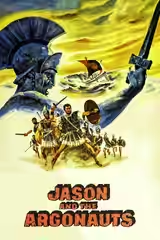
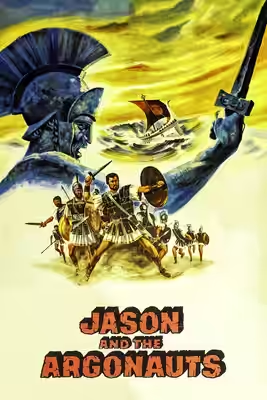
Jason and the Argonauts poster

Jason and the Argonauts

1963 · The Greek sea voyage as pure adventure, with Ray Harryhausen’s skeletons stealing the ending.

Dunkirk poster

Dunkirk

2017 · Nolan’s earlier war film, where the whole plot is trying to get home.