Wes Anderson gives Benicio del Toro a fortune, a daughter and a great many enemies, and gets back the best performance in one of his films for years. The film around him is handsome, funny in bursts, and for too long one meeting after another.
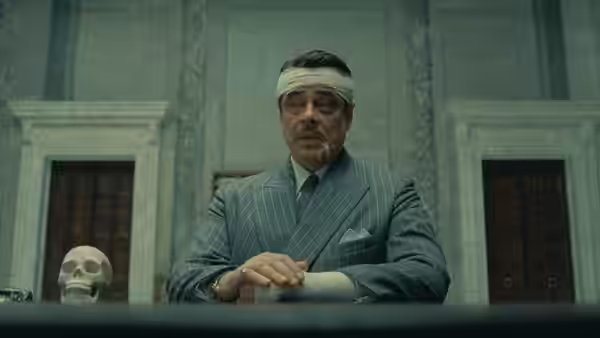
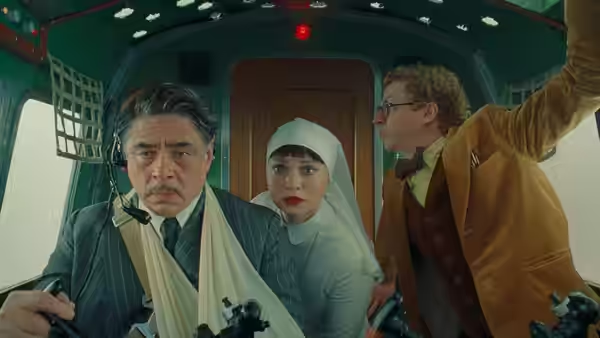
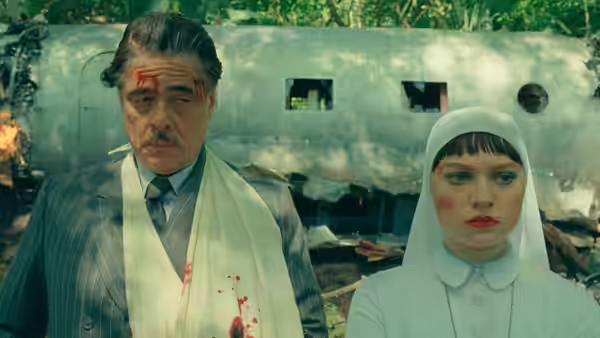
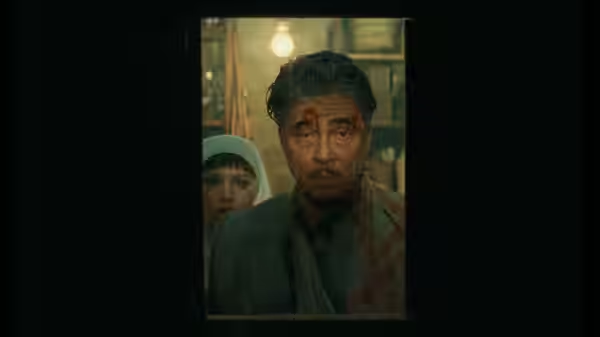
Wes Anderson has made a film about a man who is hard to kill. Zsa-zsa Korda (Benicio del Toro) is an industrialist and arms dealer who opens the film by surviving another attempt on his life, and who responds by summoning his estranged daughter Liesl (Mia Threapleton), a nun. He then takes her, along with Bjorn Lund (Michael Cera), on a tour of the partners who are meant to be paying for his grand infrastructure scheme. The money has fallen short and he needs each of them to make up the gap. It is a good film, worth your evening if Anderson is your director, and del Toro rather than the scheme is the reason.
Del Toro is the best thing Anderson has had in front of a camera for some time. He plays Korda as a heavy, patient man who speaks in complete paragraphs, and he does it without a flicker of self-regard. Threapleton plays Liesl as still and watchful, a girl who has decided in advance that she will not be impressed, and she holds the screen against him. Cera, as the sidekick, is the film’s cleanest comic instrument. Nearly every good laugh outside the central pair is his.
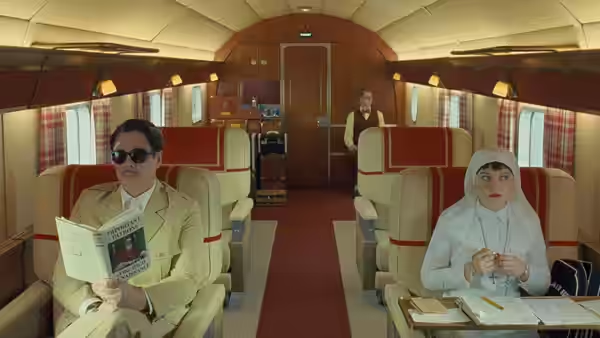
Bruno Delbonnel shoots it in warm ochres and greens, the camera square to the walls as it always is with Anderson, but he lets the interiors keep some shadow, which is not always the case in these films. The frames are barer than in the last few, with less in the corners for the eye to wander off into, and we thought that suited the man at the centre of them. Adam Stockhausen’s rooms are dioramas, each built to be seen from one angle and no other, and Korda moves through them like a man inspecting property. Milena Canonero’s costumes are as exact as the rooms. Alexandre Desplat’s score is spare and mostly stays out of the way, which is the right call.
The trouble is the itinerary. Each partner gets a chapter: Tom Hanks and Bryan Cranston as a pair of American money men who settle terms on a basketball court, Riz Ahmed’s Prince Farouk, Mathieu Amalric as a nightclub owner called Marseille Bob, Jeffrey Wright’s Marty, Scarlett Johansson’s Cousin Hilda. The basketball game made us laugh out loud; Hanks explains the rules with the gravity of a treaty. Then we noticed the shape. Korda arrives, states his price, is refused, is nearly killed, leaves with less than he came for, and the film moves on. Barney Pilling cuts each visit to a few brisk minutes, which is a mercy, but it also means nobody stays long enough to become a person. By the fourth stop we were counting how many partners were left, and we were not proud of it.
Benedict Cumberbatch’s Uncle Nubar, the relative Korda would rather not call on, arrives late, and the film brightens when he does. Richard Ayoade turns up and is dry in the way only he is. The pattern is set well before either of them, though, and it is a pattern of sketches.
Set against Anderson’s own work, this is tighter than Asteroid City and The French Dispatch, with one story and one man at the centre of it, and that is welcome. What it lacks is what The Grand Budapest Hotel had, a place we came to know and were sorry to leave. Korda is always on his way somewhere else. The father-daughter story, which most critics have taken as the film’s true subject, is thinner than they say for most of the running time: Liesl disapproves, Korda notices, they move on. Threapleton makes more of it than the script hands her.
At 102 minutes it does not waste your time, and it is never less than handsome. Go in for del Toro. Do not go in expecting the scheme to add up, because Anderson is not much interested in whether it does, and after a while neither were we.