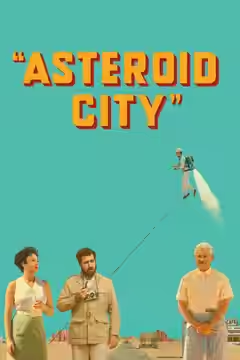
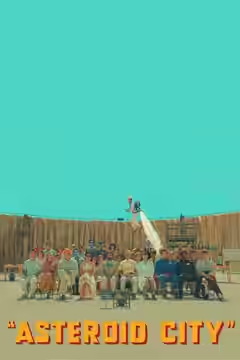
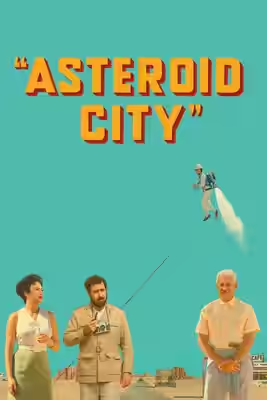
Asteroid City poster

Asteroid City

2023 · Directed by Wes Anderson
1h 45mComedyDrama12A
71
Fi1m score
70
Critics · 13
Audience · not yet

Where to watch in the UK

Checked 10 September at 22:29. Prices and availability change; the service’s page is the last word.

Plays from YouTube when you press play; nothing loads from them until then.

Synopsis

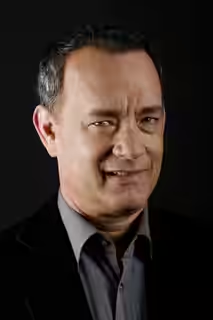
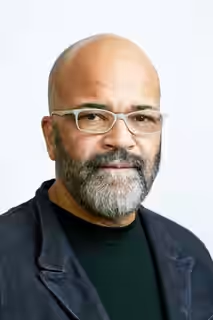
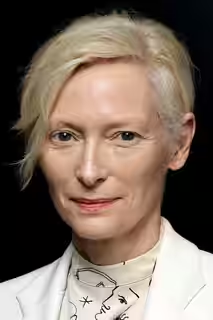
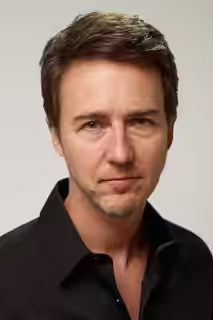
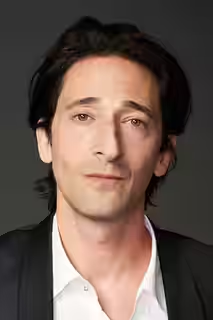
A television programme in black and white presents a play called *Asteroid City*, written by Conrad Earp (Edward Norton) and staged by Schubert Green (Adrien Brody), and then shows us the play itself. In a one-street town in the American desert, some time in the 1950s, Augie Steenbeck (Jason Schwartzman), a photographer, arrives with his four children for a junior stargazers’ convention. He has not yet told them their mother is dead. His father-in-law, Stanley Zak (Tom Hanks), follows. In the next cabin is Midge Campbell (Scarlett Johansson), a film actress. General Gibson (Jeffrey Wright) presides, Dr Hickenlooper (Tilda Swinton) runs the observatory, and the prize-giving is interrupted by something that comes down out of the sky. Wes Anderson directs from his own screenplay.

Fi1m review

In a sentenceA widower, a film star, an alien and a vending machine that sells real estate, none of them raising their voice

Wes Anderson builds a desert town to the millimetre, fills it with the bereaved and then lands an alien in it. It is funny, handsome and slow to let us in, and when it finally does, near the end, it earns its keep.

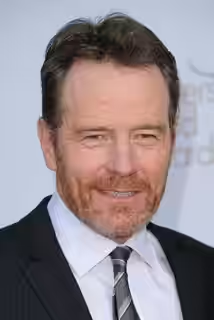
Wes Anderson’s film opens in black and white, on a television stage, where a host (Bryan Cranston) introduces a play called Asteroid City and the man who wrote it, Conrad Earp (Edward Norton). Then the picture widens, the colour comes up, and we are inside the play: a one-street town in the American desert, some time in the 1950s, where a junior stargazers’ convention is about to give out its prizes. It is funny, it is built with a care that borders on the alarming, and for a long stretch in the middle we could not feel anything about it. It gets there, late.

Augie Steenbeck (Jason Schwartzman), a photographer, drives in with his teenage son, his three small daughters and a car that dies on arrival. He has not told the children that their mother is dead. Her father, Stanley Zak (Tom Hanks), arrives to disapprove of him. Midge Campbell (Scarlett Johansson), a film actress, takes the next cabin. General Gibson (Jeffrey Wright) makes speeches and Dr Hickenlooper (Tilda Swinton) runs the observatory. Then something comes down out of the sky during the ceremony, and the town is sealed.

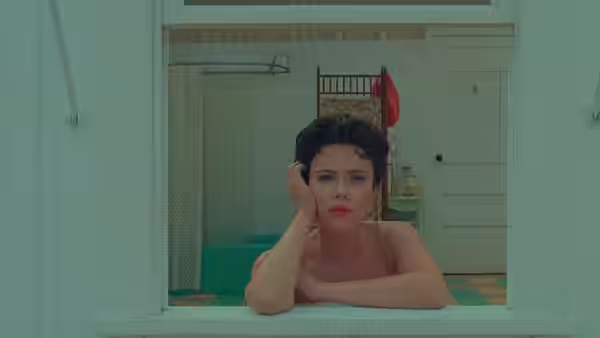
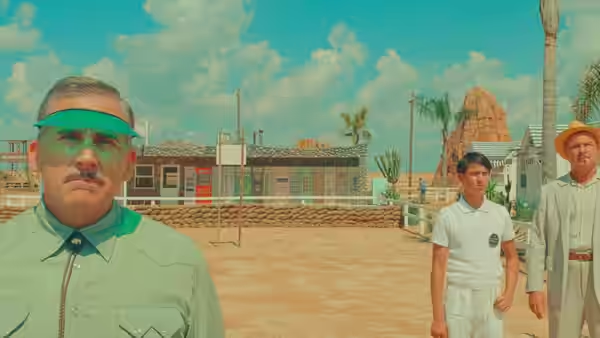
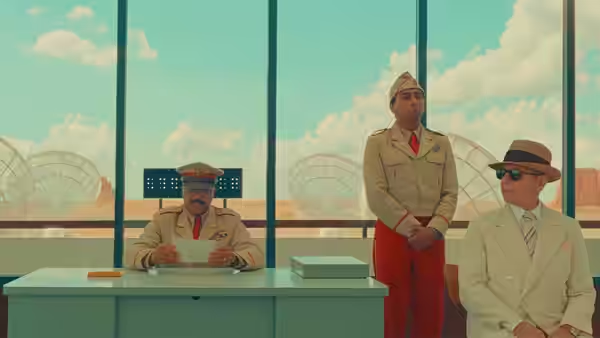
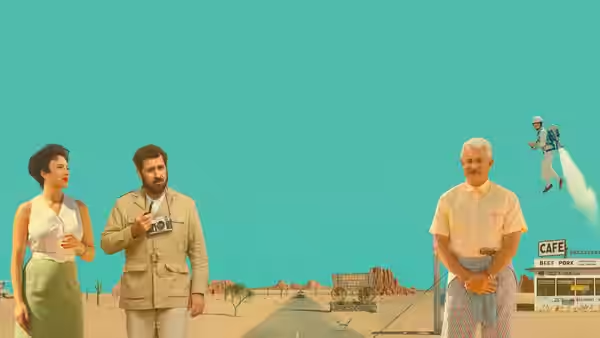
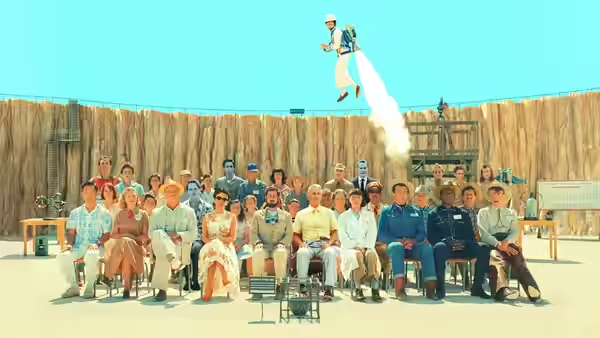
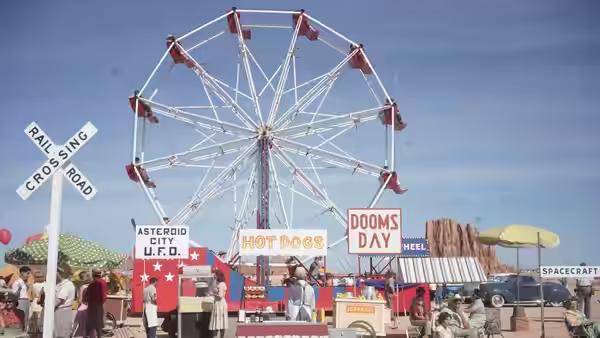
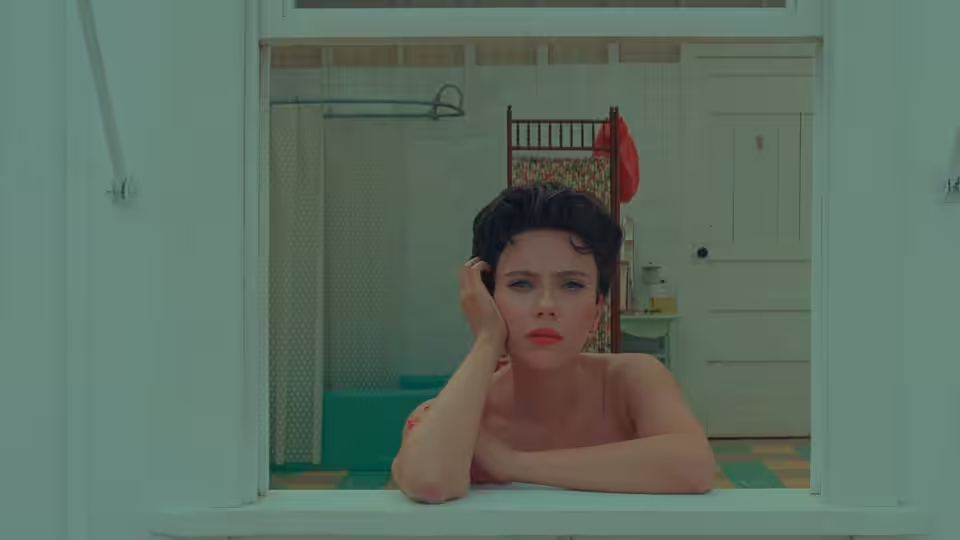
Adam Stockhausen builds the town as a handful of flat-fronted buildings on one road: a diner, a filling station, a row of motel cabins, a motorway ramp that stops in mid-air, and a crater with a fence round it. Robert D. Yeoman and Tristan Oliver share the cinematography credit, and the desert is shot wide, in orange and turquoise and cream, under a sky that never changes; the television scenes are boxed in and grey. Milena Canonero puts the parents in pressed pastels and Midge in a black wig and a painted bruise. Mushroom clouds go up on the horizon and nobody looks for long. Barney Pilling cuts the camera’s sideways slides so that it moves and the people do not.

Schwartzman plays Augie with a pipe, a beard and a voice that never rises, and he makes the flatness read as shock rather than manner. Johansson does the film’s best work. Her scenes with Schwartzman, spoken through the facing windows of their cabins while she rehearses a part in her next picture, are the only time two people in this town seem to want anything from each other. Wright’s address to the children is a fine piece of military nonsense. Hanks plays the grandfather as a man who has been angry for so long it has become good manners. Brody, as the play’s director Schubert Green, gets two scenes in the grey half and takes both.

The trouble is the middle. Once the town is sealed, everybody waits, and Anderson’s idea of waiting is a run of short, level scenes in which the children trade facts and the adults trade silences. Title cards announce the act and scene, and Cranston steps in to tell us what we are watching. For about forty minutes we were bored, and then we were irritated at being bored by something so carefully made. Alexandre Desplat writes short, dry cues, mostly plucked strings, and keeps out of the way; the country songs on the jukebox do more of the work.

Then, in its last quarter of an hour, the film does something we will not describe, except to say that it involves an actor stepping out of his part to ask a question. It moved us more than the previous ninety minutes had prepared us for. The reason is plain: it is the first moment when the play and the stage need each other, when a man in costume grieving on cue and a man out of costume who does not know how to grieve are visibly the same person. Everything before it was a box; this is what was in it.

The Grand Budapest Hotel (2014) had a story you could follow with the sound off; The French Dispatch (2021) was three short films in a folder. This has more of the second’s machinery and, for once, a centre to put it round, which is why it recovers and the earlier film did not. See it in a cinema if you can, where the width of the town matters and the grey scenes feel like the interruption they are meant to be; at home the two shrink to the same size. It runs 105 minutes and carries a 12A. It will not make converts and is not trying to. Take someone who already likes him, and sit through the middle.
Critical consensus AI synthesised

70
Positive
8
Mixed
3
Negative
2

The reviews are mostly warm, with a wide spread beneath the warmth. Most critics agree on the surface: the desert town is meticulously built, the production design and the 1950s Americana are praised almost everywhere, and the large ensemble is found to be game. The praise clusters around the play-within-a-television-broadcast framing, which the film’s admirers take as Anderson’s most searching work on grief, family and making sense of the world through art, and around Jason Schwartzman and Scarlett Johansson, whom several critics, including the Los Angeles Times and The Hollywood Reporter, single out for bringing feeling to a cool design. The reservations cluster on the same framing device: doubters find it over-complicated and dramatically inert, holding the audience at arm’s length. The dissent is sharp rather than mild. The Guardian finds it smug and suffocating, and Variety judges it for die-hards only. Nearly everyone agrees it will not convert the unconvinced.

Little White Lies
20 June 2023 · 5/5/5 · David Jenkins
100

The critic calls it a witty and deeply moving exploration, the maestro's formula tweaked to perfection, praising its metafictional dismantling of artistic creation and emotional depth.

Read the full review →
Vulture
16 June 2023 · Bilge Ebiri
90*

The review calls Asteroid City a masterpiece that brings necessary madness to Anderson's method, connecting human mysteries to the unknown. It singles out the emotional wallop of the meta-theatrical climax for praise.

Read the full review →
The Telegraph
22 June 2023 · ★★★★ · Robbie Collin
80

Anderson’s oddest and most conceptually complex film yet is a play-within-a-film confection that rewards long-term fans with intricate whirrings and emotional depth. It explores finding and playing a role in life amid grief, love and existential search, with inimitable surface pleasures.

Read the full review →
The New Yorker
16 June 2023 · Anthony Lane
75*

Emotions are stylized like the clothes in this ordered film, but Scarlett Johansson’s performance cracks the surface open. The title is a joke and the story layers a play within a TV broadcast, with delight in the textural contrasts and stylized elements.

Read the full review →
Los Angeles Times
15 June 2023 · Justin Chang
65*

The gorgeous production design and starry ensemble make for a half-irritating, half-intoxicating experience that soars, stalls and sometimes alienates. It lands on a moving conclusion that we are not alone, with Schwartzman and Johansson leaving the most poignant impression.

Read the full review →
Variety
23 May 2023 · Owen Gleiberman
40*

The director’s creation of a tiny desert town is an ingenious act of world-building, but what happens there has the turgid ironic whimsy of earlier Anderson films. It looks smashing but is dramatically inert and for die-hards only.

Read the full review →

Cast

Jason Schwartzman
Augie Steenbeck
Scarlett Johansson
Midge Campbell
Tom Hanks
Stanley Zak
Jeffrey Wright
General Gibson
Tilda Swinton
Dr. Hickenlooper
Edward Norton
Conrad Earp
Adrien Brody
Schubert Green

Stills

If you liked this, try…

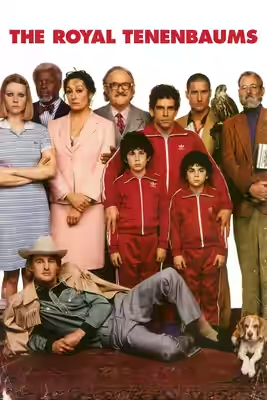
The Royal Tenenbaums poster

The Royal Tenenbaums

2001 · Anderson’s other bereaved family, funnier, warmer and far less boxed in.

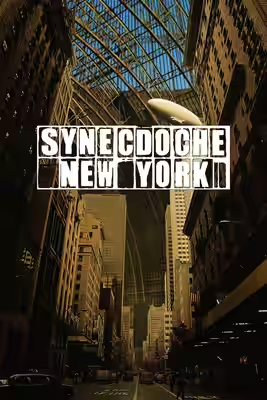
Synecdoche, New York poster

Synecdoche, New York

2008 · A play that swallows the man who wrote it, with none of the tidiness.

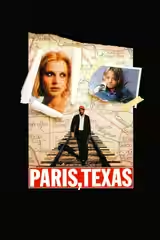
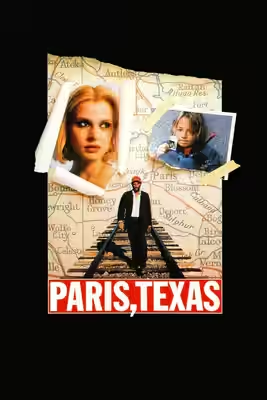
Paris, Texas poster

Paris, Texas

1984 · The American desert as a place to go and grieve, shot for real.

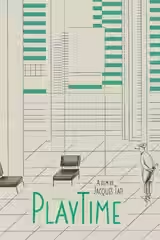
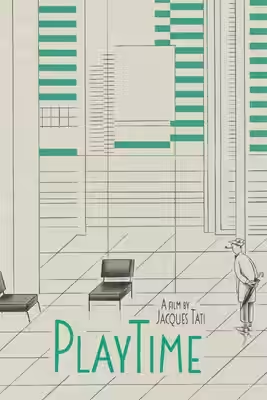
Playtime poster

Playtime

1967 · Tati builds a whole city to the millimetre and lets the people get lost in it.

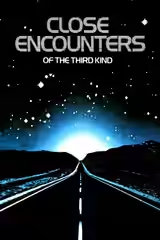
Close Encounters of the Third Kind poster

Close Encounters of the Third Kind

1977 · Something comes down out of the sky and the film means it.