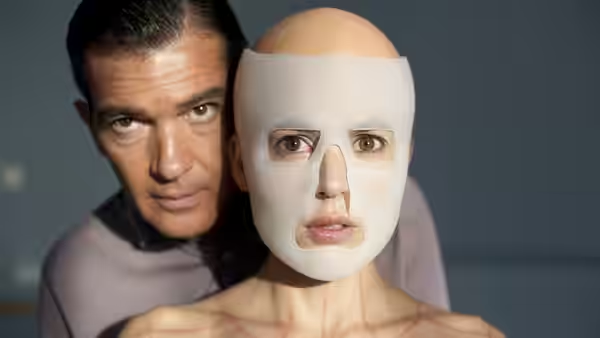
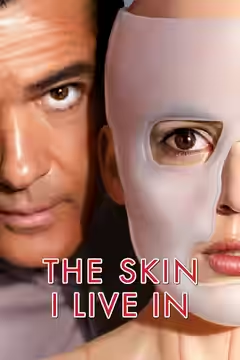
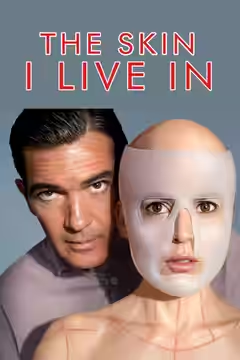
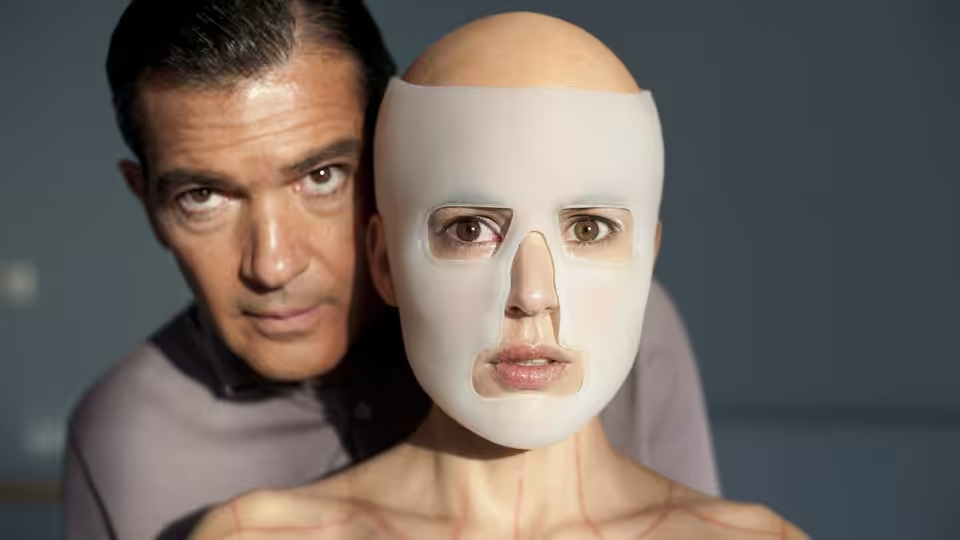
Dr. Robert Ledgard (Antonio Banderas) stands behind a woman wearing a pale face mask
Film review

The Skin I Live In

2011 · Directed by Pedro Almodóvar · 2h 00m

In a sentenceWe would like a second opinion from a doctor with fewer personal interests

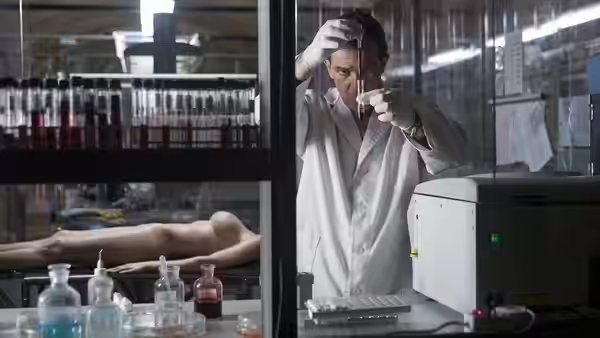
Dr. Robert Ledgard (Antonio Banderas) pursues a surgical experiment whose purpose is bound up with his own obsessions. Vera Cruz (Elena Anaya) is at the centre of the mystery surrounding his work, with Marilia (Marisa Paredes) also part of their story. The nature of the experiment and Vera’s identity remain unclear. Ledgard wants to continue his work, but the relationship between doctor and subject raises questions about control over another person’s body. What begins as a medical mystery draws surgery, confinement and self-deception into the doctor’s private affairs.

Plays from YouTube when you press play; nothing loads from them until then.

Fi1m review

Pedro Almodóvar’s surgical thriller is disturbing, carefully made and held together by Antonio Banderas and Elena Anaya. An overextended flashback costs it momentum, but the performances keep its cruelties from becoming merely clever.

The Skin I Live In is a gripping surgical thriller that loses some force by explaining itself at length. Pedro Almodóvar treats the doctor’s experiment with a seriousness that makes the grotesque premise harder to shrug off. He also allows the melodrama to be melodramatic, which takes nerve when the subject already risks seeming absurd. The combination works because the people involved remain interesting while the plot keeps its information to itself.

Antonio Banderas makes Dr. Robert Ledgard convincing because the performance never begs us to recognise a monster. There is assurance in his manner, and enough charm to make that assurance uncomfortable. The actor’s restraint lets the doctor’s obsession register without making every moment a warning, which is useful in a film already carrying so much mystery. We were unnerved by how readily we accepted his authority: the confidence with which he approaches the experiment makes it harder to dismiss him as merely deranged.

Elena Anaya has the more difficult task as Vera Cruz, since the screenplay withholds so much about her. She gives that uncertainty enough feeling to prevent it becoming merely an invitation to guess. Her performance keeps our attention on the person involved in the experiment, even when the plot encourages us to concentrate on how it all fits together. She makes it possible to care about Vera without knowing everything about her.

José Luis Alcaine makes the surgical imagery disconcertingly attractive. The control of the compositions encourages us to keep looking, rather than granting the easy relief of turning away from something crudely horrible. Antxón Gómez’s production design adds to that discomfort through its richness: these are settings we are invited to enjoy before we consider what happens within them. Paco Delgado’s costumes belong to the same carefully pleasing visual scheme. There is a risk that all this good taste will soften the horror, but for us the temptation to admire the image makes the experience worse.

Alberto Iglesias supplies music with enough force to support the film’s unabashed melodrama. The score can be enjoyed for its own extravagance, but it also helps the film move between dread and something closer to fascination. José Salcedo’s editing is persuasive when the story slips between past and present without stopping to announce how clever it is being. Those changes ask us to reconsider what we think we know, and mostly arrive before curiosity becomes impatience.

The extended flashback is where that patience is tested. Pedro Almodóvar’s screenplay spends too long explaining earlier events, and José Salcedo cannot make the interruption feel as tense as the mystery it interrupts. We do not need every answer quickly, but we do need the telling to retain some pressure of its own. After a while we found ourselves listening chiefly for information. That is a poor use of this cast.

As a mad-doctor film, it places an unusually large burden on the performances. It asks us to believe that someone could carry out this experiment, and that someone else must live with it. The actors make those people credible even when the plotting grows cumbersome. Leave it for a night when being unsettled is part of the plan.
Critical consensus AI synthesised

71
Positive
14
Mixed
7
Negative
1

Most critics respond warmly to The Skin I Live In, praising Almodóvar’s control of a macabre story that moves between melodrama, horror and science fiction. Praise clusters around the striking visuals, the performances of Antonio Banderas and Elena Anaya, and Alberto Iglesias’ score. The more enthusiastic reviews find the carefully paced mysteries gripping and the shifts in tone assured, with disturbing material handled skilfully.

The disagreement concerns how much emotional and psychological depth accompanies that craft. Some find the storytelling intricate and compelling; others consider it convoluted, meandering or insufficiently frightening. The AV Club praises the film’s visual and thematic strengths but finds its drama unsatisfying, particularly an overlong flashback. The Evening Standard offers the clearest dissent, admiring the leads while wanting more depth from the strange plot. The spread is fairly wide, though even the cooler reviews tend to acknowledge the performances and visual achievement.

Empire
15 February 2011 · Kim Newman
80*

Newman finds it macabre, assured filmmaking, though its extreme subject matter and a plot turn may divide viewers. He particularly praises the performances of Antonio Banderas and Elena Anaya.

Read the full review →
Little White Lies
25 August 2011 · ★★★★ · Adam Woodward
80

The critic calls the film a confident, sinister achievement from an auteur at the top of his game. He praises its intricate plot and controlled shifts between genres, noting its unsettling material is handled with acute tact.

Read the full review →
Radio Times
★★★★ · Trevor Johnston
80

Johnston praises Almodóvar’s distinctive take on mad-doctor horror. He singles out the film’s carefully sustained mysteries around Vera and the doctor’s experiment.

Read the full review →
The Guardian
19 May 2011 · festival review · Peter Bradshaw
80*

Bradshaw finds the film gripping, bizarre and compelling despite its familiar Almodóvar motifs. He praises the director’s hypnotic, elegantly choreographed handling of its surgical-obsession imagery.

Read the full review →
Time Out
22 August 2011 · ★★★★ · Dave Calhoun
80

The review praises Almodóvar’s genius for turning the ridiculous into the sublime. It describes the film as a creepy, sombre melodramatic thriller.

Read the full review →
Total Film
9 August 2011 · ★★★★ · Jamie Graham
80

Graham finds the film a finely executed, vigorous and unsettling tale, though it lacks the clinical horror or soul-shaking dread of some comparable directors. He praises the vivid visuals, Almodóvar’s anarchic energy, and the performances of Antonio Banderas and Elena Anaya.

Read the full review →

Straight answers AI written, from our review

Is The Skin I Live In worth watching?
The Skin I Live In is worth watching for its disturbing surgical mystery and convincing performances from Antonio Banderas and Elena Anaya; we score it 80 out of 100. An overextended flashback slows the telling, but we recommend it for a night when being unsettled is part of the plan.

How long is The Skin I Live In, and what is it rated?
The Skin I Live In runs 2h 00m. It is a drama and horror film.
Where can I watch The Skin I Live In in Colombia?
The Skin I Live In is not on any streaming or rental service in Colombia at the moment. It is available in 7 other countries; change your country at the top of the page to see where. Availability is checked daily.
How violent or frightening is The Skin I Live In, and is it suitable for children?
The Skin I Live In has a UK 15 certificate and is unsuitable for children, with disturbing surgical imagery, confinement and a doctor’s control over another person’s body central to its horror. We find the doctor’s calm authority particularly unnerving; the carefully attractive images offer little reassurance for squeamish viewers or anyone seeking mild scares.
How does The Skin I Live In compare to Eyes Without a Face?
The Skin I Live In shares the surgical obsession, physical vulnerability and unnerving composure of Eyes Without a Face, but places more emphasis on elaborate mystery and extravagant melodrama. We recommend both with pacing reservations: Eyes Without a Face suits a preference for frightening sadness, while The Skin I Live In offers a more involved puzzle whose explanations sometimes stall it.
Is The Skin I Live In based on a true story or a book?
The Skin I Live In is adapted from a novel by Thierry Jonquet, rather than based on a true story. We recommend approaching the film without advance knowledge of its central mystery: the performances make the people compelling while the screenplay keeps the experiment’s purpose and Vera’s identity unclear.
What should I watch after The Skin I Live In?
After The Skin I Live In, try Eyes Without a Face (1960, Fi1m 86): Surgical obsession and physical vulnerability, handled with a similarly unnerving composure. Then Dead Ringers (1988, Fi1m 87): Medical authority becomes deeply suspect, with performances that make the unease personal; and Seconds (1966, Fi1m 84): A different surgical nightmare about the cost of becoming somebody else.

Cast

Awards

BAFTA Film Awards, 2012

Won
Best Film Not in the English Language

Goya Award for Best Actor, 2012

Nominated
Goya Award for Best Actor

Goya Award for Best Actress, 2012

Won
Goya Award for Best Actress

Goya Award for Best Adapted Screenplay, 2012

Nominated
Goya Award for Best Adapted Screenplay

Goya Award for Best Art Direction, 2012

Nominated
Goya Award for Best Art Direction

Goya Award for Best Cinematography, 2012

Nominated
Goya Award for Best Cinematography

Goya Award for Best Costume Design, 2012

Nominated
Goya Award for Best Costume Design

Goya Award for Best Director, 2012

Nominated
Goya Award for Best Director

Goya Award for Best Editing, 2012

Nominated
Goya Award for Best Editing

Goya Award for Best Film, 2012

Nominated
Goya Award for Best Film

Goya Award for Best Makeup and Hairstyles, 2012

Won
Goya Award for Best Makeup and Hairstyles

Goya Award for Best New Actor, 2012

Won
Goya Award for Best New Actor

Goya Award for Best New Actress, 2012

Nominated
Goya Award for Best New Actress

Goya Award for Best Original Score, 2012

Won
Goya Award for Best Original Score

Goya Award for Best Production Supervision, 2012

Nominated
Goya Award for Best Production Supervision

Goya Award for Best Sound, 2012

Nominated
Goya Award for Best Sound

Goya Award for Best Special Effects, 2012

Nominated
Goya Award for Best Special Effects

BIFA for Best Foreign Independent Film, 2011

Nominated
BIFA for Best Foreign Independent Film

Broadcast Film Critics Association Award for Best Foreign Language Film, 2011

Nominated
Broadcast Film Critics Association Award for Best Foreign Language Film

European Film Award for Best Composer, 2011

Nominated
European Film Award for Best Composer

European Film Award for Best Production Designer, 2011

Nominated
European Film Award for Best Production Designer

Golden Globes, 2011

Nominated
Best Non-English Language Film

Saturn Awards, 2011

Won
Best International Film

If you liked this, try…

  1. Eyes Without a Face (1960, Fi1m 86)Surgical obsession and physical vulnerability, handled with a similarly unnerving composure.

  2. Dead Ringers (1988, Fi1m 87)Medical authority becomes deeply suspect, with performances that make the unease personal.

  3. Seconds (1966, Fi1m 84)A different surgical nightmare about the cost of becoming somebody else.

  4. Phoenix (2014, Fi1m 68)A changed face makes recognition and trust painfully difficult to separate.

  5. The Handmaiden (2016, Fi1m 85)Confinement, desire and withheld knowledge sustain another carefully controlled, disreputable thriller.