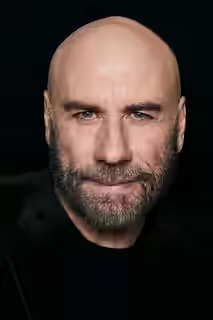
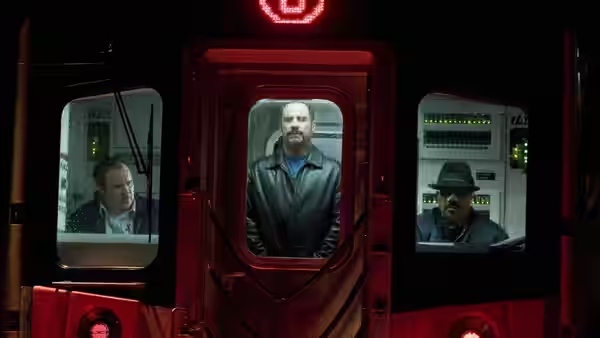
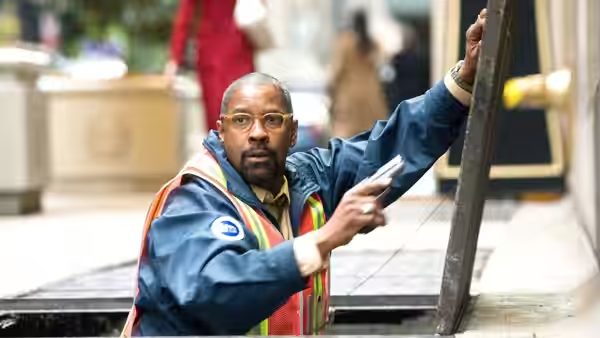
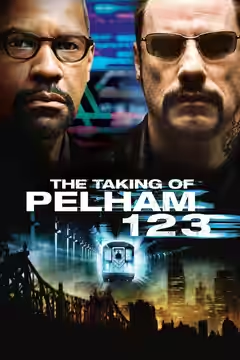
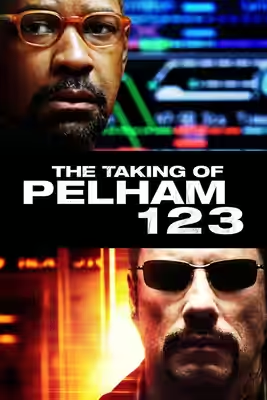
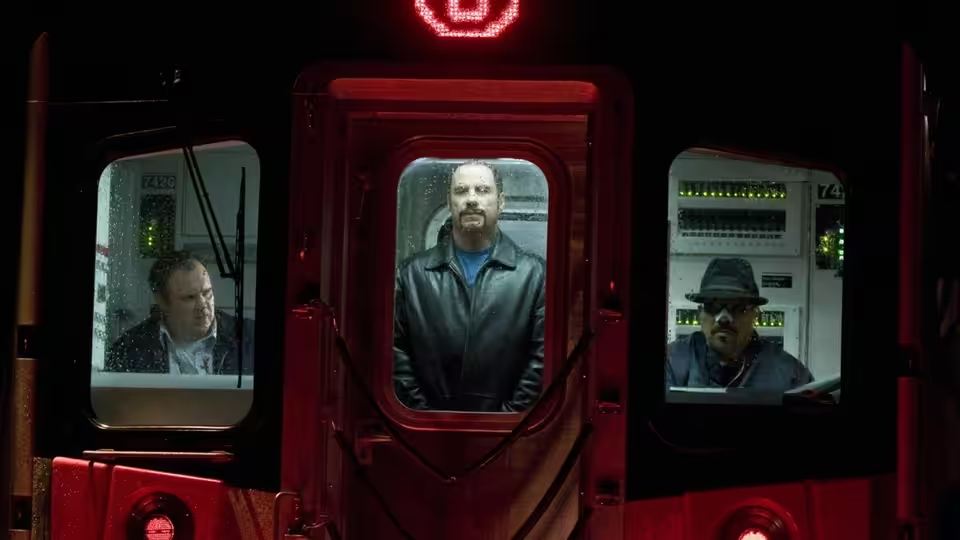
Ryder (John Travolta) stands in a subway car doorway between two seated men
Film review

The Taking of Pelham 1 2 3

2009 · Directed by Tony Scott · 1h 46m · BG C

In a sentenceTravolta shouts, Washington murmurs, and the camera has had more coffee than either of them

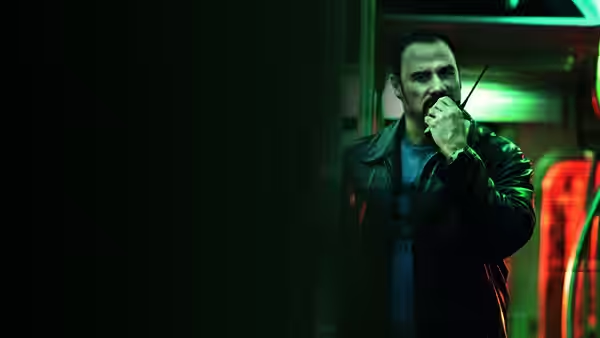
New York. On the day Walter Garber (Denzel Washington) has been demoted from management to the dispatch desk at the subway’s Rail Control Center, pending an investigation he would rather not discuss, a man calling himself Ryder (John Travolta) and three armed accomplices board the train that left Pelham Bay Park at 1.23, uncouple the front car and stop it in a tunnel under Manhattan. Ryder gets Garber on the radio and refuses to speak to anyone else, including the police negotiator, Lt. Camonetti (John Turturro). He wants ten million dollars inside an hour, and he will shoot a passenger for every minute the city is late. The mayor (James Gandolfini) has to decide whether to pay, while Garber, who wants only to keep his job and get home, finds he is the one voice Ryder will listen to.

Plays from YouTube when you press play; nothing loads from them until then.

Fi1m review

Washington and Travolta talk each other down a radio line for most of a hundred minutes and are worth hearing. Tony Scott, though, will not let a shot sit still long enough to listen, and a plain, good hostage picture is buried under the commotion.

Tony Scott’s remake of the 1974 hijack picture is a two-hander conducted down a radio line, and the idea is sound. Brian Helgeland’s screenplay, from John Godey’s novel, puts Walter Garber (Denzel Washington) at a console in the subway’s control centre and Ryder (John Travolta) in a stalled carriage under the city, and lets them talk. Garber has just been demoted and is waiting to hear whether he keeps his job. Ryder has a gun, a carriage of passengers and a clock. For an hour neither man can see the other, and the best of the film is the sound of two voices working each other out.

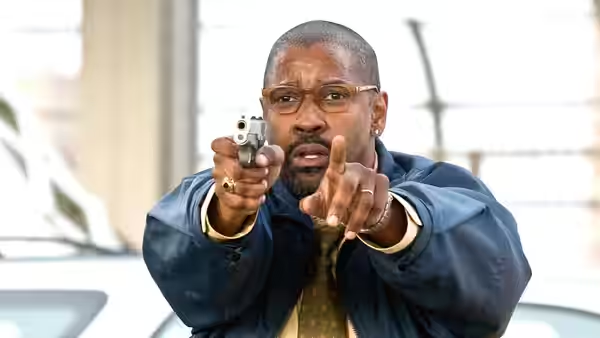
Washington plays Garber as a man in a cardigan with a moustache and a lot on his mind, and he does almost nothing, which is the point. Renee Ehrlich Kalfus dresses him like a middle manager and Washington lets the clothes do the work: he hunches, he turns a pen over, he answers Ryder in the flat, polite voice of someone who has spent years talking motormen through signal failures. It is one of his quietest performances, and the film is at its best when Scott remembers to leave the camera on him and let him listen.

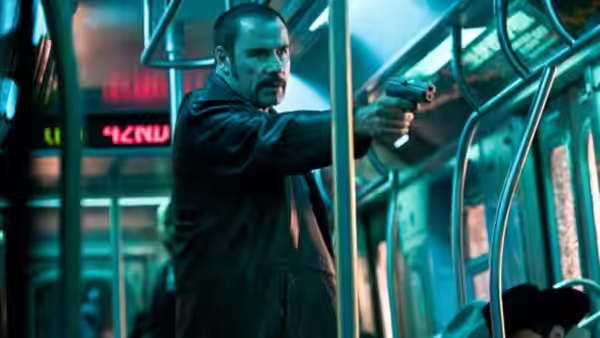
Travolta is louder. He has a goatee, a neck tattoo and a vocabulary that earns the 15 certificate on its own, and he plays Ryder as a man who enjoys the sound of his own grievances. Some of it is fun. The scenes in which he needles Garber about his pay grade, or demands to know what a New Yorker’s life is worth to the second, have a nasty wit that Helgeland writes well. But the performance has one volume, and by the halfway mark we found ourselves hoping he would run out of things to say.

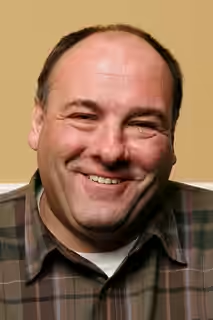
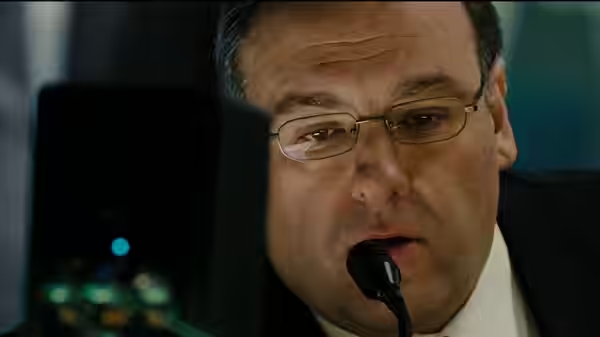
The supporting cast fare better than the noise around them suggests. James Gandolfini plays the mayor as a tired man in a bad week, more worried about the papers than the passengers until the moment he is not, and he gets most of the laughs. John Turturro is the negotiator, Lt. Camonetti, pushed aside when Ryder refuses to speak to anyone but Garber, and Turturro plays a professional’s humiliation with real care. Luis Guzmán, as Ryder’s man Phil Ramos, is given a hooded top and a handful of lines and makes a person out of them.

The trouble is Scott. Tobias A. Schliessler shoots a stationary train as if it were a getaway car: the frame rate stutters, the image smears, the camera swoops over Manhattan from a helicopter whenever a scene threatens to settle, and Chris Lebenzon cuts a conversation between two seated men as though they were trading punches. Harry Gregson-Williams’s score thuds underneath, mostly drums and treated electronics, and does not let up. Chris Seagers has built a control centre that is all glowing track maps and dim consoles, and we saw a good deal of it in the few frames per cut Scott allows.

We were irritated, and then we were bored, and the moment we can name is the money run. The ransom has to cross the city in an hour, and Scott stages it as a convoy of police cars and motorcycle outriders taking corners at speed, with the crash at an intersection you can see coming three blocks off. It is competently shot and it has nothing to do with anything. The film about two voices has become a film about traffic, and the last act, which we will not describe, carries on in that direction with guns and running and a finale any thriller could have had.

Scott and Washington have worked together before, and Crimson Tide (1995) showed how good Scott could be when he locked two men in a confined space and trusted the argument. Here he has the same set-up and does not trust it. Joseph Sargent’s original let Walter Matthau and Robert Shaw be dry and patient; this version cannot be patient about anything, and it ends up a film about a stopped train that will not stop moving.

Most critics have landed between mixed and poor, and we are not far from them. If you are in the mood for Washington being decent under pressure and Gandolfini being funny about it, there is an evening here. If you want a hostage thriller that trusts its radio, the 1974 film remains the one to see, and it has the good manners to sit still.
Critical consensus AI synthesised

48
Positive
2
Mixed
5
Negative
7

The reviews lean negative, with seven of fourteen unfavourable and only two clearly recommending it. Where praise comes, it comes for the two leads: most critics enjoy watching Denzel Washington’s restrained performance set against John Travolta’s manic one, and several say the cat-and-mouse exchanges between them are the one thing holding the film together. The supporting cast is noticed too, with John Turturro and James Gandolfini each singled out.

The reservations cluster almost entirely on Tony Scott’s direction. Critic after critic faults the frantic editing, restless camerawork and visual tricks, which several say drain tension from the climactic chase rather than add to it. The spread is wide: the kinder reviews call it solid, dumb summer fun, while the harshest find it a pointless and sensationalist remake that compares badly with the original. Empire goes further than most in finding Travolta’s villain erratic and unconvincing, where others count his mania as a plus.

Los Angeles Times
25 June 2009 · Kenneth Turan
75*

Turan gives the film a clearly positive verdict, saying it is worth seeing in theaters. He praises its professional execution and gripping action, which keep viewers’ attention.

Read the full review →
Variety
4 June 2009 · Todd McCarthy
75*

McCarthy finds the remake an efficient, exciting thriller, though Scott’s visual tricks weaken the climactic chase. He praises the chemistry between Washington’s restrained performance and Travolta’s increasingly engaging turn.

Read the full review →
Screen Daily
8 June 2009 · Brent Simon
64*

The review's verdict is not visible in the accessible page. Its specific praise or criticism is also unavailable.

Read the full review →
The Hollywood Reporter
4 June 2009 · The Associated Press
60*

The critic finds the film entertaining but less transporting than it should be, with its momentum faltering in the third act. They praise the Washington–Travolta pairing and the supporting cast, especially the leads’ game of cat and mouse.

Read the full review →
Time Out
28 July 2009 · ★★ · Tom Huddleston
40

The review gives the film a negative verdict, calling the remake pointless. It singles out the remake’s lack of justification as its central complaint.

Read the full review →
Slant Magazine
9 June 2009 · ★½/4 · Nick Schager
38

Schager finds the film an overblown, ultimately unthrilling remake with more visual commotion than substance. He praises John Travolta’s manic performance, while faulting Tony Scott’s excessive stylistic flourishes and the film’s silly plotting.

Read the full review →

Straight answers AI written, from our review

Is The Taking of Pelham 1 2 3 worth watching?
The Taking of Pelham 1 2 3 is a mixed evening, and we scored it 54. Denzel Washington's quiet dispatcher and James Gandolfini's tired mayor are worth hearing, but Tony Scott cuts and swoops so restlessly that a plain hostage picture is buried under the commotion. Watch it for Washington, not for the thriller around him.
How long is The Taking of Pelham 1 2 3, and what is it rated?
The Taking of Pelham 1 2 3 runs 1h 46m and is rated C by the BG in Bulgaria. It is a crime and thriller film.
Where can I watch The Taking of Pelham 1 2 3 in Bulgaria?
The Taking of Pelham 1 2 3 is available to rent from Apple TV and Amazon Prime Video from лв 1.99. Availability is checked daily; the links above go straight to each service.
How violent or frightening is The Taking of Pelham 1 2 3, and is it suitable for children?
The Taking of Pelham 1 2 3 is a UK 15, and it is not for children. Ryder shoots hostages when the city runs late, Travolta's vocabulary alone earns the certificate, and the last act turns to guns and running. Older teenagers used to crime thrillers will manage; the squeamish will find the threats to passengers more upsetting than the violence shown.
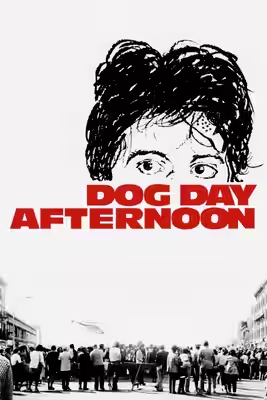
How does The Taking of Pelham 1 2 3 compare to Dog Day Afternoon?
The Taking of Pelham 1 2 3 and Dog Day Afternoon are both New York hostage crises built on talk, and Lumet's is the better film by a distance. Lumet lets the sweat and the argument do the work, where Scott will not hold a shot long enough to listen. Choose the earlier film unless you specifically want Washington and Travolta trading insults down a radio.
Is The Taking of Pelham 1 2 3 based on a true story or a book?
The Taking of Pelham 1 2 3 is based on John Godey's novel, not on a true story, and it is a remake of Joseph Sargent's 1974 film of the same book. Brian Helgeland's screenplay keeps the two-hander on the radio line. You need not know the novel, though we think the 1974 version is the one worth seeing first.

Cast

If you liked this, try…

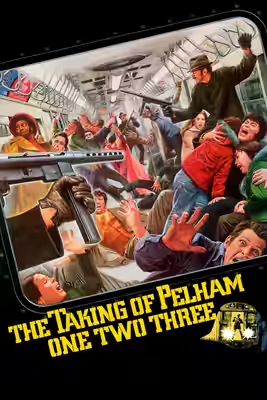
  1. The Taking of Pelham One Two Three (1974) · not reviewed yetThe original: Matthau and Shaw, same tunnel, half the volume, twice the nerve.

  2. Dog Day Afternoon (1975, Fi1m 90)A New York hostage crisis that lets the sweat and the talk do the work.

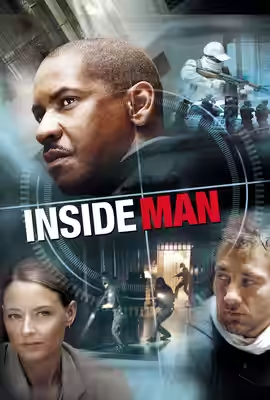
  3. Inside Man (2006) · not reviewed yetWashington as a negotiator again, in a bank siege that enjoys being clever.

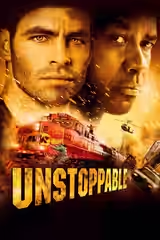
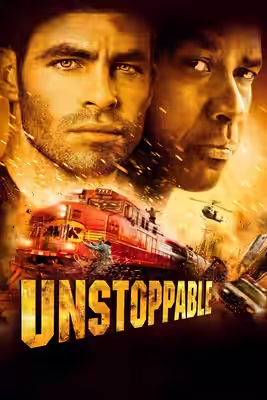
  4. Unstoppable (2010) · not reviewed yetScott and Washington on a runaway train, where the restless camera finally earns its keep.

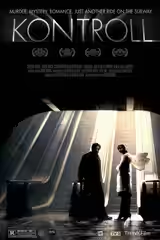
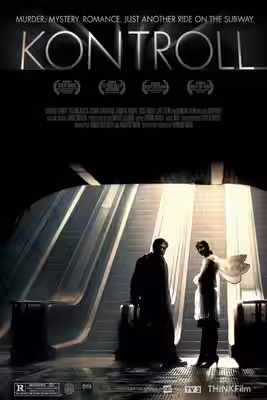
  5. Kontroll (2003) · not reviewed yetHungarian ticket inspectors in the Budapest metro; stranger, funnier and far cheaper.

Free account

Know what to watch tonight

Two lists that know where things are streaming, collections you can share, your own score beside ours, and Discover that remembers what you have seen.

  • Want to see, sorted by what is streaming now
  • Seen, with your score out of ten
  • No adverts, ever