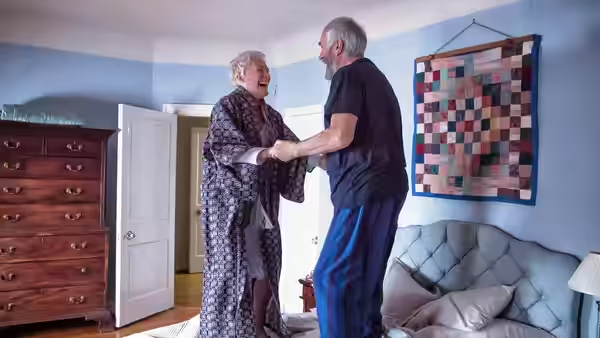
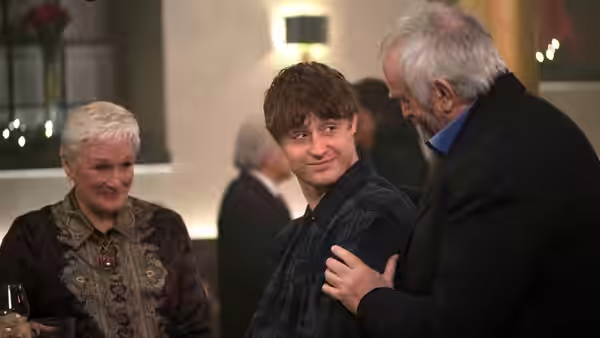
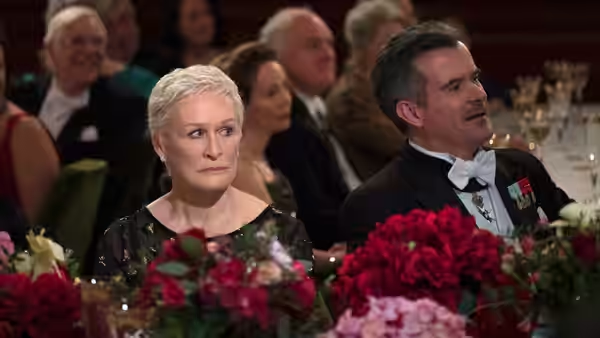
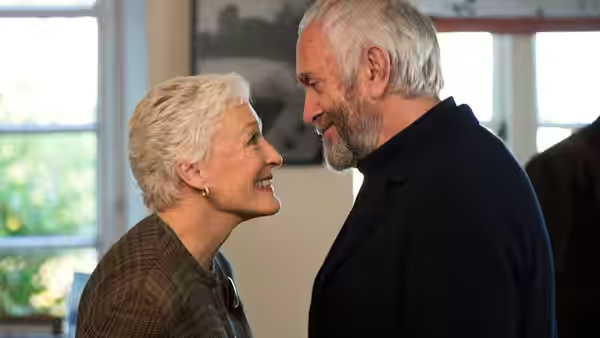
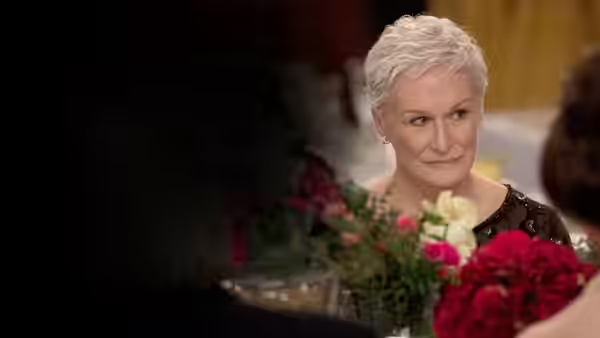
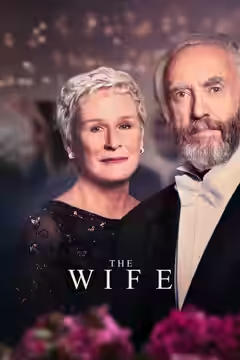
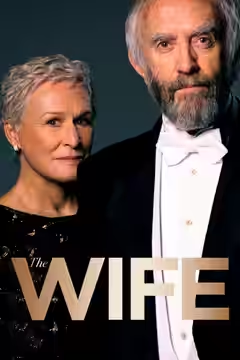
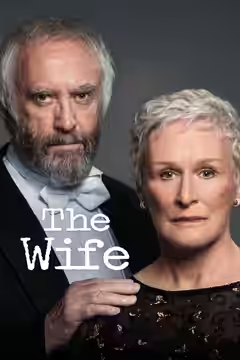
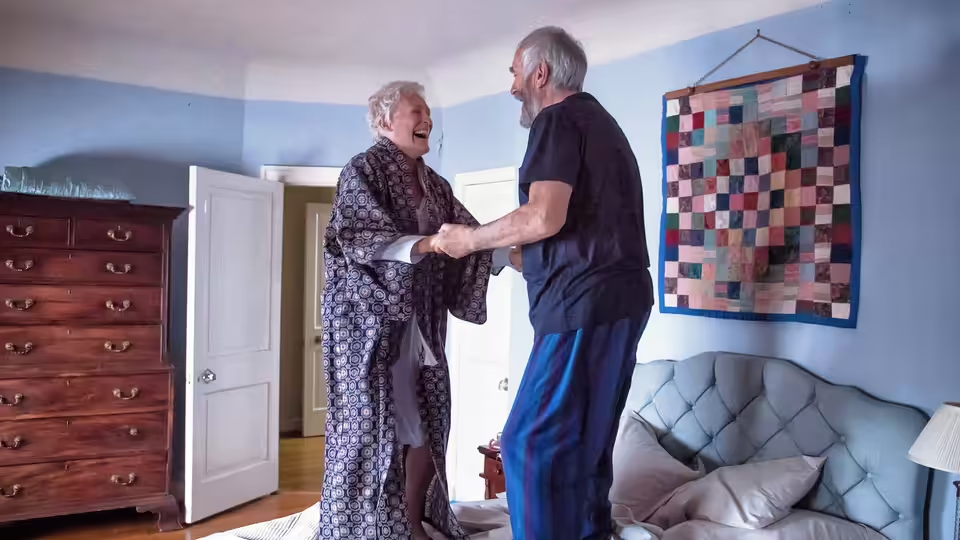
Joan Castleman (Glenn Close) and Joe Castleman (Jonathan Pryce) hold hands in their bedroom
Film review

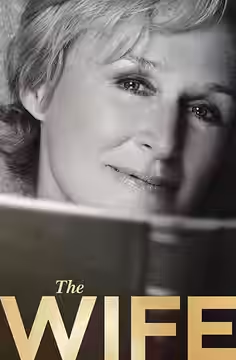
The Wife

2017 · Directed by Björn Runge · 1h 40m

In a sentenceGlenn Close makes listening to a husband look like a job with no annual leave

Joan Castleman (Glenn Close) faces renewed attention to her marriage as the success of her husband, Joe Castleman (Jonathan Pryce), brings their shared past into question. She tries to sustain the loyalty on which their partnership depends, while his need for recognition makes her position harder to maintain. Nathaniel Bone (Christian Slater), a biographer pursuing the couple’s story, gives that private strain an unwelcome audience. Between the public celebration of Joe and Nathaniel’s questions, Joan must decide how much of their life she is prepared to discuss, and on whose terms.

Plays from YouTube when you press play; nothing loads from them until then.

Fi1m review

The Wife is a good marriage drama with a familiar script and two actors worth watching closely. Glenn Close and Jonathan Pryce make the relationship convincing even when the film insists on explaining too much.

Björn Runge’s The Wife is a good marriage drama, made absorbing by two actors who suggest years of difficult accommodation. Joan Castleman has to contend with the success and neediness of her husband, Joe Castleman, and the strain is becoming harder to contain. Glenn Close and Jonathan Pryce make that relationship convincing without making it comfortable. The writing is familiar, but the attention paid to the wife beside the celebrated man gives us a reason to stay.

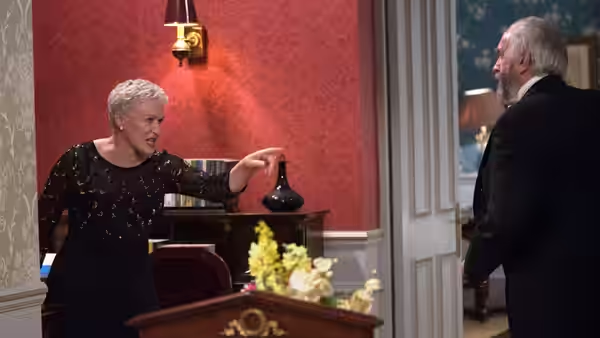
Close gives Joan a watchfulness that makes us keep checking her face, even when someone else is speaking. A small change of expression can suggest irritation, then leave us unsure how much anger sits beneath it. We felt uneasy watching her listen to Pryce, because that careful attention begins to look like work she cannot put down. Close also allows room for loyalty, which prevents Joan becoming merely an example of a woman badly treated. She makes the character’s choices worth considering even when we wish she would choose differently.

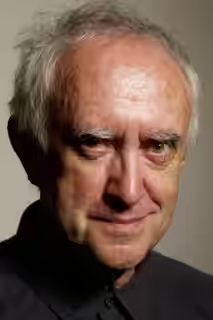
Pryce helps by making Joe needy as well as accustomed to attention. His dependence on Joan is convincing enough to complicate our impatience with him. Their shared scenes allow affection to persist alongside resentment, so there is something at stake beyond deciding who is right. Christian Slater’s Nathaniel Bone, pursuing the couple’s story, introduces a different pressure: somebody wants their private history put into words. Slater gives the intrusion a welcome sharpness.

Ulf Brantås’s cinematography gives Close’s small reactions enough attention to make them count. Mark Leese’s production design remains discreet, keeping the people more interesting than their surroundings, which suits this intimate drama. Jocelyn Pook’s music is less persuasive than the pauses between the actors, where we have time to wonder what Joan might say next. Runge’s patient approach works best when he leaves us to study her rather than pushing for a stronger response.

The trouble is Jane Anderson’s screenplay, adapted from a novel by Meg Wolitzer, which is too ready to explain what Close has already suggested. The flashbacks make the marriage easier to read, but they also interrupt the more absorbing business of watching the older couple together. Lena Dahlberg-Runge’s editing cannot quite make those returns to the past feel necessary at each point they appear. Our curiosity slackens because the film begins supplying answers too neatly. The actors have made us interested enough to tolerate uncertainty.

As a marriage drama, it understands how much can remain unsettled between people who know each other well. Loyalty need not settle a grievance, and affection does not make an unequal partnership fair. Close and Pryce keep those difficulties present without asking us to decide which spouse deserves our sympathy in every scene. That gives the film a useful awkwardness, even when the script is too keen to settle things for us.

At 100 minutes, this is a manageable commitment, though it rewards close attention more than the urge to anticipate what comes next. There is enough in the performances to keep a conversation going afterwards, particularly about the compromises Joan appears willing to make. Choose it for an evening when a difficult marriage is more appealing than an elaborate plot.
Critical consensus AI synthesised

72
Positive
17
Mixed
3
Negative
1

Most critics find The Wife absorbing, with praise concentrated on Glenn Close’s restrained performance as Joan. The reviews repeatedly single out her small changes of expression and quiet reactions, which convey resentment, loyalty and strength without spelling everything out. Jonathan Pryce also earns praise, particularly for the convincing sense of accumulated affection and friction between the couple; for many critics, their scenes together give a familiar marriage drama its emotional force.

The disagreement concerns how well the writing and direction support that acting. Reservations cluster around predictable revelations, obvious or sluggish flashbacks and a conclusion that some find overstretched or unconvincing. Most reviews remain positive despite those weaknesses, but Slant Magazine offers a sharper dissent, arguing that conventional morality and unnecessary subplots weaken the central drama. Even that review praises Close, making her performance the clearest point of agreement across an otherwise fairly broad spread of responses.

The Guardian
12 September 2017 · festival review · Peter Bradshaw
85*

Bradshaw finds the film smart, entertaining and supremely watchable. He especially praises Glenn Close’s subtle, controlled performance as Joan.

Read the full review →
Vulture
16 August 2018 · Emily Yoshida
85*

The critic finds the marriage drama wrenching and says its climactic revelations feel earned. She singles out Glenn Close’s exquisitely realized performance and the lived-in chemistry between Close and Jonathan Pryce.

Read the full review →
Evening Standard
28 September 2018 · ★★★★ · Matthew Norman
80

Norman praises the film as a showcase for Glenn Close, while finding its climax overlong and too predictable. He singles out Close’s precise, expressive performance as the film’s overwhelming strength.

Read the full review →
Little White Lies
27 September 2018 · 3/4/4 · Manuela Lazic
80

Lazic praises the film as an intelligent drama that respects its disempowered heroine. She singles out Glenn Close’s enigmatic performance and the layered portrayal of Joan’s strength and choices.

Read the full review →
Time Out
18 August 2018 · ★★★★ · Anna Smith
80

Smith finds the film absorbing, praising Glenn Close’s performance as the titular wife. She highlights the marriage’s pressures of fame, neediness and revenge.

Read the full review →
Empire
24 September 2018 · David Hughes
75*

The review is positive, finding the film gripping when its lead actors share the screen. It singles out Glenn Close and Jonathan Pryce’s performances for praise, while noting that the flashbacks lose energy.

Read the full review →

Straight answers AI written, from our review

Is The Wife worth watching?
The Wife is worth watching for Glenn Close and Jonathan Pryce’s convincing portrayal of a difficult marriage, and we score it 74 out of 100. We recommend it for an evening of closely observed acting, with the caveat that the familiar screenplay and explanatory flashbacks sometimes interrupt the more absorbing exchanges between the couple.
How long is The Wife, and what is it rated?
The Wife runs 1h 40m. It is a drama film.
Where can I watch The Wife in France?
The Wife is available to rent from Amazon Prime Video and Apple TV from €2.99. Availability is checked daily; the links above go straight to each service.
How violent or frightening is The Wife, and is it suitable for children?
The Wife carries a UK 15 certificate, making it unsuitable for children under 15 rather than a family viewing choice. We find its marital strain uneasy to watch, particularly Joan’s careful attention to her needy husband, but that emotional discomfort does not establish how much violence or frightening material it contains; the certificate remains the useful age guide.
How does The Wife compare to 45 Years?
The Wife is a good companion to 45 Years, though we give the latter the edge for its painfully convincing marriage and greater trust in small reactions. Both reward attention to pauses and glances, and both explain more than they need to; choose The Wife particularly for Close and Pryce’s mixture of affection, resentment and dependence.
Is The Wife based on a true story or a book?
The Wife is adapted by Jane Anderson from a novel by Meg Wolitzer, rather than presented as a true-story drama. No familiarity with the book is needed: we find the screenplay explains the couple’s shared past rather too readily through flashbacks, although that tells us nothing about how faithfully it follows the novel.
What should I watch after The Wife?
After The Wife, try 45 Years (2015, Fi1m 88): Another marriage made troubling through pauses, glances and things left unsaid. Then The Heiress (1949, Fi1m 90): For another closely observed woman discovering the limits of other people’s affection; and A Separation (2011, Fi1m 93): A marriage under pressure, with sympathy that refuses to stay comfortably put.

Cast

If you liked this, try…

  1. 45 Years (2015, Fi1m 88)Another marriage made troubling through pauses, glances and things left unsaid.

  2. The Heiress (1949, Fi1m 90)For another closely observed woman discovering the limits of other people’s affection.

  3. A Separation (2011, Fi1m 93)A marriage under pressure, with sympathy that refuses to stay comfortably put.

  4. The Assistant (2019, Fi1m 81)Quietly furious about the work women do to protect powerful men.

  5. An Autumn Afternoon (1962, Fi1m 86)A patient domestic drama about duty, habit and the cost of accommodation.