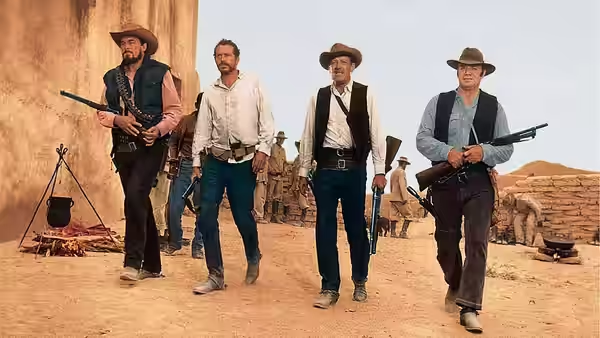
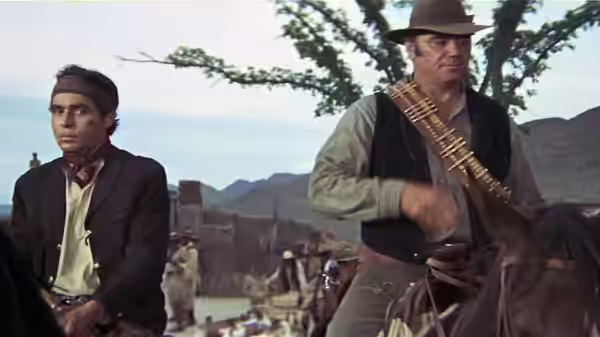
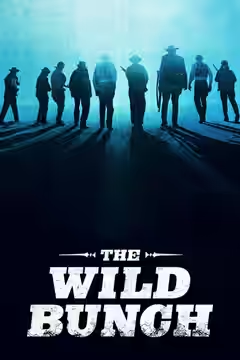
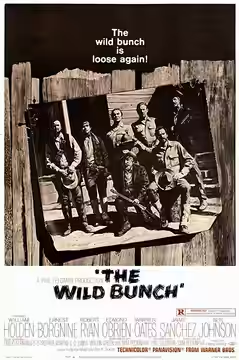
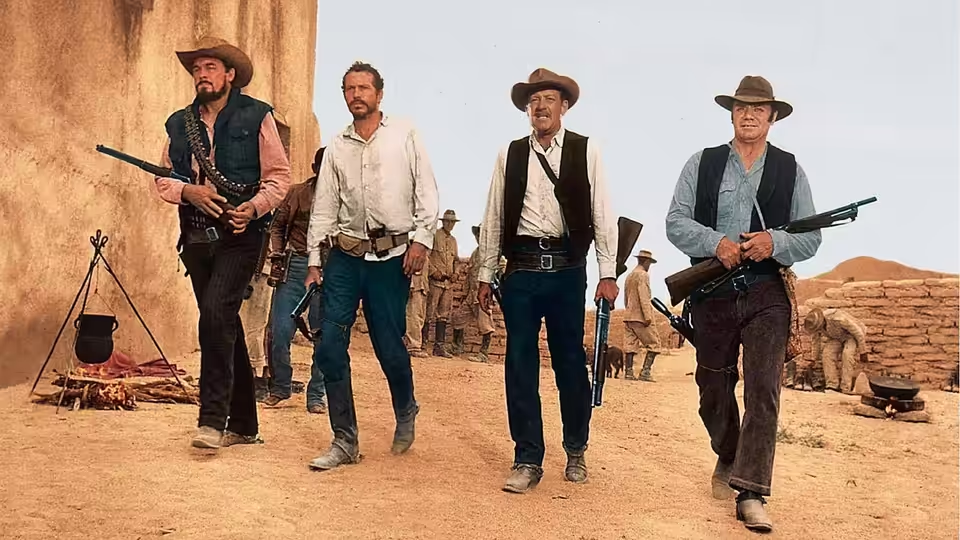
Pike Bishop and three armed men walk through a dusty settlement
Film review

The Wild Bunch

1969 · Directed by Sam Peckinpah · 2h 25m · NMHH 18

In a sentenceWilliam Holden makes outlaw loyalty look like a job with no days off

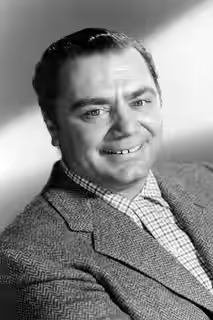
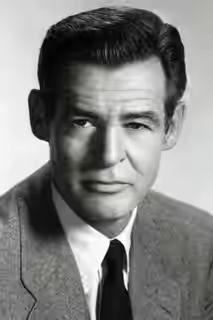
Children torment a scorpion as the story opens. Pike Bishop (William Holden) is an outlaw whose life is bound up with the men around him and the loyalties they share. Dutch Engstrom (Ernest Borgnine) and Deke Thornton (Robert Ryan) belong to the same changing land, where old friendships carry obligations. The gang holds to its way of living, with violence making its loyalty dangerous to people outside the group. Pike’s attachment to his companions complicates the question of what he owes them, and what their friendship can excuse.

Plays from YouTube when you press play; nothing loads from them until then.

Fi1m review

Sam Peckinpah’s Western is gripping, sad and troubling, with William Holden giving its outlaw loyalties real weight. The wandering first half and thinly written women matter, but the performances and force of the action make it worth the discomfort.

Sam Peckinpah’s The Wild Bunch is a gripping Western, with more feeling for its outlaws than we may be comfortable sharing. We recommend it, with a serious reservation about how little interest it takes in women. Its concern with loyalty is searching: men can care deeply about their friends and still do terrible things. William Holden makes Pike Bishop someone whose company we want, even when there is good reason to keep our distance.

We were horrified by the opening image of children tormenting a scorpion. The cruelty is small enough to be treated as play, and that is what makes it so unpleasant. Lucien Ballard’s cinematography gives the incident a disturbing prominence: a Western has barely begun and already we are watching people enjoy another creature’s suffering. It is a blunt way to start, but an effective warning against getting too comfortable with the men who follow.

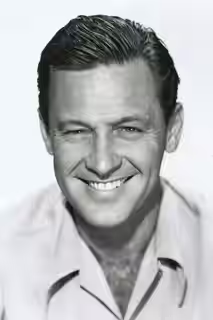
William Holden is the chief reason the film’s sadness survives its appetite for violence. His unhurried delivery gives Pike an appeal that a more openly pleading performance would lose. He lets us find the man’s humanity without insisting that we forgive him, and the restraint is moving. Ernest Borgnine plays Dutch Engstrom and Robert Ryan plays Deke Thornton, providing performances strong enough to keep this from becoming a film carried by one actor. The old friendships feel lived with, and the humour helps make the men’s attachment to one another credible.

The action is gripping, and the unease comes partly from how much pleasure there is in its force. Lou Lombardo’s editing gives the violence urgency, though accomplished cutting cannot settle the problem of making brutality exciting. The director’s attraction to the spectacle sometimes makes his concern for suffering harder to believe, and the film does not always seem aware of the difficulty. Jerry Fielding’s music adds pressure, with sound and cutting making the action hard to resist even when resistance seems the appropriate response.

The weaker stretches belong to the writing. Sam Peckinpah and Walon Green allow the first half to wander, and at 145 minutes the film asks for more patience than every detour deserves. Time spent with these men helps make their attachments believable, but there are passages where another stretch in their company tells us little we have not already understood. A firmer edit could have kept that familiarity without making the story wait quite so long.

The treatment of women is a more serious failure. The men are granted complicated feelings about loyalty, violence and one another, while the women get too little room to become equally interesting people. Calling this a film about a male gang does not excuse the narrowness, especially when the director asks us to take his account of human cruelty seriously. The screenplay is much readier to understand some people than others, and we should not mistake that for an unavoidable feature of the Western.

Within the genre, The Wild Bunch is persuasive about why men might remain loyal to companions who scarcely deserve it. The performances make that attachment credible enough to trouble us, rather than leaving it as a code of honour we are expected to applaud. Its patience with the gang produces much of its feeling, even if we sometimes wish the writing would question them more closely. Choose it for William Holden and the uneasy closeness of these friendships; leave room afterwards to disagree about how much of their violence the film enjoys.
Critical consensus AI synthesised

74
Positive
6
Mixed
5
Negative
0

Most critics respond warmly to The Wild Bunch, with praise clustering around Peckinpah’s forceful direction, the action sequences and the performances. Holden draws particular appreciation for bringing humanity, restraint and sadness to Pike Bishop. The favourable reviews find more than technical skill in the violence: they describe a film concerned with loyalty, ageing friendships and a changing world, whose humour and tenderness complicate its brutality.

The reservations concern its treatment of women, its apparent celebration of violence and moments when its energy threatens coherence. Variety offers the clearest mixed assessment, finding the film overlong and its first half digressive, while still admiring the direction and later action. The supplied scores range from mixed to enthusiastic, with none negative, but four entries lack enough accessible review text to establish their reasoning. The documented disagreement centres on how far the craft and emotional weight answer those objections.

Radio Times
★★★★★ · Tom Hutchinson
100

Hutchinson calls it one of the greatest westerns ever made, while acknowledging the controversy around its violence and portrayal of outlaws. He praises William Holden’s laconic, romantic performance as Pike Bishop.

Read the full review →
Empire
1 January 2000 · John Naughton
85*

The critic praises the film as a beautiful, poignant epic. They single out the superb performances and Peckinpah’s technical command of the set-pieces.

Read the full review →
Los Angeles Times
26 February 1995 · Kenneth Turan
85*

Turan argues that the film’s greatness extends well beyond its once-controversial violence. He singles out Peckinpah’s filmmaking craft, the performances, and the restored scenes’ emotional impact.

Read the full review →
The Independent
18 June 2005 · David Thomson
85*

Thomson finds the film irresistible: a beautiful, sad, and funny meditation on fatalism and a changing world. He especially praises its nuanced portrayal of loyalty and old friendships, while noting its troubling depiction of women and its celebration of violence.

Read the full review →
The New Yorker
75*

The critic finds the film a powerful, ambivalent poem of violence, though it teeters on the edge of incoherence. They praise Peckinpah’s filmmaking energy and the mythic life he gives the gang.

Read the full review →
Film Comment
· William Pechter
65*

The issue listing identifies William Pechter's piece as a review of The Wild Bunch. The review text is unavailable here, so its verdict and specific praise or criticism cannot be determined.

Read the full review →

Straight answers AI written, from our review

Is The Wild Bunch worth watching?
The Wild Bunch is worth watching for William Holden’s performance and its troubling account of outlaw loyalty; we score it 84. We recommend it to Western viewers willing to sit with uncomfortable violence, though the wandering first half tests patience and the thinly written women are a serious weakness.
How long is The Wild Bunch, and what is it rated?
The Wild Bunch runs 2h 25m and is rated 18 by the NMHH in Hungary. It is a western film.
Where can I watch The Wild Bunch in Hungary?
The Wild Bunch is not on any streaming or rental service in Hungary at the moment. It is available in 4 other countries; change your country at the top of the page to see where. Availability is checked daily.
How violent or frightening is The Wild Bunch, and is it suitable for children?
The Wild Bunch carries a UK 18 certificate and is not suitable for children: its violence is forceful, exciting and troubling. We find the opening image of children tormenting a scorpion particularly upsetting because they treat cruelty as play. Squeamish viewers should approach with caution.
How does The Wild Bunch compare to The Treasure of the Sierra Madre?
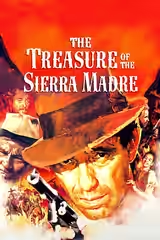
The Wild Bunch and The Treasure of the Sierra Madre both earn our recommendation, but the former examines dangerous loyalty while the latter follows companionship giving way to suspicion. We favour The Wild Bunch for the sadness Holden brings to outlaw friendship, despite its wandering passages; The Treasure of the Sierra Madre better suits an appetite for tense, funny adventure about greed, with occasional lecturing to forgive.
What should I watch after The Wild Bunch?
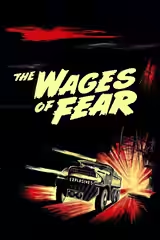
After The Wild Bunch, try The Treasure of the Sierra Madre (1948, Fi1m 88): Men under pressure discover how quickly companionship gives way to suspicion. Then The Wages of Fear (1953, Fi1m 90): Dangerous work tests a male group’s loyalty with steadily tightening suspense; and Unforgiven (1992, Fi1m 92): Another Western that makes violence difficult to separate from its admirers.

Cast

Awards

Academy Awards, 1970

Nominated
Best Original Score, no Musical
Nominated
Best Writing, Original Screenplay

If you liked this, try…

  1. The Treasure of the Sierra Madre (1948, Fi1m 88)Men under pressure discover how quickly companionship gives way to suspicion.

  2. The Wages of Fear (1953, Fi1m 90)Dangerous work tests a male group’s loyalty with steadily tightening suspense.

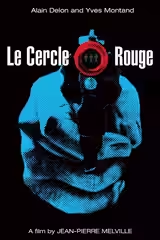
  3. Le Cercle Rouge (1970) · not on Fi1m yetCriminal professionalism and fragile trust, handled with less noise and equal pessimism.

  4. Unforgiven (1992, Fi1m 92)Another Western that makes violence difficult to separate from its admirers.

  5. The Proposition (2005) · not on Fi1m yetA harsh Australian Western with brotherhood caught up in organised cruelty.