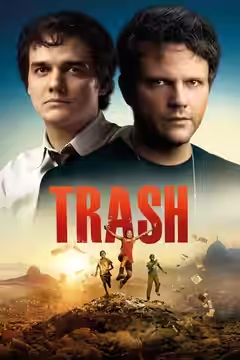
Stephen Daldry’s Trash has three engaging young leads and enough momentum to sustain its crime story. The sentimental writing is harder to accept, particularly when convenient plotting brushes aside the difficulties it asks us to take seriously.
Trash is a lively crime adventure whose young cast make a stronger impression than its carefully arranged surprises. Stephen Daldry directs Richard Curtis’s adaptation of Andy Mulligan’s novel, and the film wants the pleasures of a chase without looking away from poverty and political wrongdoing. It gets enough from its three central performances to be worth considering. The trouble is the insistence on making those pleasures reassuring: too often, a difficult situation becomes another problem the plot can neatly solve.
Rickson Tevez as Raphael, Eduardo Luís as Gardo and Gabriel Weinstein as Rato give the film its most convincing relationship. Their companionship has a warmth that does not need the story to keep certifying their goodness, and their shared energy makes the succession of clues easier to accept. We warmed to them almost immediately, because the humour in their friendship gives them a life beyond being children in danger. They are good company, and the film improves whenever their connection has room to register.
Adriano Goldman’s cinematography gives Rio a vivid presence, making the setting an important part of the excitement. That matters in an adventure which keeps asking us to take its surroundings seriously, even as the plotting grows less believable. Tulé Peak’s production design contributes to that sense of a particular place, but the attention paid to the surroundings is not matched by much curiosity about lives beyond the pursuit. The city holds our attention even when the screenplay gives us little opportunity to consider it.
Editor Elliot Graham keeps the story travelling briskly through its discoveries, and that speed is useful when the connections between them are so convenient. Each new piece of information gives the boys something else to do before the previous development has much chance to be questioned. Yet 114 minutes is a generous running time for characters the writing leaves this thin, and speed does not prevent repetition. After a while, the next clue begins to feel like an instruction to postpone asking a more interesting question about the boys themselves.
Richard Curtis’s screenplay is weakest when it treats the boys’ determination as sufficient characterisation. We need to know more about them, and the political conflict needs to be more than a succession of obstacles for resourceful children to negotiate. Antonio Pinto’s score contributes to the eagerness to make the stakes felt; that emotional encouragement is less effective than the young actors simply being together. There is suspense here, but the earnestness keeps interrupting the fun without making the injustice much clearer.
Within a child-led adventure, helpful discoveries and improbable connections are hardly offences in themselves. What bothers us here is how readily the film asks for the seriousness of a political thriller while relying on the conveniences of a treasure hunt. Stephen Daldry handles the young ensemble with evident care, and their energy stops the film becoming merely dutiful. Consider it for the three boys, provided a plot that keeps arranging the next helpful coincidence will not exhaust your patience.