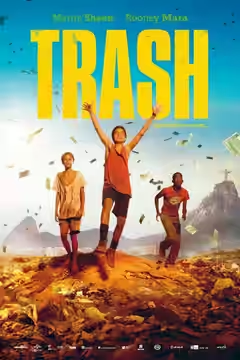
Three boys stand atop a rubbish heap as papers fly around them
Film review

Trash

2014 · Directed by Stephen Daldry · 1h 54m

In a sentenceThe three boys deserve our attention; the plot would prefer we spent it looking for the next clue

In Rio, Raphael (Rickson Tevez), Gardo (Eduardo Luís) and Rato (Gabriel Weinstein) are three boys drawn into a pursuit involving crime and political conflict. A succession of clues keeps them moving through the city, relying on their friendship as they try to work out their next move. Olivia (Rooney Mara) and Padre Juilliard (Martin Sheen) are among the adults around them. Poverty shapes the boys’ lives, but their search demands resourcefulness as well as solidarity, with each discovery giving them something else to investigate and another reason to keep going.

Plays from YouTube when you press play; nothing loads from them until then.

Fi1m review

Stephen Daldry’s Trash has three engaging young leads and enough momentum to sustain its crime story. The sentimental writing is harder to accept, particularly when convenient plotting brushes aside the difficulties it asks us to take seriously.

Trash is a lively crime adventure whose young cast make a stronger impression than its carefully arranged surprises. Stephen Daldry directs Richard Curtis’s adaptation of Andy Mulligan’s novel, and the film wants the pleasures of a chase without looking away from poverty and political wrongdoing. It gets enough from its three central performances to be worth considering. The trouble is the insistence on making those pleasures reassuring: too often, a difficult situation becomes another problem the plot can neatly solve.

Rickson Tevez as Raphael, Eduardo Luís as Gardo and Gabriel Weinstein as Rato give the film its most convincing relationship. Their companionship has a warmth that does not need the story to keep certifying their goodness, and their shared energy makes the succession of clues easier to accept. We warmed to them almost immediately, because the humour in their friendship gives them a life beyond being children in danger. They are good company, and the film improves whenever their connection has room to register.

Adriano Goldman’s cinematography gives Rio a vivid presence, making the setting an important part of the excitement. That matters in an adventure which keeps asking us to take its surroundings seriously, even as the plotting grows less believable. Tulé Peak’s production design contributes to that sense of a particular place, but the attention paid to the surroundings is not matched by much curiosity about lives beyond the pursuit. The city holds our attention even when the screenplay gives us little opportunity to consider it.

Editor Elliot Graham keeps the story travelling briskly through its discoveries, and that speed is useful when the connections between them are so convenient. Each new piece of information gives the boys something else to do before the previous development has much chance to be questioned. Yet 114 minutes is a generous running time for characters the writing leaves this thin, and speed does not prevent repetition. After a while, the next clue begins to feel like an instruction to postpone asking a more interesting question about the boys themselves.

Richard Curtis’s screenplay is weakest when it treats the boys’ determination as sufficient characterisation. We need to know more about them, and the political conflict needs to be more than a succession of obstacles for resourceful children to negotiate. Antonio Pinto’s score contributes to the eagerness to make the stakes felt; that emotional encouragement is less effective than the young actors simply being together. There is suspense here, but the earnestness keeps interrupting the fun without making the injustice much clearer.

Within a child-led adventure, helpful discoveries and improbable connections are hardly offences in themselves. What bothers us here is how readily the film asks for the seriousness of a political thriller while relying on the conveniences of a treasure hunt. Stephen Daldry handles the young ensemble with evident care, and their energy stops the film becoming merely dutiful. Consider it for the three boys, provided a plot that keeps arranging the next helpful coincidence will not exhaust your patience.


Critical consensus AI synthesised

59
Positive
5
Mixed
9
Negative
3

The consensus on Trash is mixed, with praise clustering around the three young leads and the energy they bring to the crime story. Most critics who discuss the performances value the actors’ naturalness and camaraderie, while several find the journey through Rio vivid, brisk and engaging. The more approving reviews accept the sentimentality and unlikely plotting as part of an accessible adventure; Empire goes further, finding an unexpectedly gritty thriller whose leads and setting give it considerable force.

Reservations centre on strained coincidences, simplified politics and a sweetness that can weaken the sense of danger. The spread is wide: even some sympathetic reviews question the film’s depth, while the harshest see its treatment of poverty as shallow or exploitative. Slant Magazine offers the strongest rejection, arguing that the stylised violence and lurid imagery turn suffering into spectacle rather than engaging meaningfully with it.

Empire
19 August 2014 · Simon Braund
80*

Braund calls it an unexpectedly gritty, energetic crime thriller and another winner from Daldry. He praises the three leads’ dynamite performances and the film’s vivid portrayal of Rio.

Read the full review →
Time Out
26 January 2015 · ★★★★ · Cath Clarke
80

The four-star rating indicates an approving verdict. The available page text does not reveal what Clarke singles out for praise or complaint.

Read the full review →
Los Angeles Times
9 October 2015 · Michael Rechtshaffen
75*

Rechtshaffen finds the film an intense, propulsive political thriller, though its theatrical moments sometimes weaken the gritty tone. He particularly praises the trio of young actors’ authentic performances.

Read the full review →
Evening Standard
30 January 2015 · Charlotte O'Sullivan
70*

O’Sullivan finds the film jaunty and engaging despite its sentimental, implausible moments. She praises the non-professional young actors and their characters’ self-empowerment.

Read the full review →
The Guardian
20 October 2014 · festival review · Jordan Riefe
68*

Riefe finds the film compelling and enjoyable, though its plotting and optimistic ending weaken its themes. He singles out the three young Brazilian actors’ performances as essential to its success.

Read the full review →
Variety
8 October 2014 · festival review · Jay Weissberg
65*

Weissberg finds the film audience-friendly but overly neat and unrealistic, with an improbably happy ending. He especially praises the infectious energy and camaraderie of its three young nonprofessional leads.

Read the full review →

Straight answers AI written, from our review

Is Trash worth watching?
Trash is worth considering for its engaging young leads and brisk crime adventure, but its convenient plotting keeps our score at 64. We recommend it chiefly for the warmth and humour of the boys’ friendship; the sentimental writing and thin characterisation make it less satisfying as a political thriller.
How long is Trash, and what is it rated?
Trash runs 1h 54m. It is an adventure and crime film.
Where can I watch Trash in Malaysia?
Trash is not on any streaming or rental service in Malaysia at the moment. It is available in 17 other countries; change your country at the top of the page to see where. Availability is checked daily.
How violent or frightening is Trash, and is it suitable for children?
Trash carries a UK 15 certificate, so it is not suitable for children under 15 despite having three boys at its centre. Its crime pursuit places children in danger and includes suspense around political wrongdoing; we would not mistake the youthful leads or reassuring storytelling for a family-friendly adventure.
How does Trash compare to The Kid?
Trash offers a brisk child-led crime adventure, while The Kid is the stronger choice for comedy that earns its sentiment through specific details of care and affection. We find the boys’ friendship appealing in Trash, but its convenient clues and earnest writing are less convincing than the central relationship in The Kid.
Is Trash based on a true story or a book?
Trash is based on Andy Mulligan’s novel, adapted for the screen by Richard Curtis, rather than presented as a true story. We find the film’s main weakness in how neatly its clues resolve difficult situations; familiarity with the book is not needed to follow the boys’ pursuit through Rio.
What should I watch after Trash?
After Trash, try The Kid (1921, Fi1m 84): A child’s resourcefulness and an adult’s affection, with sentiment earned through comic detail. Then The Selfish Giant (2013, Fi1m 88): For young friendship under economic pressure, with far less reassurance about the adults; and Hunt for the Wilderpeople (2016, Fi1m 82): A resourceful young outsider, an escalating pursuit and humour that allows for real hurt.

Cast

If you liked this, try…

  1. The Kid (1921, Fi1m 84)A child’s resourcefulness and an adult’s affection, with sentiment earned through comic detail.

  2. Children of Heaven (1997) · not on Fi1m yetAnother child-sized adventure in which poverty makes a small problem painfully consequential.

  3. The Selfish Giant (2013, Fi1m 88)For young friendship under economic pressure, with far less reassurance about the adults.

  4. Hunt for the Wilderpeople (2016, Fi1m 82)A resourceful young outsider, an escalating pursuit and humour that allows for real hurt.

  5. City of God (2002, Fi1m 86)A much harsher account of youth, crime and the forces shaping Rio.