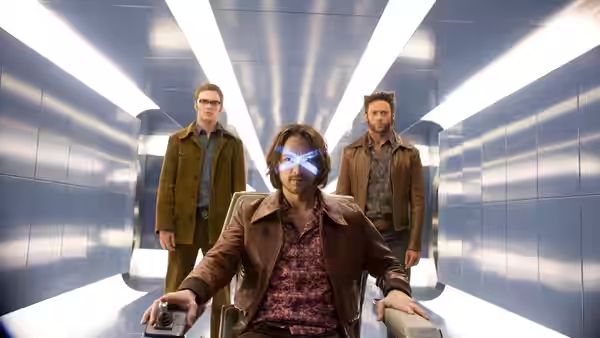
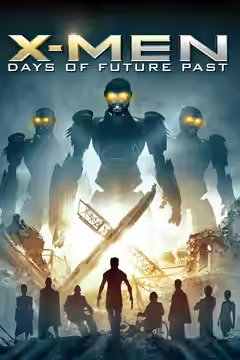
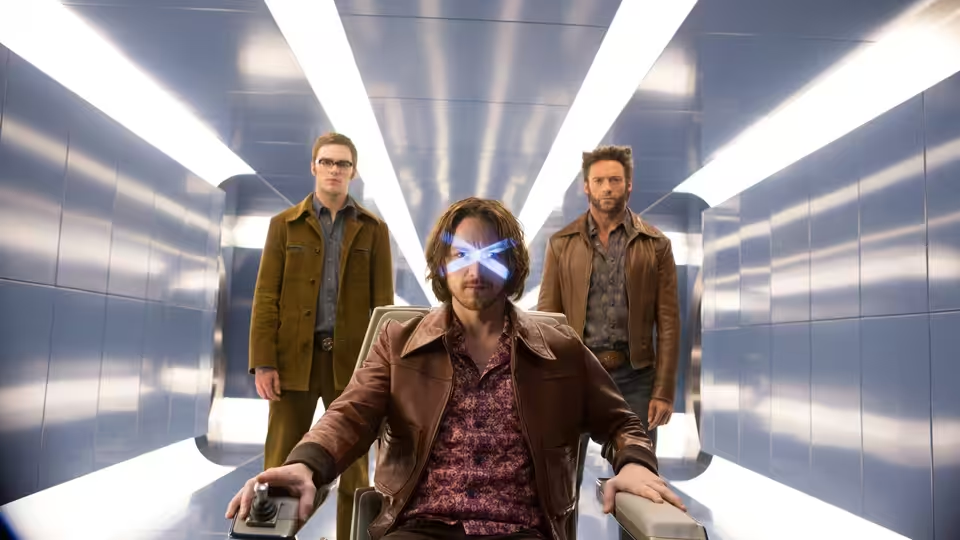
Kitty Pryde (Elliot Page) sits in a corridor as Logan and Charles Xavier stand behind her
Film review

X-Men: Days of Future Past

2014 · Directed by Bryan Singer · 2h 12m

In a sentenceThe future is dreadful, but at least the prison break has a sense of humour

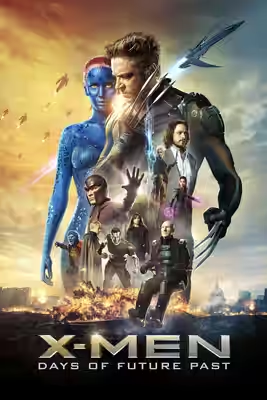
Logan / Wolverine (Hugh Jackman) faces a bleak future that can only be saved by changing the past. The effort draws in Charles Xavier (James McAvoy), Erik Lehnsherr (Michael Fassbender) and Raven / Mystique (Jennifer Lawrence), with Professor X (Patrick Stewart) and Magneto (Ian McKellen) also involved in the time-spanning struggle. A prison break at the Pentagon presents a more immediate problem, and Quicksilver’s speed becomes part of the attempt. What happens in the past will determine whether there is a future left to save.

Plays from YouTube when you press play; nothing loads from them until then.

Fi1m review

Bryan Singer’s crowded superhero film stays entertaining because its actors make the arguments matter. The character history can be cumbersome, but the playful action gives the solemn business of saving the future a welcome lift.

Bryan Singer’s X-Men: Days of Future Past is good superhero entertainment, sustained by its actors when the time-travelling business gets cumbersome. Its premise gives a crowded cast a shared task: save the future by altering the past. Simon Kinberg’s screenplay makes that easier to care about than it might sound. We stay interested because the people doing the arguing seem worth listening to, even when the explanations ask more of our patience.

James McAvoy gives Charles Xavier the emotional weight that keeps the elaborate plotting from becoming an exercise. He sounds like someone for whom taking charge is difficult, and that makes his decisions worth attending to. Michael Fassbender gives Erik Lehnsherr enough conviction to make him difficult to dismiss, even when agreement looks unwise. Their exchanges have a tension that the larger action sometimes lacks, because both actors can make listening to the other person seem like hard work.

Hugh Jackman is an assured presence as Logan / Wolverine, helping to steady a film full of competing personalities. Jennifer Lawrence gives Raven / Mystique an urgency that the writing does not consistently support with enough attention to her thinking. Peter Dinklage is effective as Dr. Bolivar Trask, although the film lacks an opposing presence as compelling as its central pair. The cast is strong enough to make the imbalance frustrating: we keep noticing people who deserve more time.

The Pentagon sequence loosens the film up. Quicksilver’s slow-motion action gives us time to enjoy the joke inside the spectacle. We laughed with relief. Watching someone take pleasure in having a superpower makes a welcome change from watching people explain its burdens, and the sequence knows when to move on. Its timing is precise without making the whole thing feel overly rehearsed.

Newton Thomas Sigel’s cinematography lets us read the slowed action clearly, giving the joke enough space to register without making it feel laboured. John Myhre’s production design gives the Pentagon a suitably officious air, which makes the irreverence funnier. Both contributions work best when there is a clear physical problem for the characters to solve. The more crowded stretches are less distinctive to look at, even when the cutting keeps them understandable.

John Ottman, editing as well as composing, keeps the crowded story moving with considerable economy. The shifts between timelines are easier to follow than the accumulated character histories, although the bleak future passages do not always maintain their urgency. His score is less persuasive when it presses for grandeur; the performances have already supplied enough feeling. A quieter cue would sometimes leave more room for the actors, particularly when the dialogue is already carrying considerable importance.

By the standards of superhero ensemble films, this is unusually willing to let conversation carry a scene. It does not give everyone enough room, and newcomers may reasonably wonder why certain faces are expected to mean so much. But its central performances reward the necessary patience, while the humour keeps the business of rescuing the future from becoming a chore. See it for the performances, but do not expect a patient introduction to everybody.
Critical consensus AI synthesised

73
Positive
17
Mixed
8
Negative
0

Most critics find X-Men: Days of Future Past an entertaining, ambitious entry, with praise concentrated on its central performances and inventive action. James McAvoy and Michael Fassbender draw particular approval, while several reviews credit Bryan Singer with giving the sprawling story emotional weight. Quicksilver’s slow-motion sequence is the clearest point of agreement, winning over even critics less persuaded by the rest. The favourable reviews value the attention paid to characters amid the competing timelines.

Reservations centre on crowded plotting, uneven urgency and the demands placed on audience familiarity with the series. The spread runs from enthusiastic approval to mixed responses, with no wholly negative verdicts in the supplied reviews. Slant Magazine finds the parallel storylines uninventive and the dialogue emotionally hollow. The Wrap finds the film entertaining but exhausting, with the bleak future scenes upsetting the balance; elsewhere, critics differ over whether Singer keeps the large cast and complicated story sufficiently focused.

Los Angeles Times
22 May 2014 · Betsy Sharkey
86*

Sharkey finds the film a deeper, richer adventure and calls it Singer’s best X-Men film. She especially praises the cast, singling out the electric performances of James McAvoy and Michael Fassbender.

Read the full review →
Empire
12 May 2014 · William Thomas
85*

The review finds the film largely fantastic and calls it the best X-Men film since the second. It especially praises the inventive action, singling out Quicksilver’s slow-motion sequence as a highlight.

Read the full review →
Little White Lies
21 May 2014 · 4/4/4 · Chris Blohm
80

The critic calls it an ambitious, thrilling blockbuster, though its crowded cast weakens its focus. The review particularly praises Michael Fassbender’s performance and the film’s dazzling set-pieces.

Read the full review →
Radio Times
★★★★ · Jeremy Aspinall
80

Aspinall calls Bryan Singer’s return triumphant and praises the ambitious, time-spanning story. The review also highlights how the film raises the stakes for the franchise.

Read the full review →
Total Film
13 May 2014 · ★★★★ · Kevin Harley
80

Harley praises the film as an assured, brisk revival that balances superhero thrills with emotional depth. He especially singles out Singer’s focus on Xavier and Mystique, alongside the cast’s performances and the inventive action.

Read the full review →
Variety
12 May 2014 · Justin Chang
78*

Chang finds the film an ambitious, emotionally resonant return to form for Bryan Singer. He especially praises the performances of McAvoy and Fassbender and the playful Quicksilver action sequence.

Read the full review →

Straight answers AI written, from our review

Is X-Men: Days of Future Past worth watching?
X-Men: Days of Future Past is worth watching for superhero fans who value strong performances and playful action; we score it 78 out of 100. McAvoy and Fassbender make the arguments matter, while Quicksilver’s Pentagon sequence supplies welcome humour. The time travel stays manageable, but newcomers may find the accumulated character history cumbersome.
How long is X-Men: Days of Future Past, and what is it rated?
X-Men: Days of Future Past runs 2h 12m. It is an action and adventure film.
Where can I watch X-Men: Days of Future Past in Croatia?
X-Men: Days of Future Past is streaming on Disney+ in Croatia. Availability is checked daily; the links above go straight to each service.
How violent or frightening is X-Men: Days of Future Past, and is it suitable for children?
X-Men: Days of Future Past has a UK 12A certificate, so children under 12 need an accompanying adult at the cinema. Its bleak future and superhero action warrant caution for younger or sensitive children, though the humour offers relief. We would not treat it as an automatic family choice: 12A does not mean suitable for every child.
How does X-Men: Days of Future Past compare to Twelve Monkeys?
X-Men: Days of Future Past is the better choice for playful superhero entertainment, while Twelve Monkeys suits an appetite for a harsher time-travel thriller. We find strong performances give both films a human centre, but their complications differ: accumulated character history weighs on the X-Men film, while restless images and an overextended script make Twelve Monkeys harder work.
What should I watch after X-Men: Days of Future Past?
After X-Men: Days of Future Past, try 12 Monkeys (1995, Fi1m 82): Time travel with bruised performances and a much nastier sense of fate. Then Unbreakable (2000, Fi1m 81): Superpowers treated as a personal difficulty, with room for doubt and conversation; and A Matter of Life and Death (1946, Fi1m 92): Another fantastical struggle over human lives, handled with wit and emotional seriousness.

Part of · 1 of 1

X-Men

1 film on Fi1m · 2014–2014 · best X-Men: Days of Future Past 78

All 1 in order

Cast

Awards

Academy Awards, 2015

Nominated
Best Visual Effects

If you liked this, try…

  1. 12 Monkeys (1995, Fi1m 82)Time travel with bruised performances and a much nastier sense of fate.

  2. The Girl Who Leapt Through Time (2006) · not on Fi1m yetChanging yesterday becomes an intimate problem in this thoughtful Japanese animation.

  3. Unbreakable (2000, Fi1m 81)Superpowers treated as a personal difficulty, with room for doubt and conversation.

  4. A Matter of Life and Death (1946, Fi1m 92)Another fantastical struggle over human lives, handled with wit and emotional seriousness.

  5. The Host (2006) · not on Fi1m yetFamily friction and monster action share the screen without cancelling each other out.