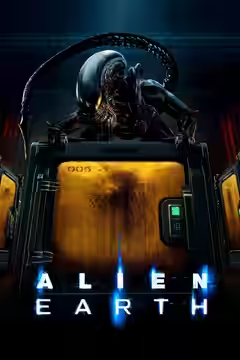
Noah Hawley’s eight-part prequel is the most confident thing done with these monsters in years, with new creatures that horrified us and a cast that takes the strangeness seriously. It also talks at length about what makes a person, and it slackens whenever it does.
Noah Hawley has taken the Alien films back to Earth and back in time, to before Ridley Scott’s 1979 original, and he has given himself eight episodes to do it. A ship comes home from space with specimens aboard. A corporation gets to them first, and the corporation is also building hybrids: bodies that are part human and part machine, the first of them a young woman called Wendy. The series is at its best when it is looking closely at something small and dreadful in a jar. It is weaker, and a good deal longer, when it stops to ask what a person is.
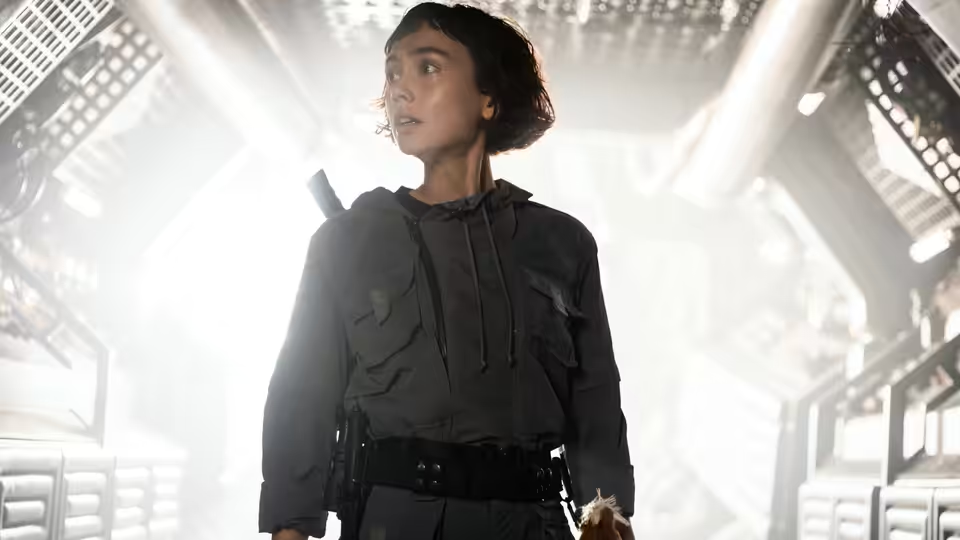
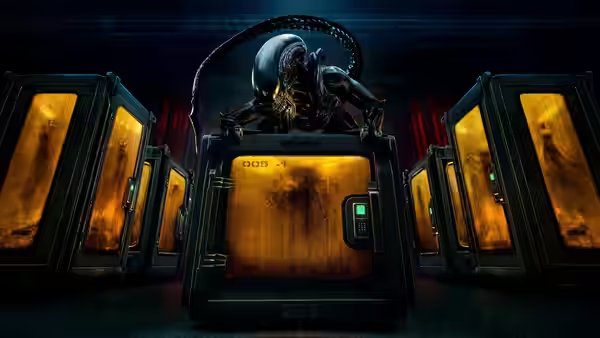
It looks right, which for this series is half the job. Jason Knox-Johnston and Andy Nicholson’s sets keep to the heavy, practical technology of the 1979 film: switches, hatches, screens that glow green, corridors you could bang your head in. Four cinematographers are credited, Dana Gonzales, David Franco, Bella Gonzales and Colin Watkinson, and Gonzales also directs, alongside Hawley and Ugla Hauksdóttir. That is a lot of hands, and the episodes nonetheless look like one thing: low light, a lot of black, faces lit from the side. Suttirat Anne Larlarb’s costumes put the company’s people in clean pale clothes and everybody else in something oily.
The creatures are the reason to watch. The famous one is here, but Hawley keeps it in reserve for long stretches and gives the screen over to new specimens, smaller and stranger, each with its own way of getting into a body and its own idea of what to do once it is there. One of them is small enough to hold in a hand, and what it does to a person once it is inside made us look away, which we do not often do. It was not the blood. It was the calm of the scene around it, the scientists watching through glass as if this were a routine procedure, and the sound design letting us hear exactly how routine it was not.
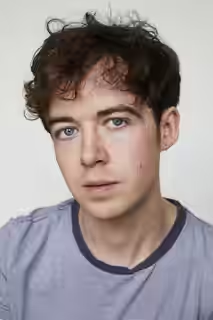
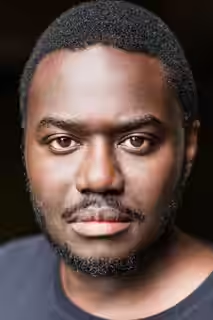
Sydney Chandler carries the series. Wendy is a new sort of thing and Chandler plays her as someone finding out, moment by moment, what her body will and will not do, without ever reaching for wide-eyed wonder. Alex Lawther’s Joe DiMaggio Hermit is the human she is tied to, and Lawther is good at looking frightened while trying not to be. Samuel Blenkin’s Boy Kavalier, the young man whose company all this belongs to, is played as a clever child who has never been told no, and Blenkin makes him funny before he makes him frightening. Essie Davis and Babou Ceesay both do a lot with stillness. Adarsh Gourav, Erana James, Lily Newmark and Jonathan Ajayi are the other hybrids, Slightly, Curly, Nibs and Smee, and they are given just enough each to make us wish they had more.
The trouble is the talking. Six writers are credited, Hawley among them, and the script has a great deal to say about corporations owning bodies, about machines that might be people and people who behave like machines. In the early episodes it says these things through what happens: a body opened, a child’s name on a grown adult, a boardroom that treats a monster as stock. Later it says them out loud, in scenes where two characters sit across a table and define terms. Jeff Russo’s score goes low and thoughtful under these conversations, and the editors, Curtis Thurber, Robin August and Regis Kimble, let them run. We found ourselves restless in the middle episodes, and then a creature would do something and we were not restless any more. That is not a structure so much as a rescue.
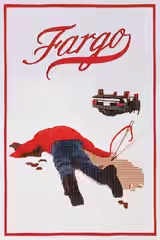
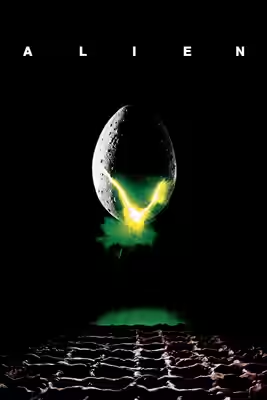
Hawley’s Fargo had the same appetite for digression and got away with it because every digression was a joke. Here the digressions are earnest, and earnest is harder to sustain across eight hours. Set against the films, this is nearer the first one than anything since: patient, dark, interested in bodies and in the people who own them.
Watch it in the evening, with the lights down and the sound up; the horror is mostly in what you hear before you see. And do not worry too much when the series wanders. Something is always about to come out of a wall.