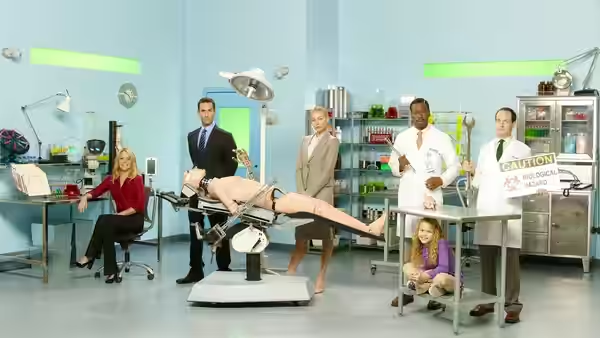
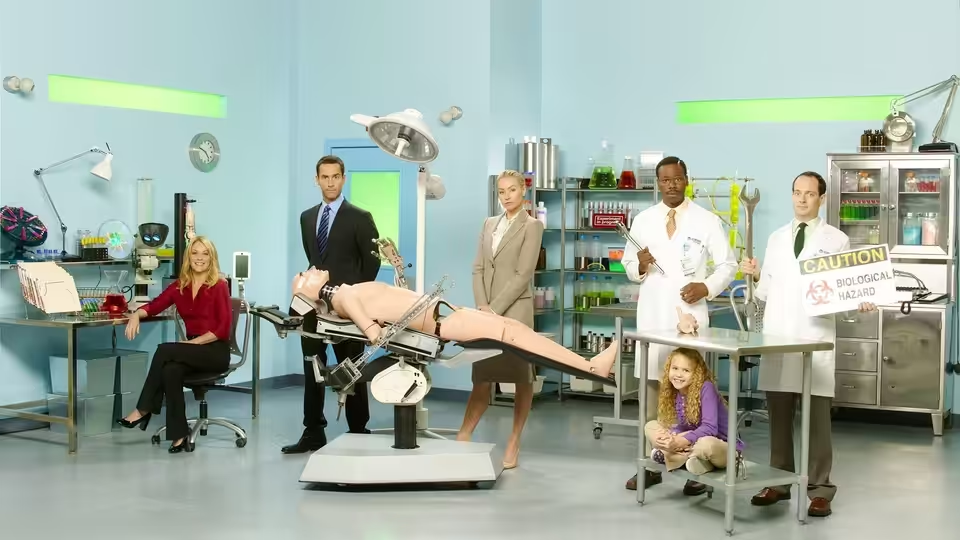
Professionals in lab coats and suits stand around a dummy on an exam table in a bright laboratory
Series review

Better Off Ted

2009 · Created by Victor Fresco · Series

In a sentenceThe scientists are lovely, the boss is a shark, and the company would sell both if the margins were right

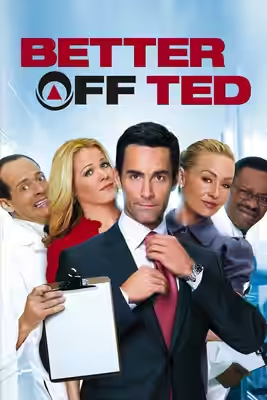
Ted Crisp (Jay Harrington) runs research and development at Veridian Dynamics, a corporation that makes weapons, office chairs and anything else with a margin, and he explains the place to camera. His boss, Veronica Palmer (Portia De Rossi), passes down orders from the floors above without asking why. His scientists, Phil Myman (Jonathan Slavin) and Lem Hewitt (Malcolm Barrett), invent whatever they are told to in a basement lab. Linda Zwordling (Andrea Anders) tests the products and steals the company’s coffee creamer in protest. Ted brings his daughter Rose (Isabella Acres) to work. In the first episode the company decides to freeze Phil, alive, to see if it can, and Ted has to decide how far he will go.

Fi1m review

Victor Fresco’s corporate comedy is quick, cold and consistently funny, with Portia De Rossi giving one of the sharpest sitcom performances of its decade. It runs 26 episodes, which is about right, and it goes soft whenever it remembers its hero has a heart.

Victor Fresco’s Better Off Ted is set inside Veridian Dynamics, a company that will make anything for anyone and has a motivational poster for every one of its crimes. Ted Crisp (Jay Harrington) is head of research and development and our guide, turning to the camera to tell us what the company has just done and why he is still there. The series first aired on 18 March 2009 and ran for two seasons of 13 episodes each. It is the sharpest American office comedy of its moment, and it is at its best when it is at its most heartless.

The world is the joke and the joke is built carefully. Between scenes the show cuts to Veridian’s own adverts: stock-photo smiles, a soothing voice, a tagline that means the opposite of what it says. Michael Hynes and Dawn Snyder design the building in white, grey and glass, so that everyone in it looks like something under a slide. Brandon Mastrippolito and Sharone Meir light it flat and bright, with no shadows anywhere, the look of a place that has nothing to hide because it has already shredded it. The editors, Lisa Bromwell and Noel Rogers among them, drop the adverts in so that they land like real commercial breaks, which is the point.

Portia De Rossi’s Veronica is the reason to watch. She says appalling things at a steady, pleasant pitch and does not blink, and she treats the people beneath her as stock that occasionally talks back. What makes it a performance rather than a cartoon is how little effort De Rossi shows: Veronica is not cruel for pleasure, she simply cannot see why anyone would put a person before a number. Some early reviews thought she was miscast. We think she is the best thing in it, and she got most of our loudest laughs.

The basement gives the show its warmth. Jonathan Slavin plays Phil as a man in a permanent state of low alarm, and Malcolm Barrett plays Lem as his prim, slightly superior partner, and together they are the one part of the building where anybody likes anybody. Their inventions go wrong in ways that make sense a beat after they happen. Harrington is a good straight man, dry and easy to like, and he has the hardest job because Ted is written as the only reasonable character, and reasonable characters get fewer lines.

The weak strand is the one the show keeps returning to. Andrea Anders is quick and likeable as Linda, but the will-they-won’t-they between her and Ted is the ordinary sitcom material the rest of the series is mocking, and every time it comes forward the pace drops. Chris Alan Lee and Scott Clausen’s music is jaunty and tells us that none of this really hurts, when the funniest episodes work because it plainly does. Several episodes share a shape: the company announces a policy, the building goes mad, Ted patches it, everyone learns nothing. When the writing is sharp that is a strength. When it is not, you can see the pattern.

There is one episode in the first season about the building’s new sensors, which fail to register anyone with dark skin, and the company’s solutions to this problem. We laughed hard, and then we sat in silence for a moment, because the joke was not on the sensors. It is the show at full stretch: a real thing, taken one step further than a real company would admit to, with nobody on screen behaving as if it were strange. It is also the kind of joke a comfortable network comedy usually will not tell, and this one told it in its first year.

Most workplace comedies of this period were about the misery of the small office and the boss who wants to be loved. Fresco’s is about a boss who does not care whether she is loved and a company that would freeze you to save on pension costs, and it plays that for comedy rather than despair. Two seasons is the right length; the shape would have worn thin over five.

Watch it in runs of two or three, at home, where the adverts land best because they arrive exactly where real ones would. Skip forward if Ted and Linda start looking at each other. It carries a 15.
Critical consensus AI synthesised

68
Positive
6
Mixed
0
Negative
2
The AV Club
18 March 2009 · B+ · Noel Murray
83

The critic finds the pilot clever and creative with an infectiously boisterous energy and odd corporate satire, but notes that it clicks along and then just kind of ends without a strong point.

Read the full review →
The Hollywood Reporter
17 March 2009
80*

The critic praises the show's fresh and lively feel, strong chemistry among the cast, and rat-a-tat dialogue that feels real. They single out the clever satire and casting as highlights, calling it the clever satire we've been waiting for.

Read the full review →
The Times
28 July 2010
70*

The series cleverly exaggerates workplace absurdities into surreal comedy, portraying big business as a sociopathic force with a straight-man hero at its center.

Read the full review →
Variety
13 March 2009 · Brian Lowry
40*

The critic found the premise promising but was disappointed overall, noting an uneven tone with a sappy heart that undercuts the satire and some miscasting. They single out the corporate video spoofs as clever but criticize the inconsistent execution.

Read the full review →
The Guardian
23 August 2010
30*

The show's corporate satire premise is promising but undermined by weak writing and poor casting choices, especially for Portia de Rossi. It falls short of being a classic due to its half-baked title and execution.

Read the full review →
Collider
25 December 2024 · Lloyd Farley
90*

The critic calls Better Off Ted one of the funniest, most underrated comedies of the 21st century and a pitch-perfect commentary on profit-driven companies and office politics. They single out the brilliant cast, especially Portia de Rossi as the narcissistic executive Veronica, along with the fourth-wall breaking narration and fake Veridian Dynamics ads.

Read the full review →

Straight answers AI written, from our review

Is Better Off Ted worth watching?
Better Off Ted is worth watching for anyone who likes their office comedy quick and cold, and we scored it 80. Portia De Rossi's Veronica, a boss who cannot see why a person would come before a number, is the reason to watch. It goes soft whenever Ted and Linda start looking at each other, so skip forward when they do.
Where can I watch Better Off Ted in Türkiye?
Better Off Ted is not on any streaming or rental service in Türkiye at the moment. It is available in 4 other countries; change your country at the top of the page to see where. Availability is checked daily.
How violent or frightening is Better Off Ted, and is it suitable for children?
Better Off Ted carries a UK 15 certificate, and its darkness is in what the company does rather than anything shown: in the first episode it freezes a scientist alive to see if it can. There is no frightening material and the violence is corporate, not physical. Teenagers who enjoy dry comedy will be fine; younger children will find little for them here.
How does Better Off Ted compare to Arrested Development?
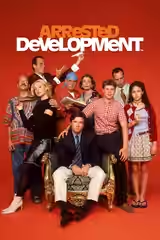
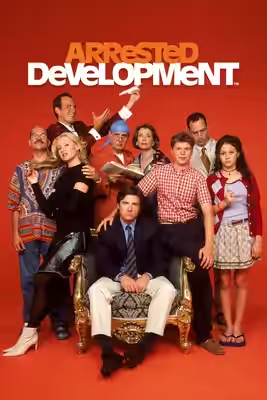
Better Off Ted is the colder and tidier of the two, a workplace comedy that plays a heartless company for laughs, while Arrested Development is a family comedy whose monsters are related to each other. Both cut at the same unforgiving speed and both give Portia De Rossi a monster to play. Arrested Development rewards closer attention but grows tiring in later stretches; Better Off Ted stops at 26 episodes, which is about right.
What should I watch after Better Off Ted?
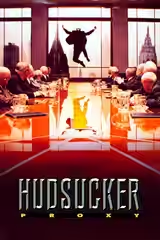
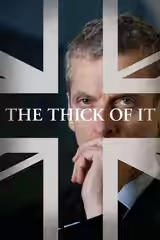
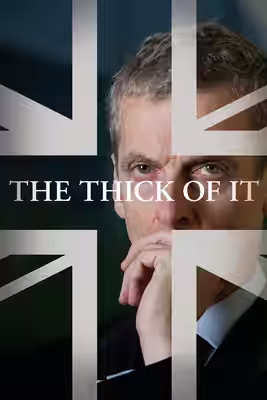
After Better Off Ted, try Arrested Development (2003, Fi1m 87): De Rossi in another family of monsters, cut at the same unforgiving speed. Then The Hudsucker Proxy (1994, Fi1m 78): The Coens build a corporation as a cathedral and then let a fool run it; and The Thick of It (2005, Fi1m 94): Institutional cowardice as farce, with British swearing in place of American stock photos.

Cast

If you liked this, try…

  1. Arrested Development (2003, Fi1m 87)De Rossi in another family of monsters, cut at the same unforgiving speed.

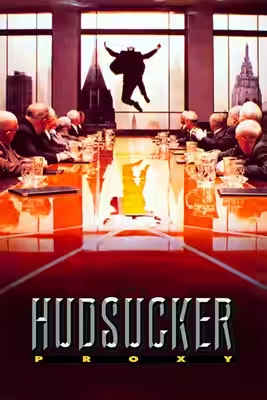
  2. The Hudsucker Proxy (1994, Fi1m 78)The Coens build a corporation as a cathedral and then let a fool run it.

  3. The Thick of It (2005, Fi1m 94)Institutional cowardice as farce, with British swearing in place of American stock photos.

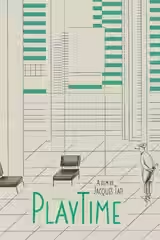
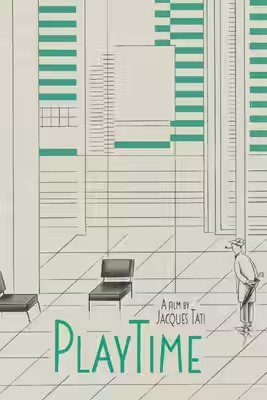
  4. Playtime (1967, Fi1m 88)Tati loses a man in glass offices; almost no words and every joke lands.

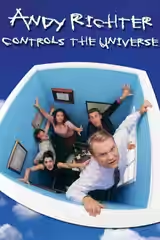
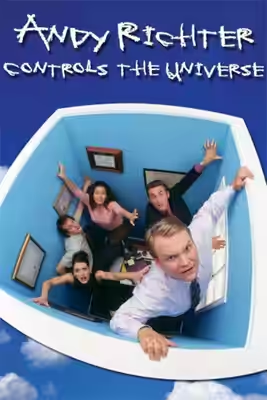
  5. Andy Richter Controls the Universe (2002) · not reviewed yetFresco’s earlier office sitcom, the same faceless employer and the same narrator to camera.

Free account

Know what to watch tonight

Two lists that know where things are streaming, collections you can share, your own score beside ours, and Discover that remembers what you have seen.

  • Want to see, sorted by what is streaming now
  • Seen, with your score out of ten
  • No adverts, ever