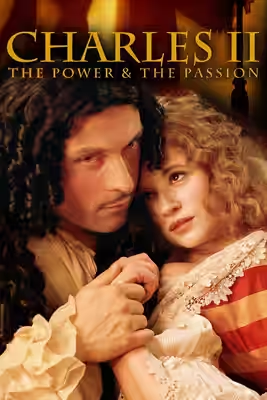
Joe Wright’s four-part drama tries to get a quarter-century of the Restoration into four hours, and the history arrives in lumps. Rufus Sewell’s Charles holds it together: watchful, charming, tired, and never the fool his court takes him for.
Adrian Hodges’s script and Joe Wright’s direction have four hours to get Charles II from a cold lodging in exile to the end of a twenty-five-year reign, and they do not pretend it fits. Events come at a run: a restoration, a marriage, a war with the Dutch, a plague, a fire, a plot, a succession crisis. We think it is good, often better than good, and we think most of what is wrong with it comes from that arithmetic. A reader with four evenings and a taste for men in wigs lying to each other will be well served.
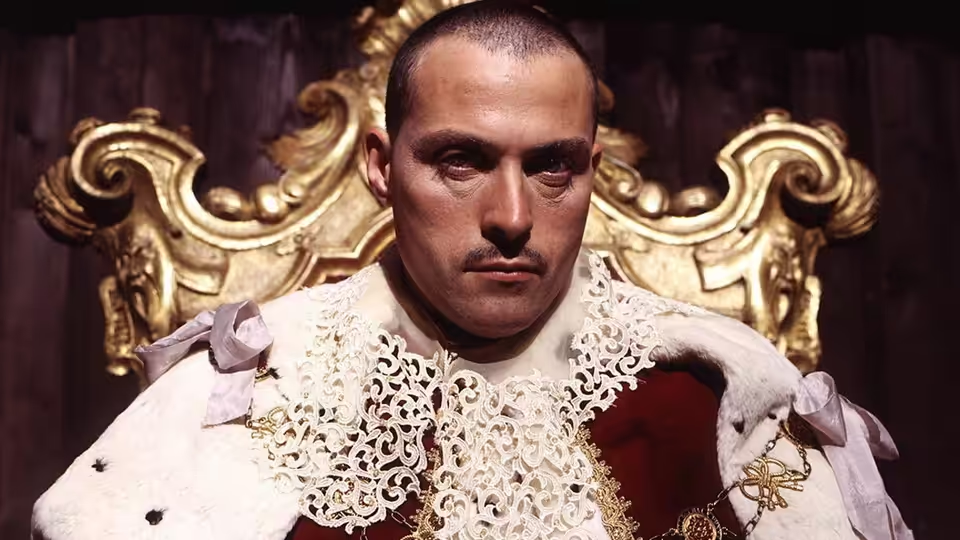
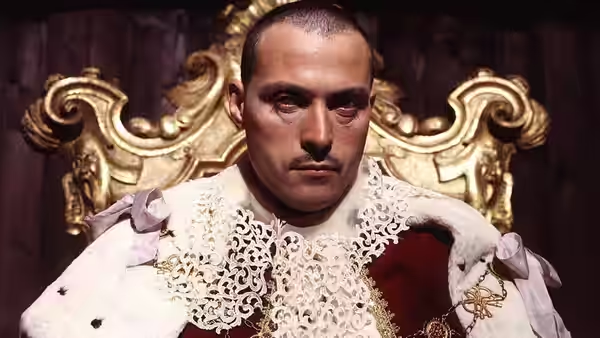
The reason to watch is Rufus Sewell. His Charles has learned in exile that everyone around him wants something, and he decides early to let them think he is a lazy man who cares only for his mistresses. Sewell plays this with his face held almost still, so the small movements register: a glance at Hyde when Parliament refuses money, a tightening when his brother talks about his faith. He is charming on purpose, and when the charm drops, which happens perhaps four times in four hours, it is frightening.
Wright and his cinematographer Ryszard Lenczewski shoot it with a handheld camera that follows people down corridors and into beds, and nearly everything indoors is lit by candles and windows, so the faces are warm and the corners are black. Sarah Greenwood’s Whitehall is not a palace of state rooms. It is a warren of panelled chambers, back stairs and curtained beds, which is right for a court where the real business is done in private. Mike O’Neill dresses the king in black and lets Buckingham and the mistresses carry the colour. Rob Lane’s score is lutes and low strings and, in the council scenes, mostly absent. Paul Tothill cuts quickly between the bedroom and the council chamber, and the series’ best joke is how often the same people are in both.
The first episode puts the executions of the regicides in front of us, with the crowd roaring and the king watching, and we were horrified; then we watched Sewell, who gives the crowd nothing. That is the series in one scene. The spectacle is loud and the man at the centre is quiet.
Helen McCrory’s Barbara Villiers is the best thing in the court. She is greedy, clever, frightened of being replaced and never once pathetic, and her scenes with Sewell have the heat of two people who know exactly what they are to each other. Shirley Henderson’s Catharine of Braganza moved us more than we expected: a small foreign woman in an enormous dress, laughed at in a language she cannot follow, who turns out to have more steel than any of the men laughing. Rupert Graves gives Buckingham a dangerous lightness, and Ian McDiarmid’s Hyde is the one adviser who tells the truth and is punished for it. Martin Freeman’s Shaftesbury arrives later as the opposition, dry and quick, and the last two episodes tilt towards him.
The compression costs the series its middle. Charlie Creed-Miles’s James gets one note, sulky piety, and holds it for four hours. Christian Coulson’s Monmouth is handsome and barely written. Peter Wight, Robert East and Dorian Lough play ministers whose names you will catch from the dialogue if you are lucky, and the Plague and the Fire of London go by in a handful of scenes between bedrooms. By the fourth episode the politics has become men shouting in rooms about a Catholic succession, and we wanted the series to stop and explain, which it does not have time to do.
Wright went on to make Pride & Prejudice two years later, and the restless camera and the dark, candlelit rooms are already here. Against the stately tradition of British royal television this is quick, carnal and modern, and it is a 15 certificate for a reason; there is a great deal of sex, most of it political. Watch two episodes at a sitting and keep a list of names by the sofa.