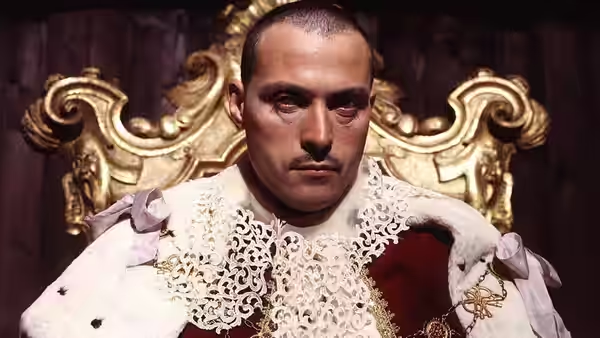
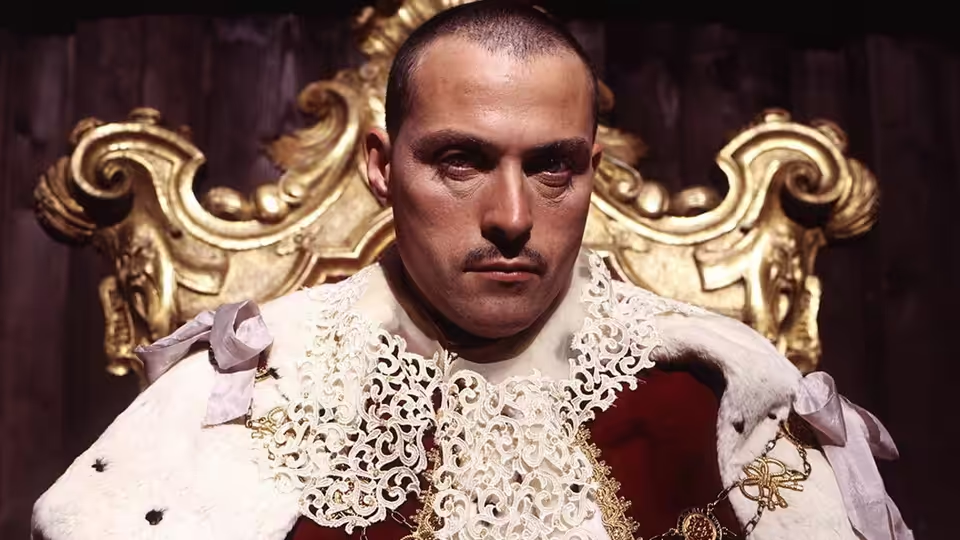
A man in a lace-trimmed coat sits before an ornate gilded throne
Series review

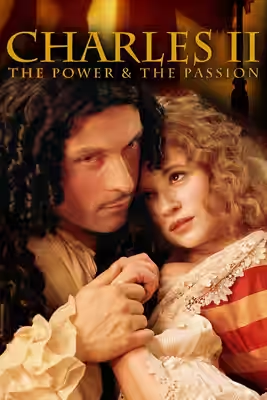
Charles II: The Power and The Passion

2003 · Created by Joe Wright · Series · 1h 00m

In a sentenceTwenty-five years of English history, mostly decided in bedrooms, and only the king seems to know it

England, 1660. Charles Stuart (Rufus Sewell) is thirty, penniless and in exile, eleven years after Parliament cut off his father’s head. With him are his brother James, Duke of York (Charlie Creed-Miles), his old friend George Villiers, Duke of Buckingham (Rupert Graves) and his adviser Sir Edward Hyde (Ian McDiarmid). Then Parliament invites him home. Charles wants his throne, the men who signed his father’s death warrant dead, and enough money to keep a court; what stands in his way is a Commons that holds the purse and remembers what it did to the last king. He takes Barbara Villiers (Helen McCrory) as his mistress, and Hyde arranges a marriage to the Portuguese princess Catharine of Braganza (Shirley Henderson), who arrives with a dowry and almost no English.

Fi1m review

Joe Wright’s four-part drama tries to get a quarter-century of the Restoration into four hours, and the history arrives in lumps. Rufus Sewell’s Charles holds it together: watchful, charming, tired, and never the fool his court takes him for.

Adrian Hodges’s script and Joe Wright’s direction have four hours to get Charles II from a cold lodging in exile to the end of a twenty-five-year reign, and they do not pretend it fits. Events come at a run: a restoration, a marriage, a war with the Dutch, a plague, a fire, a plot, a succession crisis. We think it is good, often better than good, and we think most of what is wrong with it comes from that arithmetic. A reader with four evenings and a taste for men in wigs lying to each other will be well served.

The reason to watch is Rufus Sewell. His Charles has learned in exile that everyone around him wants something, and he decides early to let them think he is a lazy man who cares only for his mistresses. Sewell plays this with his face held almost still, so the small movements register: a glance at Hyde when Parliament refuses money, a tightening when his brother talks about his faith. He is charming on purpose, and when the charm drops, which happens perhaps four times in four hours, it is frightening.

Wright and his cinematographer Ryszard Lenczewski shoot it with a handheld camera that follows people down corridors and into beds, and nearly everything indoors is lit by candles and windows, so the faces are warm and the corners are black. Sarah Greenwood’s Whitehall is not a palace of state rooms. It is a warren of panelled chambers, back stairs and curtained beds, which is right for a court where the real business is done in private. Mike O’Neill dresses the king in black and lets Buckingham and the mistresses carry the colour. Rob Lane’s score is lutes and low strings and, in the council scenes, mostly absent. Paul Tothill cuts quickly between the bedroom and the council chamber, and the series’ best joke is how often the same people are in both.

The first episode puts the executions of the regicides in front of us, with the crowd roaring and the king watching, and we were horrified; then we watched Sewell, who gives the crowd nothing. That is the series in one scene. The spectacle is loud and the man at the centre is quiet.

Helen McCrory’s Barbara Villiers is the best thing in the court. She is greedy, clever, frightened of being replaced and never once pathetic, and her scenes with Sewell have the heat of two people who know exactly what they are to each other. Shirley Henderson’s Catharine of Braganza moved us more than we expected: a small foreign woman in an enormous dress, laughed at in a language she cannot follow, who turns out to have more steel than any of the men laughing. Rupert Graves gives Buckingham a dangerous lightness, and Ian McDiarmid’s Hyde is the one adviser who tells the truth and is punished for it. Martin Freeman’s Shaftesbury arrives later as the opposition, dry and quick, and the last two episodes tilt towards him.

The compression costs the series its middle. Charlie Creed-Miles’s James gets one note, sulky piety, and holds it for four hours. Christian Coulson’s Monmouth is handsome and barely written. Peter Wight, Robert East and Dorian Lough play ministers whose names you will catch from the dialogue if you are lucky, and the Plague and the Fire of London go by in a handful of scenes between bedrooms. By the fourth episode the politics has become men shouting in rooms about a Catholic succession, and we wanted the series to stop and explain, which it does not have time to do.

Wright went on to make Pride & Prejudice two years later, and the restless camera and the dark, candlelit rooms are already here. Against the stately tradition of British royal television this is quick, carnal and modern, and it is a 15 certificate for a reason; there is a great deal of sex, most of it political. Watch two episodes at a sitting and keep a list of names by the sofa.

Critical consensus AI synthesised

1 of 6
Positive
1
Mixed
0
Negative
0
Empire
1 January 2000 · Ian Nathan
85*

Nathan finds the series riveting and intimate, despite its history unfolding in abrupt bursts. He especially praises Rufus Sewell’s vivid portrayal of the astute, troubled king.

Read the full review →

Straight answers AI written, from our review

Is Charles II: The Power and The Passion worth watching?
Charles II: The Power and The Passion is worth watching for anyone with four evenings and a taste for Restoration politics done in bedrooms, and we scored it 77. Rufus Sewell's quiet, watchful king is the reason to see it. The compression of twenty-five years into four hours means the Plague, the Fire and several ministers go by in a blur, so keep a list of names handy.
How long is Charles II: The Power and The Passion, and what is it rated?
Charles II: The Power and The Passion has episodes of about 1h 00m. It is a drama series.
Where can I watch Charles II: The Power and The Passion in Türkiye?
Charles II: The Power and The Passion is not on any streaming or rental service in Türkiye at the moment. It is available in 4 other countries; change your country at the top of the page to see where. Availability is checked daily.
How violent or frightening is Charles II: The Power and The Passion, and is it suitable for children?
Charles II: The Power and The Passion is a UK 15 and is not suitable for children. It opens with the public executions of the regicides, which we found horrifying, and it contains a great deal of sex, most of it political and shown frankly. Older teenagers used to adult period drama will cope; the squeamish should be ready for the first episode.
How does Charles II: The Power and The Passion compare to The Favourite?
Charles II: The Power and The Passion is the straighter and more generous of the two, a four-hour drama that takes its king seriously, where The Favourite is a sharper, crueller two-hour comedy about a later Stuart court. Lanthimos's film is the tighter piece of work and the funnier one; Wright's series gives you more history, more people and more time with them, at the cost of a baggy middle. Pick the film for wit, the series for Sewell.
What should I watch after Charles II: The Power and The Passion?
After Charles II: The Power and The Passion, try The Favourite (2018, Fi1m 87): A later Stuart court where the mistresses do the governing and nobody is kind. Then The Madness of King George (1994, Fi1m 83): A king, a Parliament and a succession scare, played for comedy until it isn’t.

Cast

If you liked this, try…

  1. Wolf Hall (2015) · not reviewed yetAnother court run from the corridors, slower and quieter, with a lead who listens.

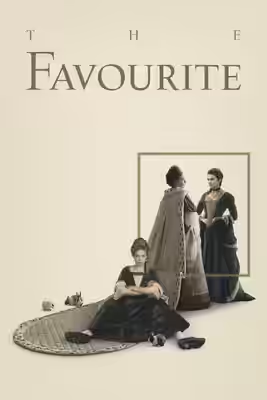
  2. The Favourite (2018, Fi1m 87)A later Stuart court where the mistresses do the governing and nobody is kind.

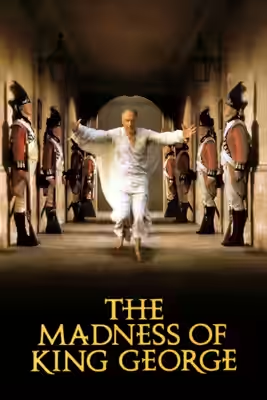
  3. The Madness of King George (1994, Fi1m 83)A king, a Parliament and a succession scare, played for comedy until it isn’t.

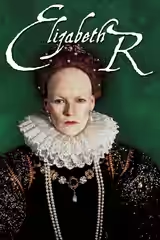
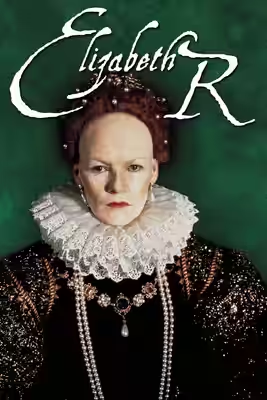
  4. Elizabeth R (1971) · not reviewed yetSix episodes of a monarch outthinking her advisers; stately where Wright is restless.

  5. La Prise de pouvoir par Louis XIV (1966) · not reviewed yetRossellini’s account of Charles’s cousin learning that power is a performance.

Free account

Know what to watch tonight

Two lists that know where things are streaming, collections you can share, your own score beside ours, and Discover that remembers what you have seen.

  • Want to see, sorted by what is streaming now
  • Seen, with your score out of ten
  • No adverts, ever