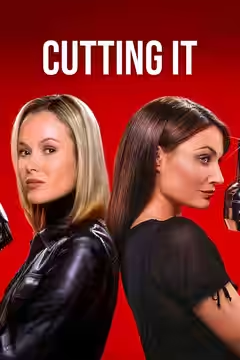
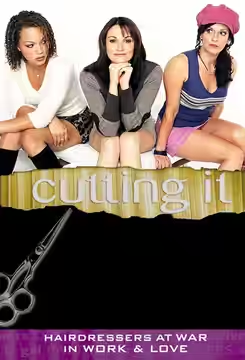
Debbie Horsfield’s hairdressing drama is a soap in a good coat: quick, funny, well cast and at its best when it does not ask to be believed. Sarah Parish holds it together across four series; by the last one, not much else does.
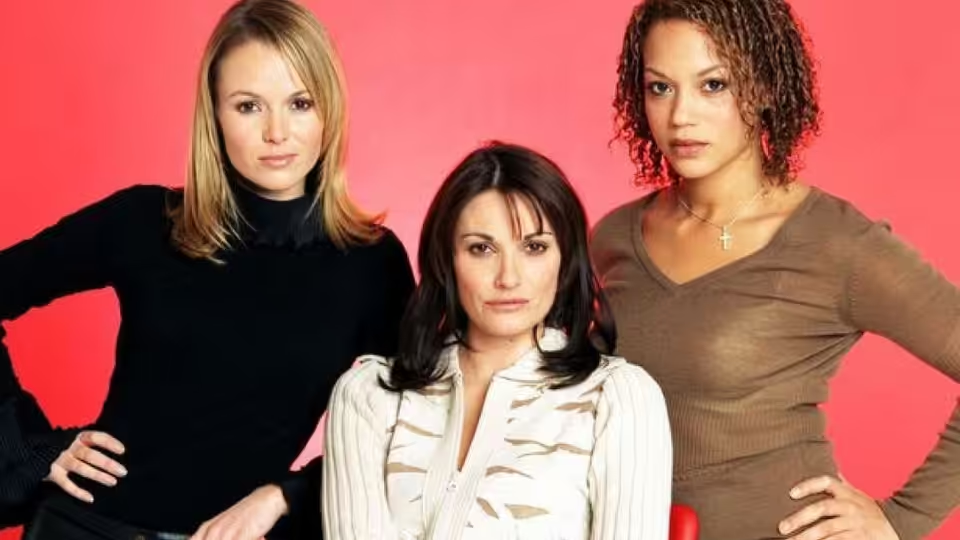
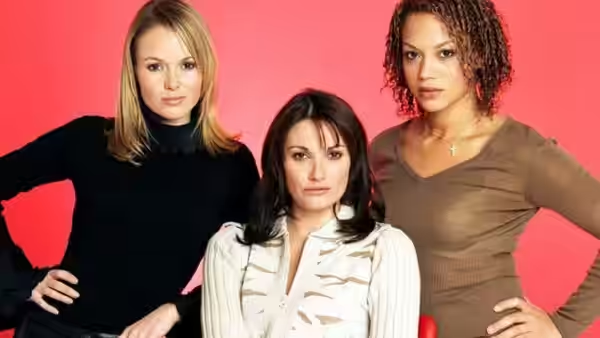
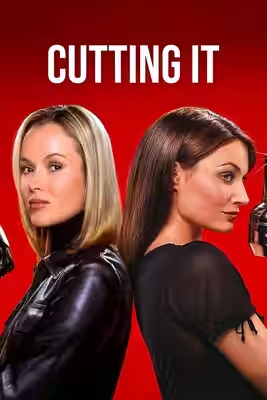
Debbie Horsfield writes about people who work with their hands and talk while they do it, and in Cutting It she gives them scissors. Two hairdressing salons face each other across a Manchester street. One belongs to Allie Henshall (Sarah Parish) and her fiancé Gavin Ferraday (Jason Merrells); the other is opened, in the first hour, by Finn Bevan (Ben Daniels) and his wife Mia (Amanda Holden). Allie and Finn have history. Gavin and Mia do not know. That is the engine, and Horsfield runs it for four series and twenty-five episodes, which is three series longer than the engine was built for.
It is good, and we want to be clear about that before we start listing what is wrong with it. The first series, which began on 16 April 2002, is as well-made a piece of mainstream British television as we had seen in a while. Horsfield writes dialogue people can say at speed, and she gives every character a job to do in every scene, so a conversation about a perm is also a conversation about a marriage. The salons themselves are the point. Everyone is looking at a mirror, which means everyone can see who is watching them.
Parish is the reason to watch. Allie is competent, sharp and quietly miserable, and Parish plays all three at once without underlining any of them. The scene in the first episode where she looks up from a client and sees Finn through the window across the road moved us more than a hairdressing drama had any right to. She does nothing. Her hands keep working. Daniels, opposite her, is cooler and harder to like, and that is correct; Finn is the sort of man who opens a shop across the road from an old lover and tells himself it is a business decision.
Around them, the cast is deep and mostly used well. Annette Badland’s Brawdie, the Henshall matriarch, got more laughs out of us than anyone, usually by saying the thing the whole room was thinking and then helping herself to a biscuit. Sian Reeves and Angela Griffin, as the sisters, are given real lives rather than reaction shots. Merrells has the hardest part, the decent man in the way, and manages to keep Gavin sympathetic even when the script needs him to be a fool. Amanda Holden’s Mia is brittle and expensive and works best when she is allowed to be funny.
The look is bright and clean. Four cinematographers, Sean Van Hales, Mark Waters, Ian Liggett and Grant Cameron, share the credit across the run, and between them they keep the salons white, glossy and over-lit, like a magazine spread you could walk into, while the Henshall kitchen stays cluttered and warm. Mark Hinton Stewart’s music is light and quick and sits under the pop songs rather than fighting them. Nine directors took turns, from Roger Goldby to Fraser Macdonald, and the house style is strong enough that you cannot tell where one hands over to the next. The five editors keep each hour moving at a clip; nothing lingers, which suits a show about people who talk fast.
The trouble is what Horsfield does once the first secret is out. Every series needs a new one, and they get bigger. By the fourth series, which arrived on 7 June 2005, the show has stopped being about two salons and started being about whatever will get it through the next hour. We will not say what happens. We will say that a story which began with a woman looking through a window ends up needing a great deal more than a window to shock us, and that we stopped believing in these people some time before the show stopped asking us to. The one critic we have read on the third series enjoyed exactly the chaos that wore us down, and we can see why; it is never boring. It is just no longer true.
Watch the first series on its own merits, and the second if you are enjoying yourself. After that you are watching a soap, a good one, and you should go in knowing it.