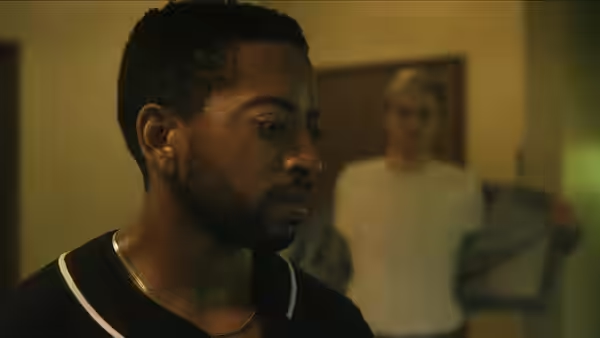
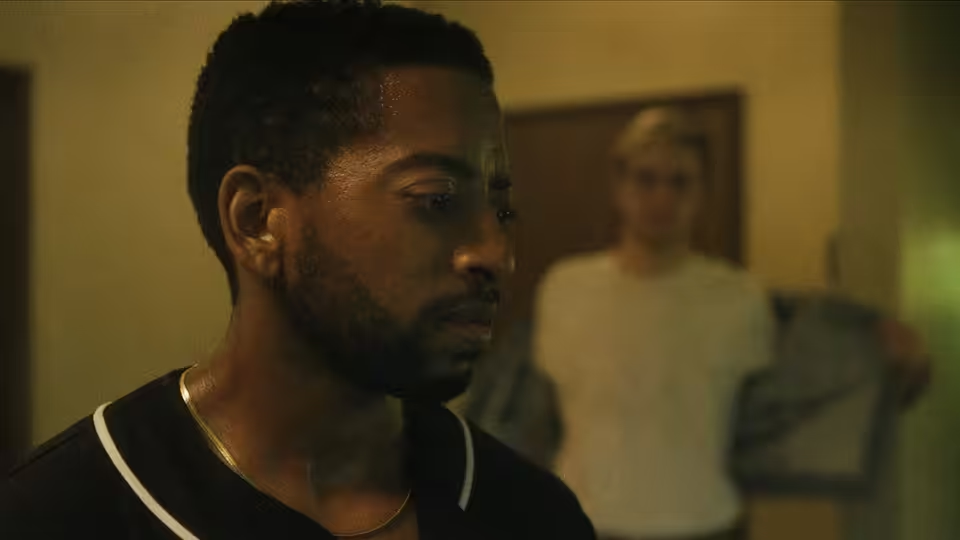
A bearded man in a black shirt looks sideways with a person in the background
Series review

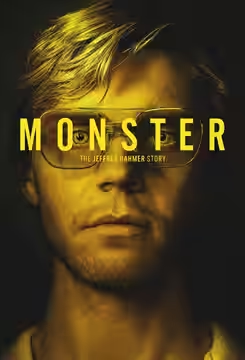
DAHMER - Monster: The Jeffrey Dahmer Story

2022 · Created by Ian Brennan, Ryan Murphy · Series · LSF D

In a sentenceTen episodes about Dahmer, several good performances, and an increasing wish to spend time with somebody else

Jeffrey Dahmer (Evan Peters) is the focus of a dramatisation of his life and crimes. The opening stretch concentrates on his biography, while Lionel Dahmer (Richard Jenkins) and Glenda Cleveland (Niecy Nash) form part of the wider account. Shari Dahmer (Molly Ringwald) and Catherine Dahmer (Michael Learned) also appear. The ten-episode series follows the crimes and examines the failures that allow them to continue, bringing in the perspectives of victims and parents as it moves beyond its initial concentration on Dahmer himself.

Fi1m review

Evan Peters, Richard Jenkins and Niecy Nash give strong performances in a crime drama that too often repeats itself. The passages devoted to victims suggest a more worthwhile series than the prolonged study of Dahmer delivers.

Ryan Murphy and Ian Brennan’s DAHMER – Monster: The Jeffrey Dahmer Story is a well-acted crime drama that spends too long repeating its most unpleasant material. It wants to examine the failures that allowed Jeffrey Dahmer’s crimes to continue and give proper attention to the people he harmed. Yet its early biographical emphasis keeps bringing us back to Dahmer, as though another examination of him will explain what the previous one could not. Across ten episodes, that becomes exhausting.

Evan Peters is a substantial reason to persist. His performance as Jeffrey Dahmer sustains an unsettling presence even when the writing has stopped offering much new to consider. We were worn down by the repeated attention to the grisly details of the crimes. There comes a point when another passage of appalling behaviour merely confirms what the programme has already established, and the performance cannot make that repetition useful.

Richard Jenkins, as Lionel Dahmer, and Niecy Nash, as Glenda Cleveland, make the wider cast worth attending to. Both give the series a reason to move beyond its scrutiny of the killer, and both are underserved by the uneven attention paid to other lives. The material concerned with the parents broadens the account, though it still keeps the questions close to Dahmer. For a programme professing concern for victims, the time allotted to each perspective matters.

Jason McCormick and John T. Connor’s cinematography gives the series a sepia cast that makes the prolonged unpleasantness still more oppressive. It is a consistent look, but there is little respite from its insistence that everything must feel dreadful. Matthew Flood Ferguson’s production design is caught in that treatment, with the surroundings chiefly reinforcing the discomfort. The visual coherence is a virtue, yet the programme needs more changes of emphasis if it is going to hold our attention for this long.

The editing, credited to Curtis Thurber, Regis Kimble, Taylor Joy Mason and Stephanie Filo, leaves the shifts between biography and the wider failures feeling awkward. Too much material repeats the same points before the series gets round to people and questions that warrant more attention. Nick Cave and Warren Ellis’s music contributes to the unease, although further unease is seldom what these passages need. The slow progress makes the accumulated discomfort harder to tolerate.

The sixth episode shows what changes when a victim’s life receives sustained attention. Its use of sound and its interest in that person’s history allow the programme to spend time on something beyond the details of a crime. We were moved by the care given to that history. The improvement is considerable, and it makes the decision to spend so much time with Dahmer elsewhere more frustrating.

Crime drama can examine a perpetrator closely and still find room for the people around him. Here, the stronger attention to victims and institutional failure comes after too much familiar, punishing biography, and it cannot repair the series’ uneven shape. The good performances and the more thoughtful passages keep it from being a simple exercise in unpleasantness. Anyone drawn by the cast should be prepared for long stretches when the programme has little to offer beyond another reason to feel ill.

Critical consensus AI synthesised

51
Positive
1
Mixed
4
Negative
1

The reviews lean towards mixed, with praise clustering around the performances rather than the storytelling. Evan Peters earns credit for an unsettling portrayal of Dahmer, while Richard Jenkins and Niecy Nash also draw approval. Critics find more to value when the series gives its victims sustained attention. Vulture singles out the episode centred on Tony Hughes, praising its use of audio and backstory to give him the humanity that other episodes struggle to establish.

The main reservations concern repetition, uneven structure and the amount of time spent on grisly detail. Several critics question whether the promised focus on victims survives the series’ fascination with the killer. The spread is fairly narrow, though Consequence offers a more favourable assessment: it finds that the second half effectively addresses victims and systemic failures after a laboured opening stretch. Elsewhere, those improvements rarely outweigh concerns about exploitation or a lack of insight.

The Telegraph
21 September 2022
51*

The review describes the series as landing between tedious and too appalling to watch, leaning heavily into grisliness to the point of being unwatchable. It notes Evan Peters' performance as a saving grace in an otherwise competent but overly queasy character study.

Read the full review →
The Hollywood Reporter
22 September 2022 · Daniel Fienberg
50*

The series is an infuriating hodgepodge that is haphazardly structured and never finds a happy medium between exploration and expectation. Strong performances, particularly from Richard Jenkins and Niecy Nash, are undermined by repetitive storytelling.

Read the full review →
Vulture
23 September 2022 · Jen Chaney
50*

The series states its aim to humanize victims but frequently centers the killer instead, with uneven execution across episodes. It singles out the sixth episode for effectively shifting focus to victim Tony Hughes through innovative audio design and backstory.

Read the full review →
The Guardian
23 September 2022
46*

The critic finds the series almost unwatchably queasy and exploitative, spending too long on the grisly details of Dahmer's crimes without much insight or focus on victims. It improves later with episodes on a victim's life and the parents' perspective, but overall seems thrilled by its own unpleasantness.

Read the full review →
Variety
21 September 2022 · Caroline Framke
43*

The series is a grim, sepia-toned slog that rarely justifies its own existence, with a nonsensical title and predictable addition to Ryan Murphy's oeuvre. It only meaningfully expands beyond the killer himself in one standout episode focused on a victim.

Read the full review →
Consequence
22 September 2022 · B-
70

The series aims to highlight Dahmer’s victims and the systemic failures that enabled his crimes but only achieves this effectively in the second half after a somewhat familiar and sloggy biographical first portion. Evan Peters gives a strong, unsettling performance as the killer.

Read the full review →

Straight answers AI written, from our review

How long is DAHMER - Monster: The Jeffrey Dahmer Story, and what is it rated?
DAHMER - Monster: The Jeffrey Dahmer Story is rated D by the LSF in Indonesia. It is a crime and drama series.
Where can I watch DAHMER - Monster: The Jeffrey Dahmer Story in Indonesia?
DAHMER - Monster: The Jeffrey Dahmer Story is streaming on Netflix in Indonesia. Availability is checked daily; the links above go straight to each service.
What should I watch after DAHMER - Monster: The Jeffrey Dahmer Story?
After DAHMER - Monster: The Jeffrey Dahmer Story, try Zodiac (2007, Fi1m 91): A patient investigation that makes obsession disturbing without treating the killer as fascinating. Then Memories of Murder (2003, Fi1m 91): Police failures and social pressures become as troubling as the crimes under investigation; and M (1931, Fi1m 94): Murder, public panic and competing authorities, with a sharper sense of social consequence.

Cast

If you liked this, try…

  1. Zodiac (2007, Fi1m 91)A patient investigation that makes obsession disturbing without treating the killer as fascinating.

  2. Memories of Murder (2003, Fi1m 91)Police failures and social pressures become as troubling as the crimes under investigation.

  3. The Investigation (2020) · not on Fi1m yetA procedural that gives investigators and the victim’s family the sustained attention they deserve.

  4. M (1931, Fi1m 94)Murder, public panic and competing authorities, with a sharper sense of social consequence.

  5. Unbelievable (2019) · not on Fi1m yetA drama about sexual assault that takes the experience of being disbelieved seriously.

DAHMER – Monster: The Jeffrey Dahmer Story (2022) review: Good acting (Indonesia) | Fi1m