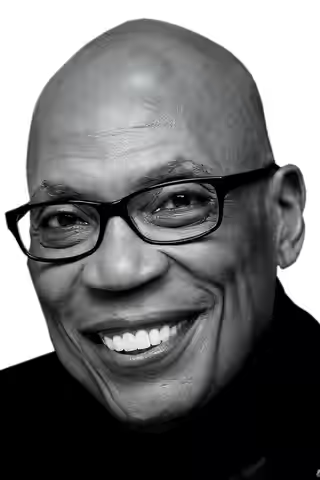
Paris Barclay’s strength is patient work with actors inside an established programme. We rate his adaptability and care with ensembles, though an overinsistent camera move can undo the discretion he values.
Fi1m perspective
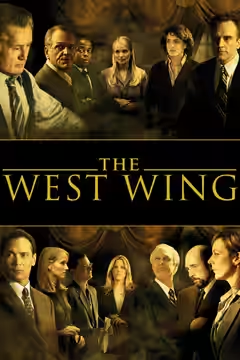
A circular Steadicam shot in The West Wing draws attention because it breaks the programme’s established style. The episode is The Indians in the Lobby, and the director is Paris Barclay. It is an instructive lapse for someone who aims to fit his work to each series and keep himself out of the way. Here, the movement is too conspicuous. A director joining an established series has to judge how much the audience can be asked to notice before the actors cease to hold its attention.
In The West Wing (1999), the actors make an earnest programme absorbing and funny. We warmed to the speeches because the cast finds the human feeling in them, even when the dialogue sounds pleased with itself. That is precisely the sort of work an unobtrusive director ought to protect. Those virtues belong to a series and its ensemble, however, and cannot all be credited to Barclay. His preference for adapting to an established programme makes sense here, though even the most attentive direction cannot entirely rescue dialogue that congratulates itself.
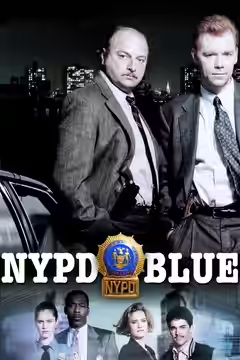
The route to that work ran through music videos for LL Cool J and Janet Jackson, followed by his first feature, Don't Be a Menace to South Central While Drinking Your Juice in the Hood (1996). Series television, entered through John Wells on ER and NYPD Blue, gave Barclay a more sustained place to work with casts. On In Treatment (2008), he was both executive producer and a frequent director, directing dozens of episodes across three seasons with a theatrical rehearsal process. That attention to preparation helps explain why actors and ensembles are central to our view of his work. His background in musical theatre and music videos also informs his work with ensembles and musical numbers, where keeping track of several performers is part of the job.
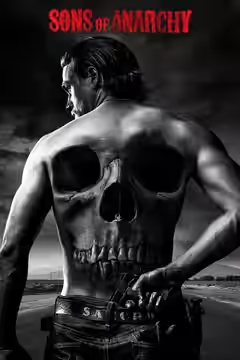
The sustained involvement continued on Sons of Anarchy, where he was executive producer and primary director for seasons four to seven. His work also takes in Glee and Ryan Murphy’s Dahmer – Monster: The Jeffrey Dahmer Story (2022), placing him with markedly different ensembles and material. Calling him unobtrusive should not mean overlooking how much responsibility those producing posts carry. Start with The West Wing, provided its fondness for an earnest speech does not put you off.
Biography
Paris Barclay (also credited as Paris K.C. Barclay) is an American television director, producer and writer. He studied English at Harvard University and began his career directing music videos before moving into film and television in the 1990s.
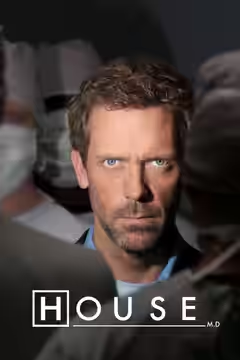
He has directed episodes of numerous series including The West Wing (1999), NYPD Blue, ER, Lost (2004), House (2004), Sons of Anarchy (2008), Glee, American Horror Story (2011), How to Get Away with Murder (2014), Station 19 (2018) and DAHMER – Monster: The Jeffrey Dahmer Story (2022). Barclay won two Primetime Emmy Awards for directing NYPD Blue and served two terms as President of the Directors Guild of America from 2013 to 2017, the first African-American and first openly gay person to hold the post.