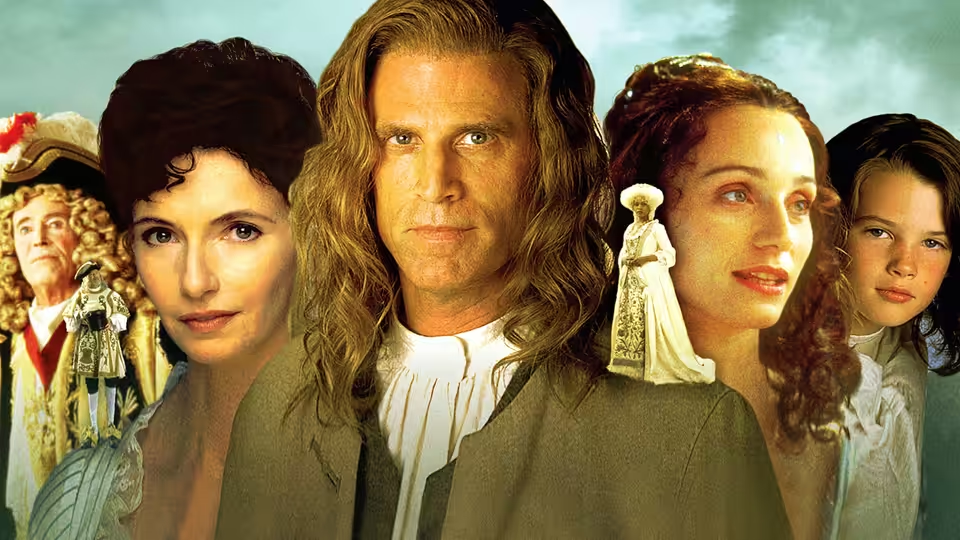
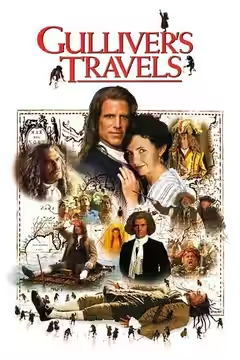
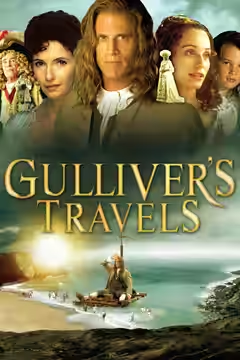
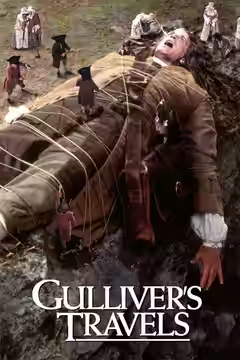
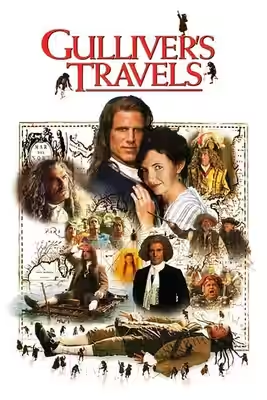
Charles Sturridge’s two-part Swift is handsome, well acted and kinder than the book, which is both its charm and its limit. Ted Danson is better than you fear, Peter O’Toole is a delight, and the asylum framing gives it a spine the voyages alone would not have.
Simon Moore’s adaptation starts where Swift’s 1726 book never goes: at home. Lemuel Gulliver walks back into his village after years at sea and will not stop talking about tiny men and flying islands, so Dr. Bates has him locked in Bedlam, and the voyages are told from a cell, to doctors and to a wife who wants her husband back. It is a clever idea and the series earns most of it. Over two episodes, first broadcast on 4 February 1996, Charles Sturridge makes a handsome, good-natured and slightly soft version of a famously unkind book, and we enjoyed it more than we expected to.
The framing works because of how Peter Coulson cuts between the two worlds. A hand on a cell door becomes a hand on a Lilliputian gate; Gulliver turns in the asylum yard and finishes the turn on a beach. The transitions are the best thing in the series and they do a job, because they let Danson stay one man in two places rather than a narrator and a hero. Howard Atherton lights Bedlam in cold grey daylight from high windows and the voyages in warmer colour, so we always know which world Gulliver would rather be in.
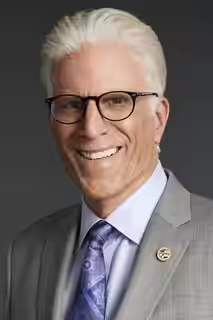
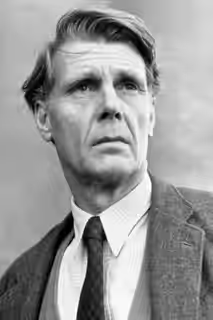
Danson was cast, we assume, for American viewers, and he is better than the assumption. He plays Gulliver as a decent, literal man who cannot understand why the truth is not enough, and he is good at the slow business of a mind fraying in a cell while staying lucid about Lilliputian court politics. We were moved more than we expected in the scene where his wife visits and he cannot stop telling her about the King of Lilliput long enough to ask her anything about the years he missed; Danson plays it without self-pity, and that is what hurts. James Fox’s Bates is smooth, patient and poisonous, a villain who never raises his voice because he has the law.
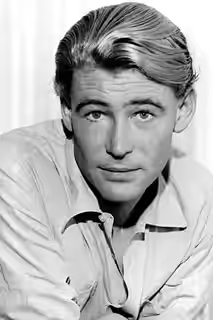
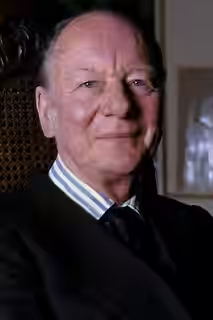
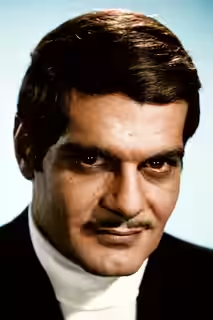
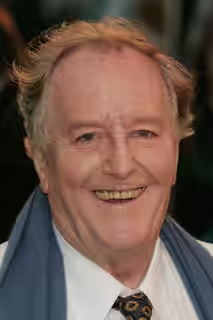
Then there is the cast list, which reads like a benefit evening. Peter O’Toole’s King of Lilliput is the best of the guests, a tiny tyrant of enormous vanity who regards his giant as a public work and is capable of real outrage when the giant disagrees. Alfre Woodard’s Queen of Brobdingnag treats Gulliver with an amused tenderness that unsettles more than cruelty would, and Ned Beatty’s Farmer Grultrad is exactly the man who would charge a penny a look. Some of these are performances and some are cameos, and the series does not always know the difference. Gielgud’s Professor of Light, trying to get sunbeams out of cucumbers, is a complete comic character; Sharif is on and off before his Sorcerer has done much of anything.
What has dated is the trick photography. Danson in Lilliput is often a man standing in front of a plate, with a faint halo at his shoulders, and he and the little people never quite share the same ground. It is noticeable, it was presumably noticeable in 1996, and after an hour we stopped minding, because Sturridge keeps the camera on faces rather than on the join. Shirley Russell’s costumes do a lot of the work the effects cannot, the Lilliputians in a riot of frogging and feathers, the court of Brobdingnag in heavy stuff that makes everyone look like furniture.
The softness is in the writing. Swift wrote the book to tell the human race what he thought of it, and the later voyages are the bitterest things in English satire. Moore keeps the destinations and files the point off most of them, and the last stretch is warmer than anything Swift would have signed. Sturridge made Brideshead Revisited for television and he brings the same patience here, which is a virtue in Bedlam and a drag in Laputa, where the second episode slows down so that everyone can have their scene.
Watch it over two evenings, as it was made to be watched, with children old enough to sit through the asylum. It is a kind, careful, well-acted Gulliver, and if it is not quite Swift, it is a good deal better than most of what carries his name.