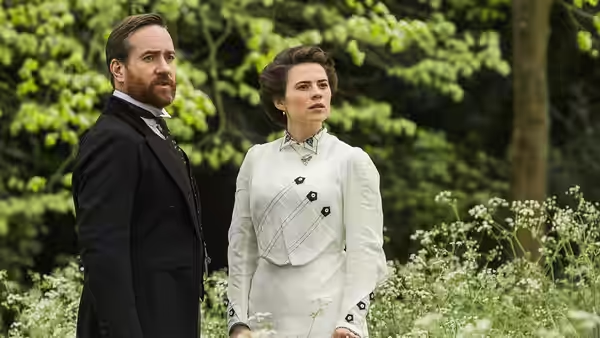
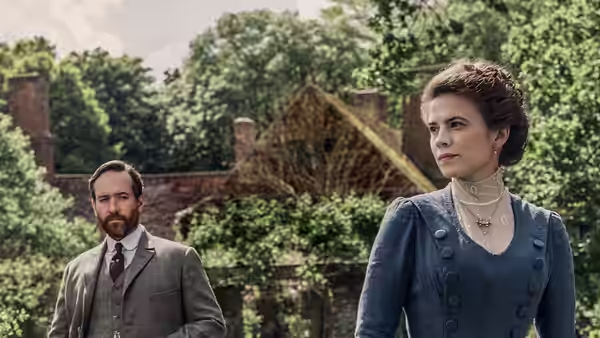
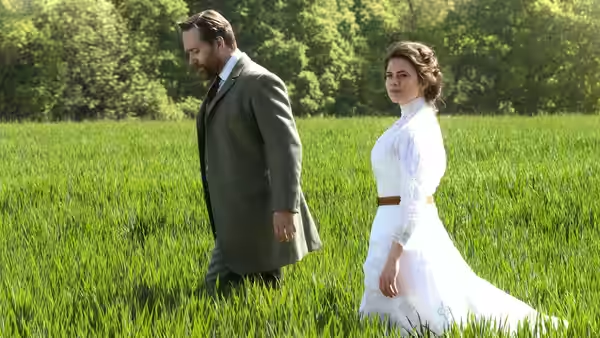
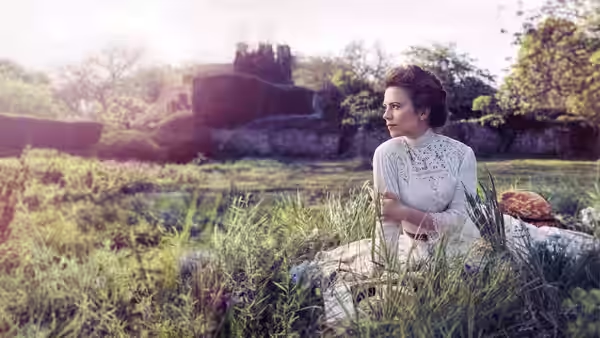
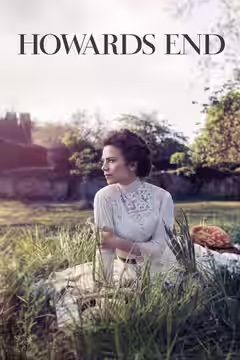
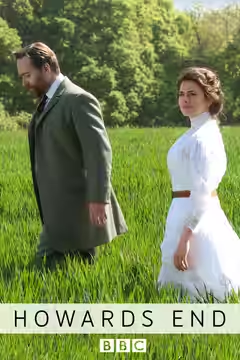
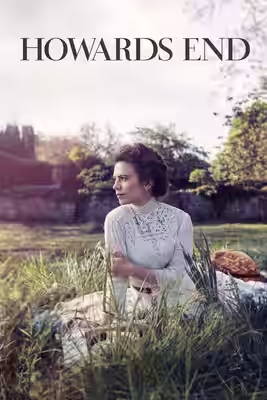
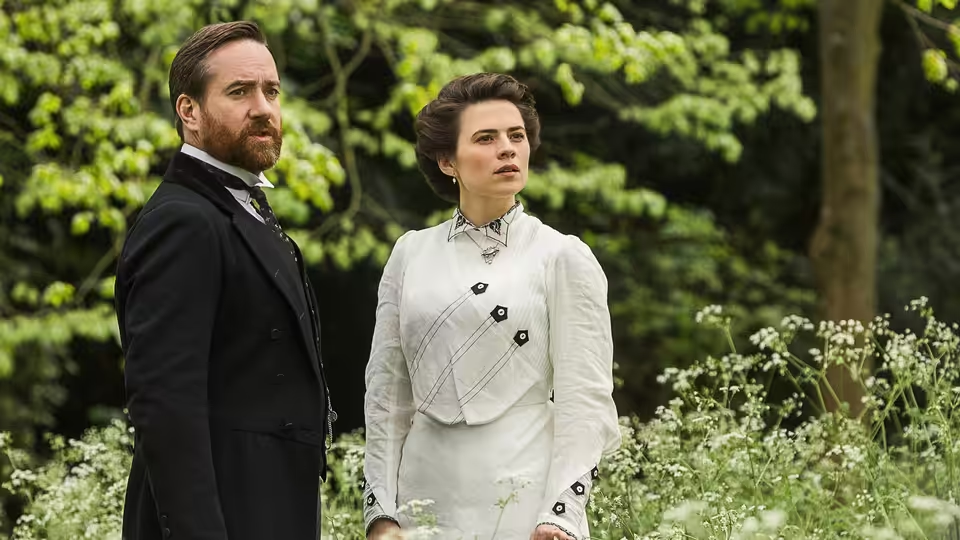
Henry Wilcox (Matthew Macfadyen) and Margaret Schlegel (Hayley Atwell) stand among flowers in a garden
Series review

Howards End

2017 · Created by Hettie Macdonald · Series · 55m

In a sentenceFour episodes of arguments, and we would still accept an invitation from the Schlegel sisters

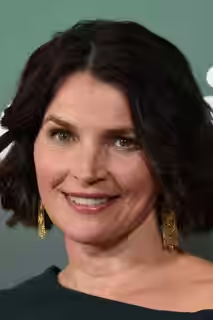
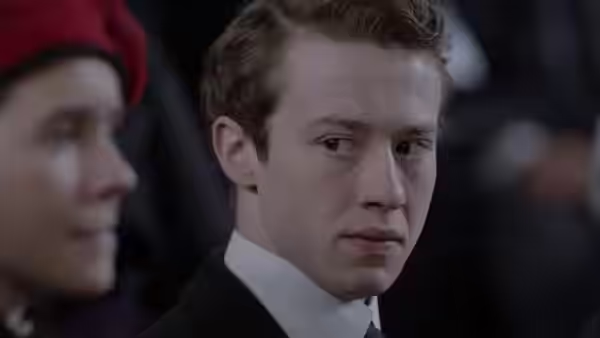
Margaret Schlegel (Hayley Atwell) and Helen Schlegel (Philippa Coulthard) are sisters with ideas about how people should live, and a relationship that accommodates disagreement. Their circle brings them into contact with Henry Wilcox (Matthew Macfadyen), Mrs. Wilcox (Julia Ormond) and Leonard Bast (Joseph Quinn). Differences of class and politics complicate the prospect of understanding one another, while affection makes those differences harder to keep at a distance. Across four episodes, Kenneth Lonergan’s adaptation of E.M. Forster’s novel follows the conversations and relationships through which these people try to find common ground.

Plays from YouTube when you press play; nothing loads from them until then.

Fi1m review

A warm, absorbing adaptation, carried by Hayley Atwell and Philippa Coulthard. Its conversations are more persuasive than its central romance, but the sisters make four episodes feel like time well spent.

Hettie Macdonald’s Howards End is a warm, intelligent adaptation that earns our attention through its conversations. Kenneth Lonergan, adapting E.M. Forster’s novel, takes seriously the pleasure of talking to someone who disagrees with us, and the irritation of discovering they have a point. The exchanges about class and the place of women have enough human friction to keep them from feeling like subjects set for discussion. The main weakness is a romance that needs more time to become convincing; the Schlegel sisters are persuasive from the start.

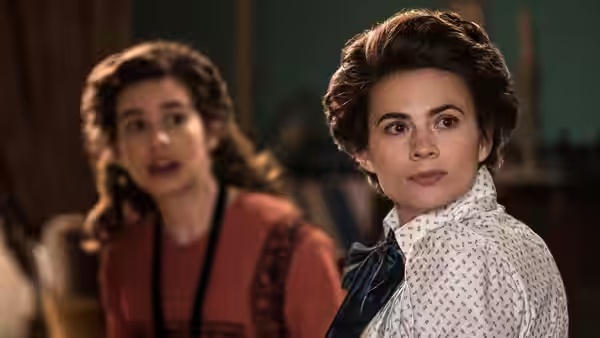
Hayley Atwell plays Margaret Schlegel with an enjoyment of other people that makes the character easy to spend time with. She can sound certain without seeming finished with the conversation, a useful distinction in a drama where opinions matter so much. Philippa Coulthard gives Helen Schlegel the energy to challenge that certainty. We grew fond of these sisters because their disagreements never made us doubt their attachment to one another. The performances give the dialogue the familiarity of people who have heard each other argue before.

Matthew Macfadyen gives Henry Wilcox an assurance that can make disagreement feel like an inconvenience. Julia Ormond’s Mrs. Wilcox is more quietly affecting, and her warmth complicates any easy division into sympathetic and unsympathetic households. Both performances matter because the sisters are such appealing company that everyone else risks being judged by how well they suit them. The supporting cast keeps the drama from becoming quite so comfortable, giving us reasons to take an interest in people who do not share the sisters’ habits of mind.

The series also understands that having an opinion about inequality is much easier when the conversation costs nothing. Its arguments about class retain a useful awkwardness: liking someone does not settle the practical differences between their lives. Kenneth Lonergan gives women’s voices enough space to be insistent, funny and occasionally exhausting. We are allowed to enjoy the sisters without being required to endorse everything they say, and the writing leaves their disagreements open long enough for us to consider them.

Luke Hull’s production design provides an attractive period setting without making the furnishings more interesting than the people. Hettie Macdonald keeps the emphasis on the cast, which is the right choice when these faces have so much to tell us. Nico Muhly’s music is more persuasive when it leaves the emotion alone; at times its warmth feels like encouragement we did not need. The performances already give us ample reason to care, particularly when the sisters are together.

Stephen O’Connell’s editing generally gives the dialogue enough breathing room for the relationships to feel familiar. The unevenness comes when the series asks its central romance to become convincing on a tighter schedule. We can understand the attraction without quite feeling that we have watched it develop, and the compression is conspicuous beside the patience elsewhere. Four episodes offer welcome space for discussion, but the lovers could have used more of it. This is a substantial reservation in a drama so concerned with how people come to understand one another.

As a literary television drama, Howards End makes good use of the freedom to linger over a conversation. There are stretches that will feel slow to anyone waiting for the next confrontation, though the humour usually prevents the earnestness from becoming heavy. Its strongest reason to stay is the sisters, whose company remains engaging even when their opinions become tiring. Choose it for an evening when there is time to listen.

Critical consensus AI synthesised

72
Positive
6
Mixed
1
Negative
1

Most critics welcome Howards End as a fresh, thoughtful adaptation, with praise clustering around the cast and the attention paid to people and ideas rather than period spectacle. Hayley Atwell is the recurring highlight, while the Schlegel sisters’ relationship gives several reviews their strongest reason to recommend the series. The dialogue, warmth and interest in women’s voices also earn approval, alongside a treatment of class and politics that most critics find relevant and humane.

The spread is wide, however, and the reservations concern pace and dramatic development. Some find the series overly stately or a central romance rushed. The i Paper admires the cast and sensitivity to Forster’s tone but remains mixed about the execution. Variety is the sharpest dissenter: it praises the performers, particularly Julia Ormond, yet finds the adaptation syrupy and messy, its final hour mishandled and its humanity diminished.

IndieWire
5 April 2018 · A · Ben Travers
95

Travers praises the adaptation as lively, incisive, and timely. He especially singles out Hayley Atwell’s joyful, compelling performance as Meg.

Read the full review →
The Hollywood Reporter
3 April 2018 · Tim Goodman
85*

The reviewer finds this adaptation fresh, focused, and successful on its own merits. They especially praise Hayley Atwell and Philippa Coulthard, whose performances make the Schlegel sisters the retelling’s compelling heart.

Read the full review →
Evening Standard
2 November 2017 · Johanna Thomas-Corr
80*

Thomas-Corr calls the adaptation an intelligent, handsome period drama that speaks compellingly to contemporary concerns. She praises its sharp dialogue and thoughtful focus on ideas, especially women’s voices.

Read the full review →
The Guardian
4 December 2017 · Sam Wollaston
80*

Wollaston finds the adaptation thoughtful, humane, witty and bold, despite its lack of a rollicking finale. He especially praises its portrayal of Margaret and Helen’s relationship and the focus on people and ideas over period spectacle.

Read the full review →
Vulture
6 April 2018 · Matt Zoller Seitz
75*

Seitz finds the miniseries a subtly audacious, fresh adaptation that mostly delivers and grows more distinctive as it unfolds. He praises its nuanced treatment of race and class, while noting that a crucial love story feels rushed.

Read the full review →
The i Paper
12 November 2017 · Jeff Robson
55*

Robson finds the adaptation overly stately, though he thinks it could become one of the BBC’s finest literary dramas. He praises its cast and its warm, perceptive capture of Forster’s tone.

Read the full review →

Straight answers AI written, from our review

Is Howards End worth watching?
Howards End is worth watching for patient viewers who enjoy literary drama and lively disagreement; we score it 80 out of 100. Hayley Atwell and Philippa Coulthard make the Schlegel sisters warm, absorbing company across four episodes, though the central romance develops too quickly to convince and some conversations will feel slow to viewers wanting more incident.
How long is Howards End, and what is it rated?
Howards End has episodes of about 55m. It is a drama series.
Where can I watch Howards End in Canada?
Howards End is streaming on Crave, Amazon Prime Video and Apple TV in Canada, and it is also available to buy from Apple TV. Availability is checked daily; the links above go straight to each service.
How violent or frightening is Howards End, and is it suitable for children?
Howards End carries a US TV-14 rating, which signals parental caution for children under 14 rather than suitability for young children. Our review describes a conversation-led drama about class, politics and relationships, but does not establish its levels of violence or frightening material, so we cannot give a more specific reassurance for sensitive viewers.
How does Howards End compare to The Age of Innocence?
Howards End offers engaging conversations and sisterly affection, while The Age of Innocence is the more persuasive romance. Both patiently examine affection constrained by money, manners and social expectation; we recommend the series for the Schlegel sisters’ company and the film for its painful treatment of suppressed desire, though both can linger longer than necessary.
Is Howards End based on a true story or a book?
Howards End is Kenneth Lonergan’s adaptation of E.M. Forster’s novel, rather than a drama presented as a true story. We find it attentive to the book’s concerns with class, women’s lives and human connection, without making a claim for scene-by-scene fidelity; the sisters and their conversations give newcomers enough reason to watch without reading the novel first.
What should I watch after Howards End?
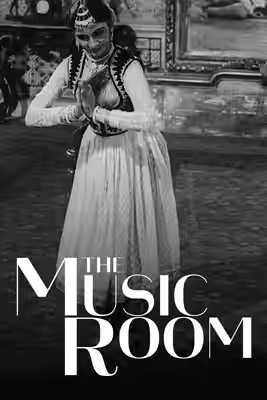
After Howards End, try The Age of Innocence (1993, Fi1m 86): Another patient examination of affection constrained by money, manners and social expectation. Then North & South (2004, Fi1m 83): Class disagreements give a developing romance something substantial to contend with; and The Music Room (1958, Fi1m 88): For another view of class, property and the comforts of cultivated taste.

Cast

If you liked this, try…

  1. The Age of Innocence (1993, Fi1m 86)Another patient examination of affection constrained by money, manners and social expectation.

  2. North & South (2004, Fi1m 83)Class disagreements give a developing romance something substantial to contend with.

  3. The Makioka Sisters (1983) · not reviewed yetFamily loyalties and social expectations complicate the lives of four sisters.

  4. The Music Room (1958, Fi1m 88)For another view of class, property and the comforts of cultivated taste.

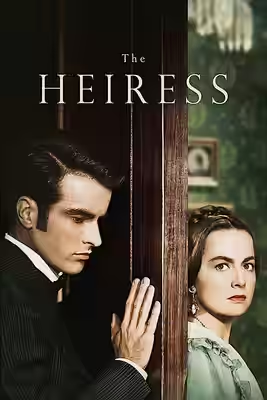
  5. The Heiress (1949, Fi1m 90)Money makes affection difficult to judge in another closely observed literary adaptation.

Free account

Know what to watch tonight

Two lists that know where things are streaming, collections you can share, your own score beside ours, and Discover that remembers what you have seen.

  • Want to see, sorted by what is streaming now
  • Seen, with your score out of ten
  • No adverts, ever