Nicole Taylor’s fourteen-part version of David Nicholls’s novel gives the one-day-a-year idea the time the film never had, and Ambika Mod is reason enough to stay. It spends too long on Dexter and lets the middle sag, but the last stretch landed on us hard.
David Nicholls’s novel follows two people for twenty years by looking in on them once a year, on 15 July, and leaving before the day is out. A film tried this in 2011 and had to skip most of the years. Nicole Taylor’s series gives each year its own episode, fourteen in all, which is the shape the idea always wanted. It is good television, slow in the middle, too fond of its leading man, and in its last stretch it got to us. If romances are your genre, it is worth your evening. Several evenings, in fact.
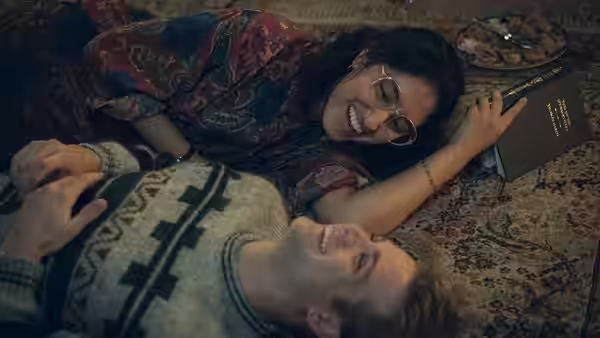
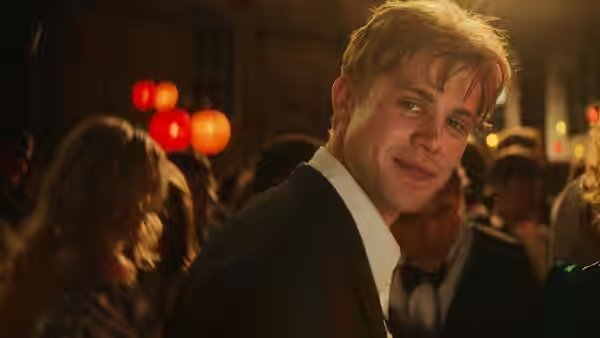
Ambika Mod carries it. Her Emma is quick and deflecting, a woman who makes the joke before anyone else can make it about her, and Mod lets us see the half-second after each line when Emma checks whether it landed. She is funny the way people are funny when they are nervous, and she gets less nervous as the years pass, and the performance changes with her. Leo Woodall has the harder job, because Dexter is a handsome boy who wants to be looked at and has no idea what to do once he is, and Woodall plays the charm as a habit rather than a gift. For the first two episodes we were not convinced they liked each other. That turns out to be roughly the point, and the series is patient enough to let the liking arrive.
Four cinematographers are credited, Ollie Downey, Jonas Mortensen, Álvaro Gutiérrez and Nick Cooke, and the look holds across all fourteen episodes: warm, soft, mostly daylight, with Edinburgh at dawn in the first episode shot in a long pale light the series spends the rest of its run trying to get back to. Patrick Rolfe’s production design does the social work the dialogue is sometimes too polite to do. Emma’s rooms are small and the books are on the floor; Dexter’s parents’ house has a lawn, a pool and a drinks tray. Emma Rees puts Emma in big glasses and jumpers a season behind and Dexter in shirts open a button too far, and when the glasses eventually go you notice before anyone on screen does. The score, by Anne Nikitin, Tim Morrish and Jessica Jones, stays out of the way; the period pop does the heavier lifting, and once or twice does too much of it.
The trouble is Dexter. The middle run of episodes follows his years on television, and they teach the same lesson about fame and drink several times over, while Emma’s life, her writing, her flat, her own disappointments, is handled in a scene or two per episode. Four directors share the series (John Hardwick, Luke Snellin, Molly Manners and Kate Hewitt) and five editors are credited, and you feel the joins less in the look than in the pace: some episodes know exactly how long their day is, and some stay at the party an hour after it has ended. Essie Davis and Tim McInnerny, as Dexter’s parents, are excellent in little, Davis especially. Amber Grappy’s Tilly is the kind of friend the script remembers whenever Emma needs someone to say the obvious thing and forgets the rest of the time.
Then there is an episode late on, built around one long walk and one long conversation, where we noticed we had stopped taking notes. It moved us more than we expected, and we can say why: by then the series had spent a dozen episodes teaching us exactly how these two talk to each other, the jokes they use to avoid saying things, so that when one of them finally says the plain thing we heard every year behind it. What follows we will not describe. We will say the last episodes are handled with more restraint than the middle ones, and that the restraint is the right choice.
Against the book, this is faithful to a fault. Against the 2011 film, with Anne Hathaway as Emma, it is a clear improvement, mainly because it has time. Against the best recent television romance, Normal People (2020), it is softer and less willing to let its people be unlikeable for long. Nicholls was always kinder to Dexter than Dexter deserved, and the series inherits that.
Watch it two or three episodes at a time rather than in a weekend. The idea works because a year has gone by between visits, and a night off between episodes does something similar for you. It carries a 15 certificate.