Andrea Levy’s novel arrives on television with its warmth intact and its structure squeezed. Naomie Harris and Ruth Wilson carry the two halves of it, and a narrator keeps telling us what their faces have already said.
Andrea Levy’s novel told its story in four voices across two islands, and gave each of them room. John Alexander’s adaptation, written by Paula Milne and Sarah Williams, has two ninety-minute episodes to do the same and spends them well. It is warm, it is properly cast, and it is about a thing British television had not often looked straight at: what the people who answered the call to the Mother Country found when they got here. It is also a series that does not trust us to notice any of this unaided, and that is the one fault that matters.
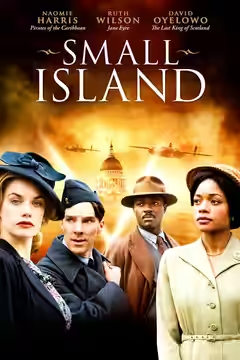
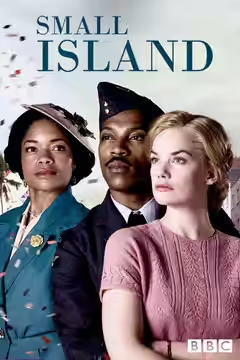
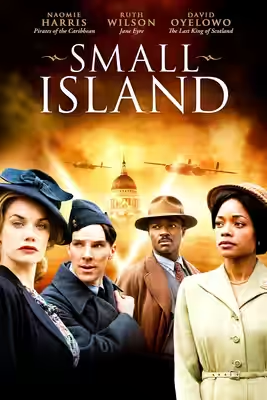
The shape is simple enough. Hortense (Naomie Harris) wants England, Gilbert (David Oyelowo) wants to be treated as the airman he was, and Queenie (Ruth Wilson) wants anything to happen at all in a house in Earls Court where her husband Bernard (Benedict Cumberbatch) is missing and the lodgers are the only company. The war puts Gilbert and Queenie under the same roof; 1948 puts Hortense there too, with a suitcase and a set of expectations that nobody has thought to correct.
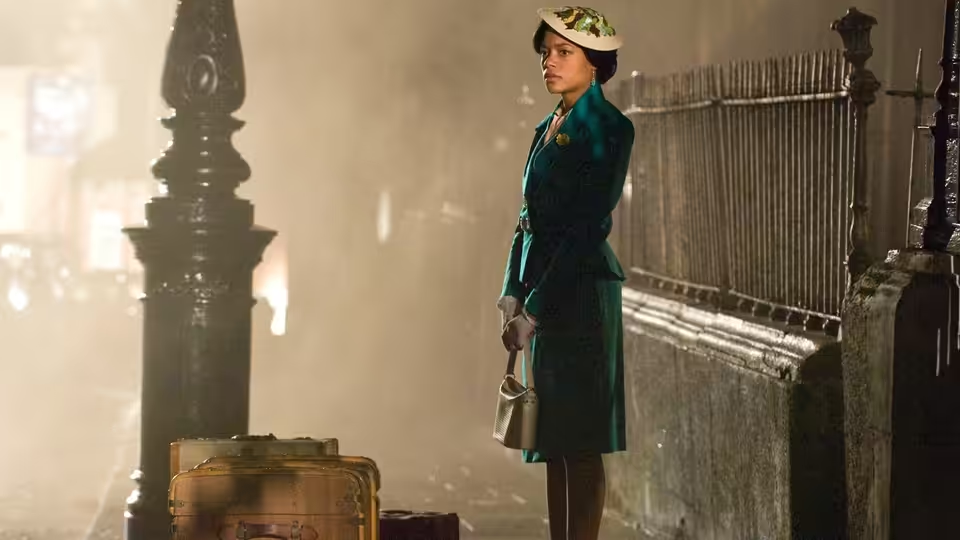
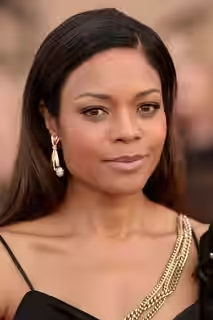
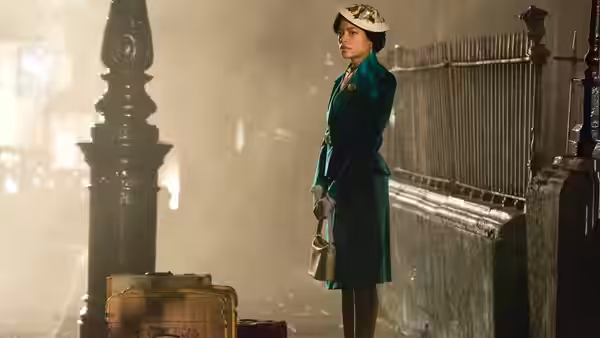
Harris is the reason to watch. She plays Hortense with a straight back and a set of vowels learned from a book, and she lets us see how much work it costs to hold both in place. The scene at the top of Queenie’s stairs, where Hortense looks at one room with a gas ring and understands that this is the whole of what she was promised, moved us more than we expected. The reason is plain: Harris does not cry, does not raise her voice, and simply puts her gloves down on the bed, and that is worse. Wilson is her equal in the other key, generous and bored and too quick to say yes, and the two women circling each other in a kitchen are the best scenes in the series.
Oyelowo gives Gilbert a lightness that keeps getting knocked out of him, and he is funny about it, which the part needs. Ashley Walters makes Michael a man you would follow out of a door without asking where. Cumberbatch has the thin end of the script; Bernard arrives late, stiff and frightened, and the series has not left itself time to show us why, so he reads as an obstacle rather than a person.
It looks handsome. Tony Miller shoots Jamaica in warm yellows and London in the colour of weak tea, and the cut between them, which Roy Sharman makes often, is the series’ quiet argument about the gap between the brochure and the place. Will Hughes-Jones gives Queenie’s house peeling paper, a shared bathroom and a front step everyone has an opinion about, and Lorna Marie Mugan dresses Hortense a size too formal for every room she walks into. Martin Phipps’s score is strings and restraint, and it mostly knows when to stop.
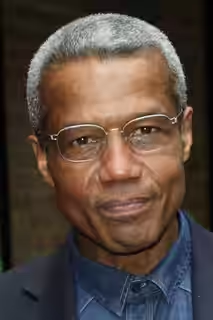
The narration does not. Hugh Quarshie is credited as Narrator, and he is used to explain what Hortense is feeling as Harris is in the middle of showing us. It is there, we suspect, to carry what the novel’s inner voices carried, but the actors have already done that job and the voiceover arrives like a second person reading over your shoulder. We found it mildly irritating in the first episode and properly so in the second, where it starts to tell us what things mean. The second episode also takes a turn we will not describe, and the series handles it with more melodrama than the book did, though the cast keeps it standing.
For a two-part adaptation of a long novel, this is near the top of what the form allows. It keeps the book’s anger and its good humour, and it keeps them in the same scenes. Watch both episodes in one sitting, because the first earns the second, and be prepared to argue with the man doing the talking.