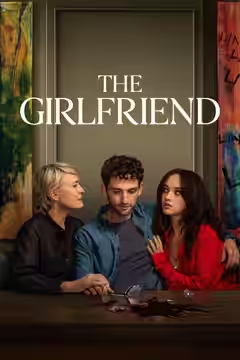
Robin Wright and Olivia Cooke make this family feud worth following, even when the plotting becomes predictable. The shifting viewpoints keep it lively; thin supporting characters and increasingly outlandish behaviour stop it becoming much more than enjoyable melodrama.
The Girlfriend is good, enjoyably excessive television, provided a family feud is enough to keep us watching for six episodes. Adapted from Michelle Frances’s novel, it puts a mother and her son’s girlfriend into a contest that grows less reasonable as it goes along. Directors Robin Wright and Andrea Harkin understand that the pleasure lies in watching these women take each other seriously long after sensible people would have stopped. The suspense works best when it concerns who is misreading whom, rather than what extraordinary thing might happen next.
Wright plays Laura Sanderson, whose concern about Daniel’s relationship has the force of an objection that ought to settle the matter. We were surprised by how funny we found Laura’s possessiveness. Wright plays her certainty that Cherry is a problem so firmly that there seems barely any space left for Daniel to have an opinion. The hostility remains uncomfortable, but the humour comes from recognising how easily a parent’s concern can become an excuse to interfere.
Olivia Cooke, as Cherry Laine, keeps that performance from taking over. There is enough resistance in her playing for the conflict to feel like an encounter between two people, even when their next clash becomes easy to predict. The shifting viewpoints help: conduct that seems clear enough from one woman’s account becomes less simple through the other’s. Cooke makes those changes worth watching, though the format can grow repetitive once we have learnt to expect a second account.
Cinematographer Mattias Nyberg and production designer Niamh Coulter supply the gloss and lavish surroundings, and the polish suits a drama so willing to let its characters misbehave. The setting makes the women’s hostility seem particularly disruptive amid all that comfort. It is an effective choice, although the handsome presentation sometimes promises more psychological detail than the writing supplies. Ruth Barrett’s music makes less of an impression. We remember the friction between the leads more clearly than anything the score contributes.
Laurie Davidson is Daniel Sanderson, the son at the centre of the dispute, and he gets considerably less to work with. The writing needs to make his importance to both women feel particular; too often, being the son and the boyfriend is his whole job. The supporting characters have much the same problem, with little to distinguish them once their place in the conflict is established. We wanted Daniel to have more to do than give the two leads a reason to quarrel.
The plot is familiar, and changing the viewpoint does not make every development a surprise. As the behaviour escalates, the women lose some of the complexity that made their early hostility interesting. Wright and Harkin keep the melodrama entertaining, but the psychological thriller needs motives we can believe for longer. We kept watching for the performances, with diminishing interest in the mystery itself. Choose it for an evening when reasonable behaviour would be a disappointment.