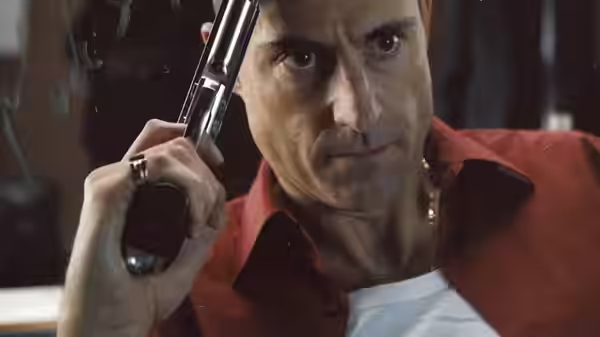
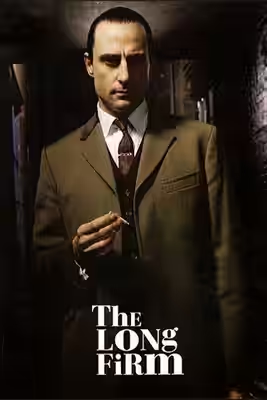
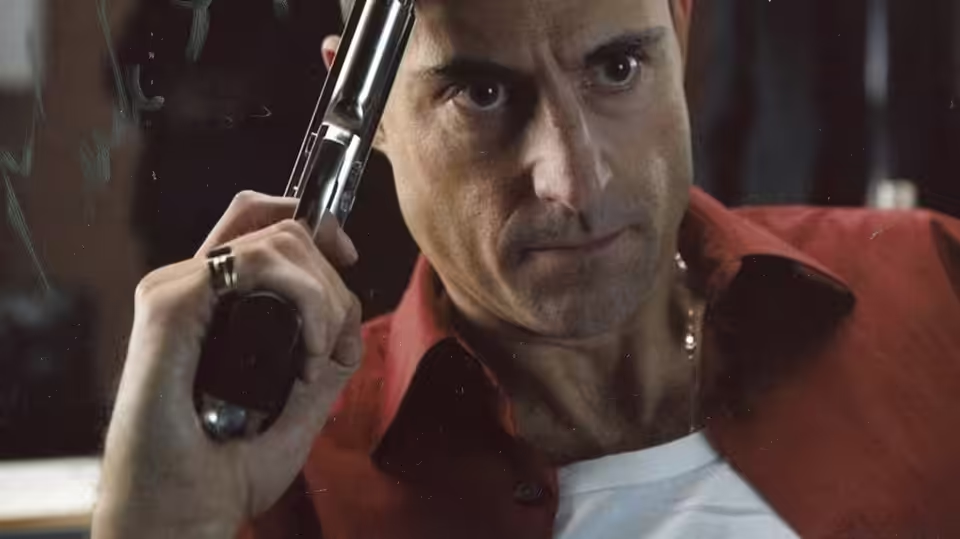
Harry Starks (Mark Strong) holds a pistol beside his face
Series review

The Long Firm

2004 · Series · 1h 00m

In a sentenceMark Strong smiles like a man deciding which of your fingers to keep

London in the 1960s. Harry Starks (Mark Strong) runs clubs and a protection racket and wants more than money: he wants to sit at tables that would not usually have him. Lord Edward ‘Teddy’ Thursby (Derek Jacobi), a peer with debts, a wife, Lady Thursby (Judy Parfitt), and a taste for young men, is introduced to Harry’s circle and finds the gangster attentive, generous and hard to refuse. Ruby Ryder (Lena Headey), an actress whose best parts are behind her, drinks at Harry’s club. Jimmy (Phil Daniels) runs Harry’s errands and does his hurting. Harry puts Teddy’s name to a company, and the peer, flattered and frightened, signs. The first hour watches Teddy sink into Harry’s debt while the MP Tom Driberg (Damien Thomas) looks on from the same parties.

Fi1m review

Jake Arnott’s novel of a sixties London gangster who wants to be respectable reaches television with Mark Strong at his most quietly frightening and Derek Jacobi at his most lost. The first two hours grip; the last two drift, and the city never quite leaves the studio.

Jake Arnott’s novel gives us Harry Starks, a gangster in sixties London who reads, who weeps at old films, who collects peers and policemen the way other men collect cars, and who will break a jaw in the same tone of voice he uses to order a drink. Joe Penhall’s adaptation keeps the book’s trick: each of the four hours is told by someone standing near Harry rather than by Harry himself, so we only ever see him through the eyes of people who are afraid of him or in love with him or both. Bille Eltringham directs. It is a good piece of television, and for its first half it is better than good. Then it tires.

Mark Strong is the reason to watch. He plays Harry as a man who has worked out that menace is more efficient than violence and uses violence anyway, because he enjoys it. He listens more than he talks. He lets a silence run on until the other man fills it with something he will regret. When he does move, it is sudden and short and he is already apologising for it. We were frightened of him by the end of the first hour, and it was nothing he did; it was the way he looked at Teddy Thursby across a dinner table, as though pricing him.

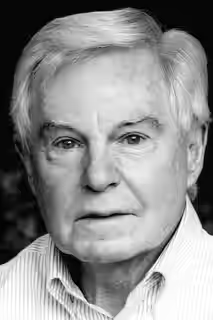
Derek Jacobi’s Teddy is the first hour’s narrator and the series’ best written part. He is a peer with no money and a great deal of appetite, and Jacobi plays the appetite without a trace of camp, just a tired man who knows exactly what he wants and how much it is going to cost him. The scenes between the two of them, Harry courteous and Teddy trying to pretend he has the upper hand, are the series at full strength. Judy Parfitt, as Lady Thursby, needs about three lines to let us know she has seen all of this before.

Sean Bobbitt shoots nearly everything indoors: clubs, flats, back rooms, the Thursbys’ drawing room, all of it lit warm and low, with cigarette smoke doing half the work. It is handsome and it is cramped. Sixties London is a few streets, a doorway and a lot of curtains, and after a while we started to feel that Harry’s empire would fit in a small van. Rob Lane’s score leans on brass and a slow walking bass and knows when to stop. Paul Tothill cuts each hour around its narrator, so that the same events can be glimpsed from two sides, and the first time the series doubles back on itself we sat up.

The later hours have the harder job and do not quite manage it. Lena Headey’s Ruby is given plenty to drink and not enough to do, and her episode feels like a story Harry wanders through rather than one he drives. Phil Daniels is sharp and sour as Jimmy, the man who has stood behind Harry longest and been thanked least, and George Costigan’s Mooney, a policeman with his hand out, is nicely greasy. But the thing that made the opening frightening, not knowing what Harry would do next, wears off, because by the third hour we do know. By the fourth we found we were watching for Strong and waiting through the rest.

As a British gangster story it keeps familiar company, and it knows that company well: the club, the peer, the bent copper, the boy who is going to get hurt. What it adds is Harry’s longing. He does not want to run London; he wants London to have him to lunch, and the series is at its most interesting when it lets that wish be ridiculous and sad at once. It is less interesting when it reaches for the usual guns.

See the first two hours for certain. Stay for the other two if Strong has got under your skin, which he probably will. Four episodes, an hour each, first shown from 7 July 2004.

Critical consensus AI synthesised

2 of 6
Positive
2
Mixed
0
Negative
0
The Guardian
5 July 2004 · Mark Lawson
70*

Lawson finds the drama compelling and convincing, despite its familiar gangster-story territory. He praises the lead performances but faults the constrained period staging, which makes London feel claustrophobic.

Read the full review →
Variety
3 March 2005 · Brian Lowry
70*

Lowry finds the miniseries compelling overall, though its final two hours lose some of the opening’s intensity. He singles out Mark Strong’s menacing performance and Derek Jacobi’s supporting turn, along with the distinctive premise and storytelling structure.

Read the full review →

Straight answers AI written, from our review

Is The Long Firm worth watching?
The Long Firm is worth watching for its first two hours and for Mark Strong, and we scored it 72. Strong plays the sixties gangster Harry Starks as quietly frightening and Derek Jacobi matches him as the indebted peer he collects; the last two episodes drift and the studio-bound London starts to feel small. Stay on if Strong has got under your skin.
How long is The Long Firm, and what is it rated?
The Long Firm has episodes of about 1h 00m. It is a drama and crime series.
Where can I watch The Long Firm in Austria?
The Long Firm is not on any streaming or rental service in Austria at the moment. It is available in 3 other countries; change your country at the top of the page to see where. Availability is checked daily.
How violent or frightening is The Long Firm, and is it suitable for children?
The Long Firm carries no certificate, but it is an adult crime drama and not for children. Harry runs a protection racket, breaks jaws as easily as he orders drinks, and the menace is in his silences rather than in gore; there are sexual relationships, heavy drinking and a peer with a taste for young men. Teenagers used to television crime drama will cope; the squeamish will mostly be unsettled rather than sickened.
How does The Long Firm compare to The Long Good Friday?
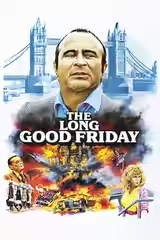
The Long Firm and The Long Good Friday both follow a London gangster who wants respectability, but the film is the tighter and more thrilling of the two. Bob Hoskins gets one weekend and a plot that moves; Mark Strong gets four hours told by the people around him, which is richer in the first half and slacker in the second. Watch the film for pace, the series for the performances.
Is The Long Firm based on a true story or a book?
The Long Firm is based on Jake Arnott's novel of the same name, not on a true story, though it sets its fictional gangster among the clubs, peers and bent policemen of real sixties London. Joe Penhall's adaptation keeps the book's structure, with each hour narrated by someone standing near Harry Starks rather than by Harry himself. You do not need to have read it.
What should I watch after The Long Firm?
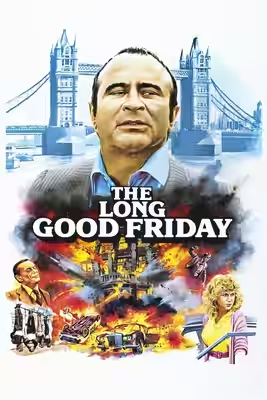
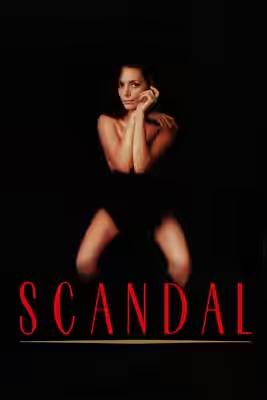
After The Long Firm, try The Long Good Friday (1980, Fi1m 88): Bob Hoskins’s gangster wants respectability too, and London takes a weekend to tell him no. Then Our Friends in the North (1996, Fi1m 88): Four friends, four decades and the same bent coppers; British television at its most patient; and Scandal (1989, Fi1m 66): The Profumo affair as bedroom farce turned sour; peers, girls and a very sixties London.

Cast

If you liked this, try…

  1. The Long Good Friday (1980, Fi1m 88)Bob Hoskins’s gangster wants respectability too, and London takes a weekend to tell him no.

  2. Our Friends in the North (1996, Fi1m 88)Four friends, four decades and the same bent coppers; British television at its most patient.

  3. Scandal (1989, Fi1m 66)The Profumo affair as bedroom farce turned sour; peers, girls and a very sixties London.

  4. Gomorrah (2014) · not reviewed yetNaples crime without a single glamorous frame; the antidote to anyone romanticising Harry.

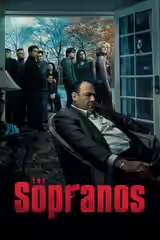
  5. The Sopranos (1999, Fi1m 94)Another boss who weeps at films and breaks jaws, given eighty-six hours to explain himself.

Free account

Know what to watch tonight

Two lists that know where things are streaming, collections you can share, your own score beside ours, and Discover that remembers what you have seen.

  • Want to see, sorted by what is streaming now
  • Seen, with your score out of ten
  • No adverts, ever