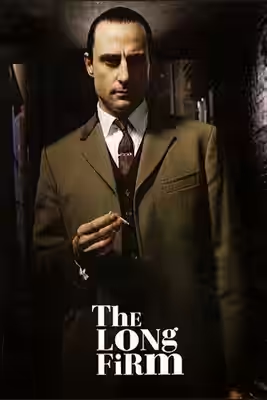
Jake Arnott’s novel of a sixties London gangster who wants to be respectable reaches television with Mark Strong at his most quietly frightening and Derek Jacobi at his most lost. The first two hours grip; the last two drift, and the city never quite leaves the studio.
Jake Arnott’s novel gives us Harry Starks, a gangster in sixties London who reads, who weeps at old films, who collects peers and policemen the way other men collect cars, and who will break a jaw in the same tone of voice he uses to order a drink. Joe Penhall’s adaptation keeps the book’s trick: each of the four hours is told by someone standing near Harry rather than by Harry himself, so we only ever see him through the eyes of people who are afraid of him or in love with him or both. Bille Eltringham directs. It is a good piece of television, and for its first half it is better than good. Then it tires.
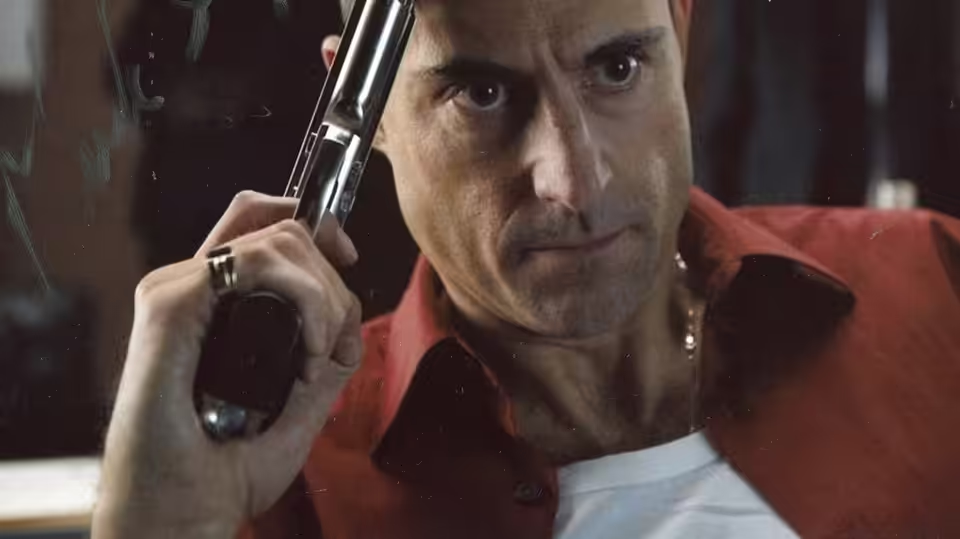
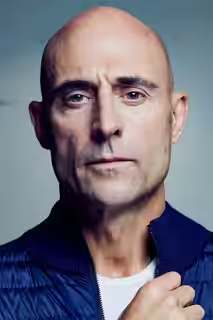
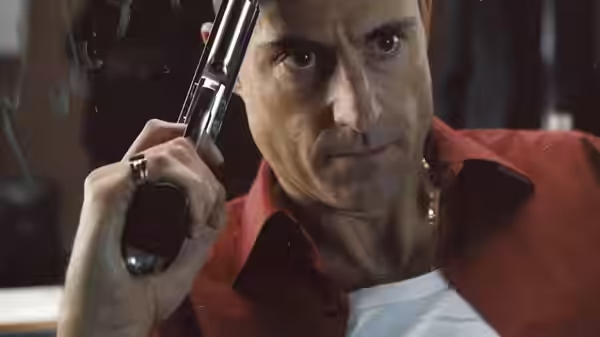
Mark Strong is the reason to watch. He plays Harry as a man who has worked out that menace is more efficient than violence and uses violence anyway, because he enjoys it. He listens more than he talks. He lets a silence run on until the other man fills it with something he will regret. When he does move, it is sudden and short and he is already apologising for it. We were frightened of him by the end of the first hour, and it was nothing he did; it was the way he looked at Teddy Thursby across a dinner table, as though pricing him.
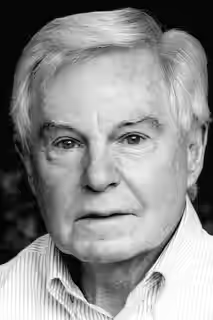
Derek Jacobi’s Teddy is the first hour’s narrator and the series’ best written part. He is a peer with no money and a great deal of appetite, and Jacobi plays the appetite without a trace of camp, just a tired man who knows exactly what he wants and how much it is going to cost him. The scenes between the two of them, Harry courteous and Teddy trying to pretend he has the upper hand, are the series at full strength. Judy Parfitt, as Lady Thursby, needs about three lines to let us know she has seen all of this before.
Sean Bobbitt shoots nearly everything indoors: clubs, flats, back rooms, the Thursbys’ drawing room, all of it lit warm and low, with cigarette smoke doing half the work. It is handsome and it is cramped. Sixties London is a few streets, a doorway and a lot of curtains, and after a while we started to feel that Harry’s empire would fit in a small van. Rob Lane’s score leans on brass and a slow walking bass and knows when to stop. Paul Tothill cuts each hour around its narrator, so that the same events can be glimpsed from two sides, and the first time the series doubles back on itself we sat up.
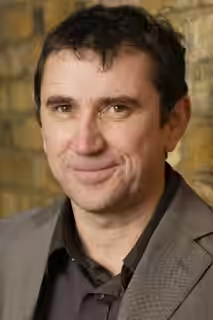
The later hours have the harder job and do not quite manage it. Lena Headey’s Ruby is given plenty to drink and not enough to do, and her episode feels like a story Harry wanders through rather than one he drives. Phil Daniels is sharp and sour as Jimmy, the man who has stood behind Harry longest and been thanked least, and George Costigan’s Mooney, a policeman with his hand out, is nicely greasy. But the thing that made the opening frightening, not knowing what Harry would do next, wears off, because by the third hour we do know. By the fourth we found we were watching for Strong and waiting through the rest.
As a British gangster story it keeps familiar company, and it knows that company well: the club, the peer, the bent copper, the boy who is going to get hurt. What it adds is Harry’s longing. He does not want to run London; he wants London to have him to lunch, and the series is at its most interesting when it lets that wish be ridiculous and sad at once. It is less interesting when it reaches for the usual guns.
See the first two hours for certain. Stay for the other two if Strong has got under your skin, which he probably will. Four episodes, an hour each, first shown from 7 July 2004.