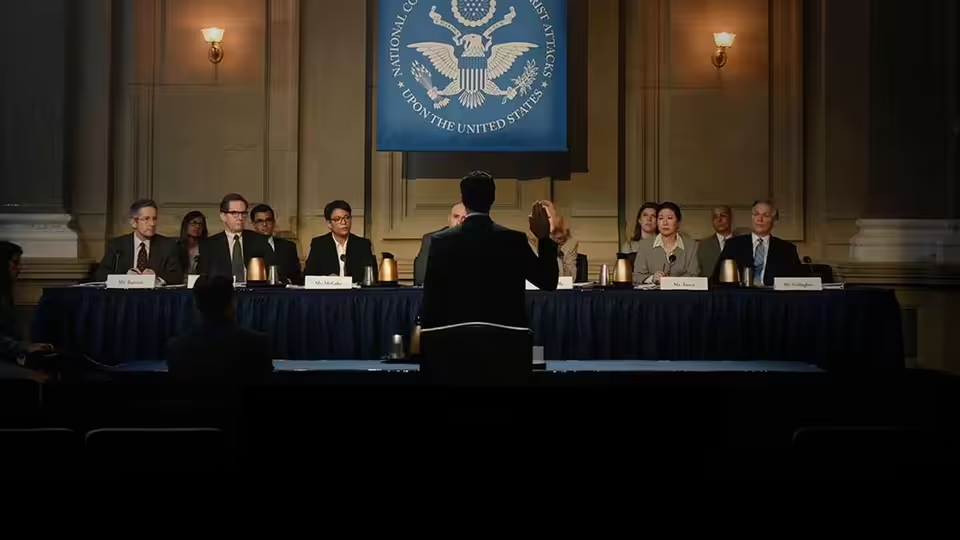
A patient, well-acted account of how the FBI and the CIA failed to talk to each other in the years before 11 September 2001. Jeff Daniels and Tahar Rahim are excellent; the CIA is written as a pantomime, and the series is weaker for it.
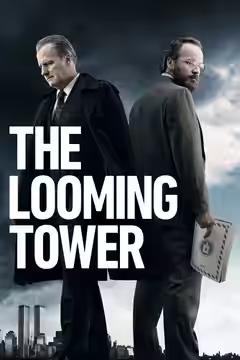
Lawrence Wright’s book The Looming Tower set out to explain how the United States had the pieces of the 11 September plot in front of it and never put them together. Wright, Dan Futterman and Alex Gibney have turned it into ten episodes of about fifty minutes, and their answer is simple: the CIA knew things, the FBI could have acted on them, and the two would not talk. It is a good series, patiently made and well acted, and worth your evenings if institutional failure is your idea of drama. Its weakness is the CIA, which it writes as a pantomime.
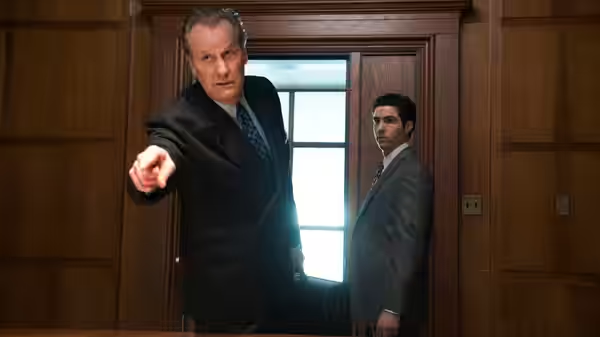
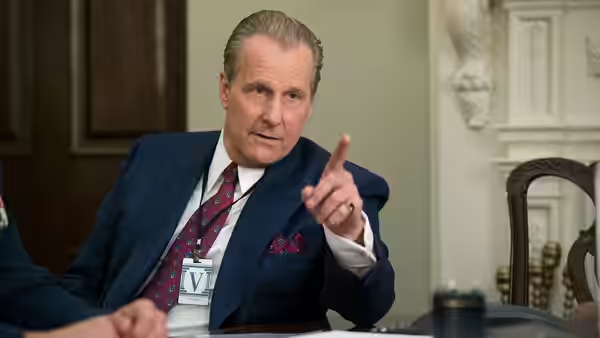
Jeff Daniels plays John O’Neill, who runs the FBI’s counterterrorism squad in New York, as a big, loud man in expensive suits who goes to Mass in the morning and to one of several women at night. Daniels lets him be a bully and a bore and still the cleverest man in most rooms, and he is good company for eight hours. Tahar Rahim’s Ali Soufan is the still point beside him, a young agent who speaks Arabic, reads the documents nobody else will read, and can sit across a table from a suspect and quote the Quran back at him. Rahim does most of his acting with his eyes, and the series is at its best when it stops and lets him listen.
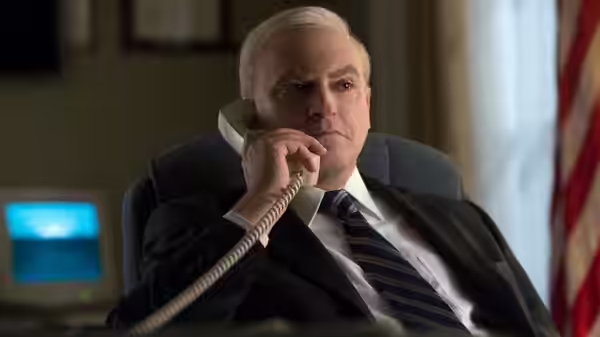
The producers include Ali Soufan himself, and it shows in the shape of the thing. The FBI is never wrong. Peter Sarsgaard plays Martin Schmidt, a fictional composite standing in for the CIA’s bin Laden unit, as a soft-voiced man who withholds cables out of what looks like vanity, and Sarsgaard does the sneer well because the script gives him nothing else. The series does not ask why an intelligent man might believe the FBI would burn his sources; it simply has him refuse and lets us hiss. Michael Stuhlbarg’s Richard Clarke, the White House counterterrorism man caught between them, is the most believable of the three, exasperated in doorways, always one meeting short of authority.
Here is what we felt. Watching Schmidt sit on a piece of information the New York office needed, we were angry, properly so, hands tight on the arm of the sofa. A minute later we were slightly embarrassed, because the series had stacked the deck to get us there, and anger you have been handed is not worth as much as anger you have earned.
The craft is sober and mostly right. Lester Cohen designs the FBI’s New York office as beige partitions and stacked paper, and Schmidt’s unit as a windowless room of screens, so the contrast makes the argument without anyone stating it. Will Bates’s score stays low, a drone under the phone calls, and does not tell us when to be frightened. Real news footage of the period is cut in between scenes, Clinton at a podium, the impeachment hearings, so that the country’s attention is always shown to be elsewhere. The directors, Craig Zisk, Ali Selim, Michael Slovis, John Dahl and Gibney, keep the camera steady and the takes long, and the overseas episodes, in Nairobi and later in Yemen, are the strongest, because the agents are out of their depth and the series admits it.
The women are the other problem. Wrenn Schmidt’s Diane Priest, an analyst in Schmidt’s unit, is given a conscience and nothing to do with it. Virginia Kull’s Kathy Shaughnessy and Ella Rae Peck’s Heather exist to wait for O’Neill and Soufan to come home and to be lied to when they do. The scripts, by Futterman, Shannon Houston, Bathsheba Doran, Adam Rapp and Selim, also have a habit of making characters explain to each other things they both already know, so that we can overhear. Bill Camp’s Robert Chesney, across an interrogation table, is the exception: the series slows down, trusts two faces, and is briefly as good as anything in the genre.
Against Zero Dark Thirty, which followed the same enemy with fewer heroes, this is the more comfortable work. It ends where everybody knows it ends, and the last episode has the sense not to stage what we all watched on television. Watch it two episodes at a time and it holds. Do not expect it to argue with you; it decided who was to blame before the first cable was sent.