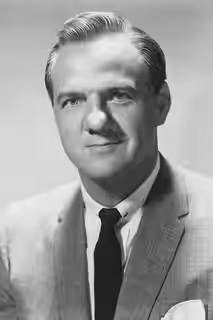
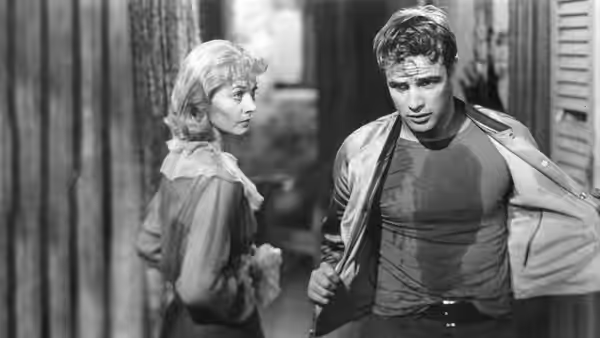
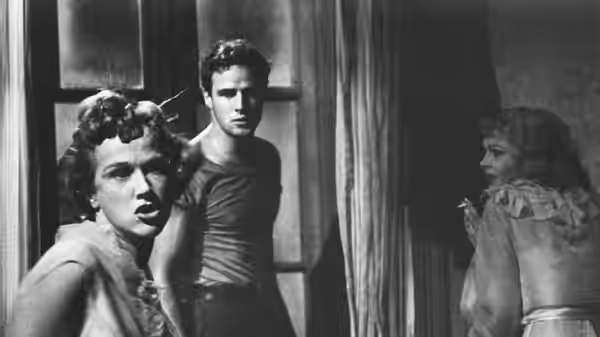
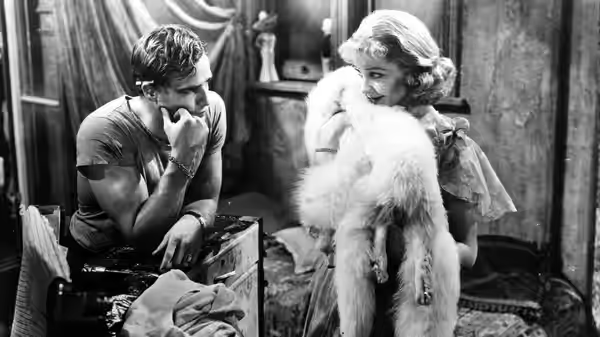
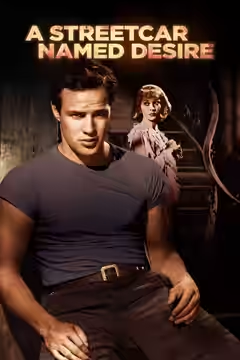
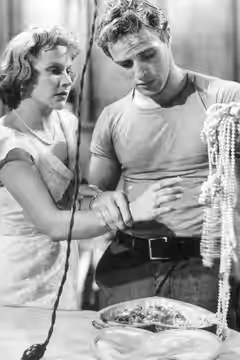
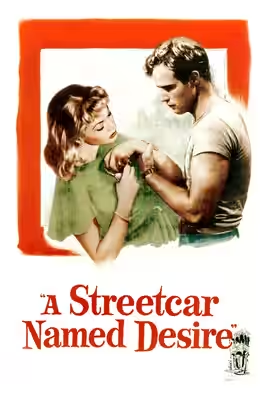
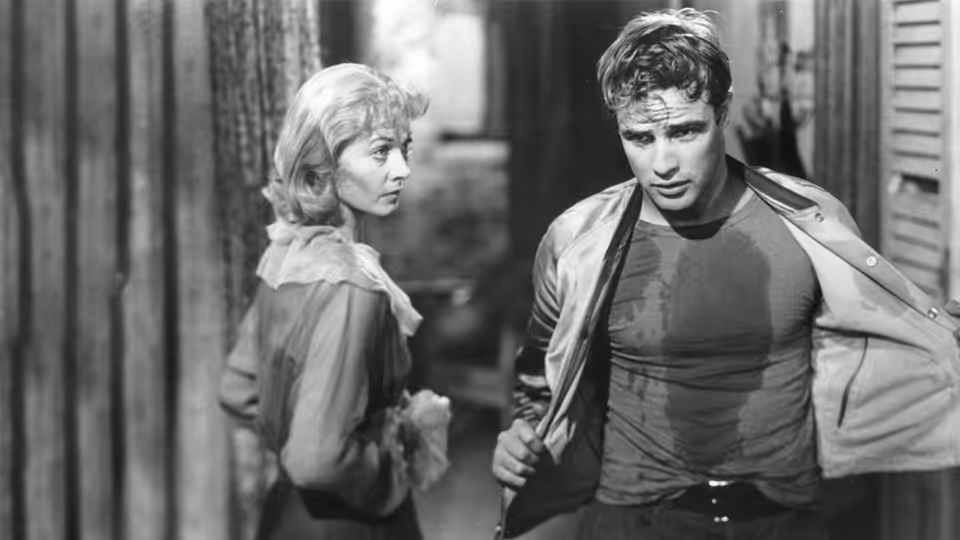
Stella (Kim Hunter) watches Stanley (Marlon Brando) remove his jacket
Film review

A Streetcar Named Desire

1951 · Directed by Elia Kazan · 2h 02m

In a sentenceShe cannot stand a naked light bulb, and her sister has married one

New Orleans, the French Quarter. Blanche DuBois (Vivien Leigh), a schoolteacher from Mississippi, arrives by train and streetcar at a two-room flat on Elysian Fields to stay with her younger sister Stella (Kim Hunter). The family plantation, Belle Reve, has been lost, and Blanche says she has taken leave from her school for her nerves. Stella’s husband, Stanley Kowalski (Marlon Brando), who bowls and plays poker with his friends, wants to know where the money from the plantation went and does not believe a word Blanche says. Blanche drinks his whisky when nobody is looking, covers the bare bulb with a paper lantern, and catches the eye of Stanley’s friend Harold Mitchell (Karl Malden), a bachelor who lives with his sick mother. Between the two rooms there is a curtain, and not much else.

Plays from YouTube when you press play; nothing loads from them until then.

Fi1m review

Kazan’s film of Tennessee Williams’s play is still a shock: Brando and Leigh in two rooms, one bare bulb, and Harry Stradling’s walls closing in. The censor’s softenings show, and Leigh starts higher than she needs to, but we came out shaken.

Elia Kazan directed Tennessee Williams’s play on Broadway in 1947 with Marlon Brando as Stanley Kowalski, and when he came to film it he kept Brando, kept the two rooms and the curtain between them, and replaced his stage Blanche with Vivien Leigh, who had played the part in London. Williams and Oscar Saul’s screenplay opens the story out for a few minutes, a railway station, a bowling alley, a wet street, and then shuts the door. Nearly everything after that happens in a flat you could cross in four strides.

It is a fine film and still a frightening one, and its faults are mostly the faults of 1951. Blanche DuBois arrives from Mississippi to stay with her sister Stella (Kim Hunter) and Stella’s husband, with the family plantation gone and a story about nerves and a leave of absence from her school. Stanley does not believe her. That is the plot, and it is enough, because the film is about two people who cannot be in a room together and a third who has to choose between them.

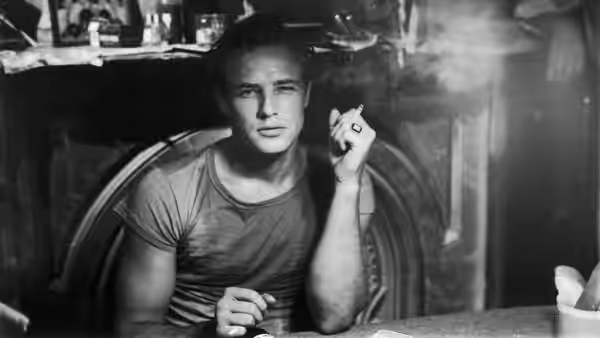
Brando has been imitated so often it is a surprise to see how careful he is. Stanley scratches, eats with his fingers, talks through a mouthful, and takes his shirt off because it is wet rather than because a camera is watching. He is funny, which the imitators forget. The poker night is where the film turns. Blanche has the radio on, Stanley has twice said to turn it off, and he gets up and puts it through the window. We flinched as if it had gone past our own heads. What frightened us was not the throw but the pause before it, Brando deciding, in front of his friends, that he can. Kim Hunter’s walk back down the iron staircase afterwards, slow, in a dressing gown, is the plainest thing in the film about why Stella stays.

Leigh divides people, and we understand why. She starts at a pitch that leaves her nowhere to go: the hands never still, the little laugh, the eyes checking every corner. For half an hour we wanted her to sit down. Then she sits down, on the poker night, and asks Mitch to put a paper lantern over the bare bulb because she cannot stand a naked light, and the performance comes into focus. Blanche is acting, all the time, for everyone, and Leigh is showing us a woman whose act is wearing through. Once we saw that, the mannerisms were the point. We still think Kazan could have reined her in for the first two reels.

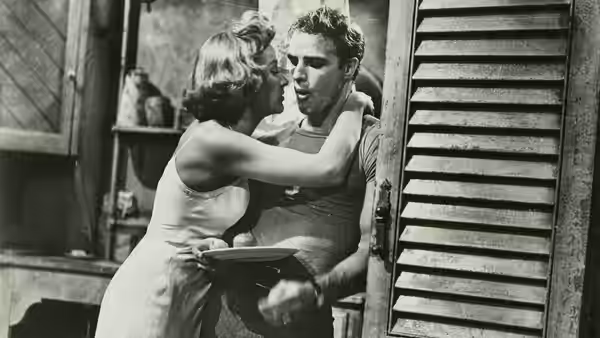
Harry Stradling shoots the flat in hard black and white, and he lights the two leads on opposite principles. Leigh is seen through lanterns, shutters and the folds of a scarf, half in shadow by her own arrangement; Brando gets flat glare, sweat and all. The set was built so the walls could be moved inward as the film went on, and by the last reel the rooms look smaller than they did at the start. David Weisbart holds on faces longer than editors of the period usually did, and we think he is right to, in a script where every line has a second one underneath it. Alex North’s score is a trumpet from the bar across the alley and a polka that only Blanche seems to hear, and the film is careful not to explain the polka until it has to.

The compromises show. Several things the play says outright the film mutters or drops, some of Blanche’s past among them, and the ending has been altered from the stage in a way we will not describe. A few minutes cut before release were put back in 1993, and that is the version to see, but there are still moments where the camera looks away and you can feel a studio hand on Kazan’s shoulder. Karl Malden’s Mitch, the big shy man with a sick mother and a cigarette case he wants you to read, is played so gently that his later scenes hurt more than we expected.

At 122 minutes it is a play’s length and it moves like a play, one long scene giving way to the next, and it is none the worse for that. It is a 12 certificate. Watch it with the sound up. The blues from next door is telling you what this flat is for.

Critical consensus AI synthesised

79
Positive
11
Mixed
1
Negative
0
Los Angeles Times
26 September 1993 · Kenneth Turan
90*

Turan hails the restored film as a landmark of American cinema and ensemble acting, praising how the recovered footage adds a more openly sensual tone and allows full appreciation of Brando, Leigh, Hunter, and Malden's performances.

Read the full review →
RogerEbert.com
12 November 1993 · Roger Ebert
90*

Ebert praises the 1993 restoration for revealing the full daring of Kazan's original cut and highlights Brando's raw, influential performance as Stanley as the standout element that shaped modern screen acting.

Read the full review →
The AV Club
18 April 2012 · Noel Murray
90*

The critic notes that despite censorship of its racier elements, the film still seethes with lust and retains much of Williams’ florid dialogue. Brando’s revelatory performance and the balance of naturalism with expressionism allow the movie to feel both exaggerated and true, offering what Blanche calls magic as well as realism.

Read the full review →
Variety
20 June 1951 · Variety Staff
90*

The review calls the film an absorbing adult drama of frustration and tragedy, commending the excellent production values, Kazan's direction, and the compelling performances by Leigh, Brando, Hunter, and Malden.

Read the full review →
Empire
1 January 2000 · Kim Newman
85*

Kazan adapted Williams' play for the screen with some changes to the ending, but kept the rape scene. Brando and Leigh deliver epic, atmospheric performances in a seedy New Orleans setting.

Read the full review →
The Guardian
6 February 2020 · Peter Bradshaw
70*

The critic finds the toxic chemistry between Vivien Leigh and Marlon Brando compelling but notes Leigh's mannered performance goes too far into paranoia too quickly. Kazan controls the tense final scenes effectively in this re-release of the 1951 classic.

Read the full review →

Straight answers AI written, from our review

Is A Streetcar Named Desire worth watching?
A Streetcar Named Desire is worth watching for anyone who can sit through two hours of two people who cannot share a room, and we scored it 88. Brando is careful and funny rather than the caricature his imitators made him, and Vivien Leigh's Blanche comes into focus once you accept that she is acting for everyone. Expect a play's pace and some visible 1951 softenings.
How long is A Streetcar Named Desire, and what is it rated?
A Streetcar Named Desire runs 2h 02m. It is a drama and thriller film.
Where can I watch A Streetcar Named Desire in Canada?
A Streetcar Named Desire is not on any streaming or rental service in Canada at the moment. It is available in 21 other countries; change your country at the top of the page to see where. Availability is checked daily.
How violent or frightening is A Streetcar Named Desire, and is it suitable for children?
A Streetcar Named Desire is a 12 certificate in the UK, and its violence is domestic and brief rather than bloody: a radio thrown through a window, a man deciding in front of his friends that he can. What frightens is the menace between people, and the sexual undercurrent the censor muffled is still there. It is not for young children; teenagers who can follow the tension will find it gripping.
How does A Streetcar Named Desire compare to On the Waterfront?
A Streetcar Named Desire and On the Waterfront share Elia Kazan and Marlon Brando, but the earlier film is confined to two rooms and a curtain, while the later one moves out onto the docks. Streetcar is the tighter and more frightening of the two; Waterfront has the more open-hearted performances but a tendency to lecture once the acting has made its point. Start with Streetcar if you want the pressure, Waterfront if you want the sweep.
What should I watch after A Streetcar Named Desire?
After A Streetcar Named Desire, try On the Waterfront (1954, Fi1m 89): Kazan and Brando three years on, out of the flat and onto the docks. Then Sunset Boulevard (1950, Fi1m 91): Another woman keeping the lights low; Wilder is crueller about it than Kazan; and All About My Mother (1999, Fi1m 88): Almodóvar’s women pass a stage production of this very play between them.

Cast

Awards

Academy Awards, 1952

Nominated
Best Actor
Nominated
Best Cinematography, Black-and-White
Nominated
Best Costume Design, Black-and-White
Nominated
Best Director
Nominated
Best Original Dramatic or Comedy Score
Nominated
Best Picture
Nominated
Best Sound
Nominated
Best Writing, Adapted Screenplay
Won
Best Actress
Won
Best Art Direction, Black and White
Won
Best Supporting Actor
Won
Best Supporting Actress

Grand Jury Prize of the Venice Film Festival, 1951

Won
Grand Jury Prize of the Venice Film Festival

If you liked this, try…

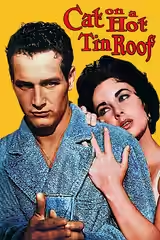
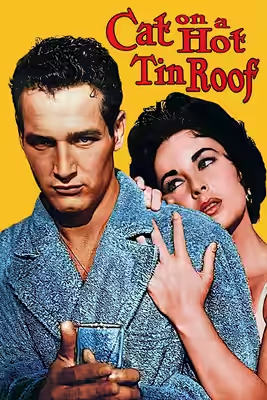
  1. Cat on a Hot Tin Roof (1958) · not reviewed yetMore Williams, softened again by the censor, with Newman and Taylor sweating through it regardless.

  2. On the Waterfront (1954, Fi1m 89)Kazan and Brando three years on, out of the flat and onto the docks.

  3. Sunset Boulevard (1950, Fi1m 91)Another woman keeping the lights low; Wilder is crueller about it than Kazan.

  4. All About My Mother (1999, Fi1m 88)Almodóvar’s women pass a stage production of this very play between them.

  5. Who's Afraid of Virginia Woolf? (1966, Fi1m 86)One long night, one small house, far too much to drink, and no exit.

Free account

Know what to watch tonight

Two lists that know where things are streaming, collections you can share, your own score beside ours, and Discover that remembers what you have seen.

  • Want to see, sorted by what is streaming now
  • Seen, with your score out of ten
  • No adverts, ever