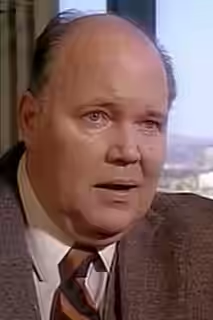
Michael Colin Gallagher (Paul Newman) sits holding a newspaper in a wood-paneled room
Film review

Absence of Malice

1981 · Directed by Sydney Pollack · 1h 56m

In a sentenceEvery word in the newspaper is true and Paul Newman still has every right to be furious

Miami. A union leader, Joey Diaz, has vanished, and the federal strike force run by Elliott Rosen (Bob Balaban) has nothing. Rosen leaves a file open where Megan Carter (Sally Field), a reporter on the Miami Standard, will see it, and the file says the force is investigating Michael Gallagher (Paul Newman), a liquor wholesaler whose late father was a mobster and whose uncle, Santos Malderone (Luther Adler), still is. Megan prints it. Gallagher, who knows nothing about Diaz, arrives at work to find his trucks idle and his men walking out. He goes to the newspaper to ask Megan who told her, and she will not say. Teresa Perrone (Melinda Dillon), a devout friend of Gallagher’s, knows where he was on the day Diaz disappeared, and wants to say so without saying why.

Fi1m review

Sydney Pollack’s drama about a reporter, a prosecutor and the man they ruin between them is intelligent, unhurried and properly grown up. Paul Newman gives it a spine; the romance Kurt Luedtke bolts on to it does not.

Absence of Malice is the film of someone who knows how a wrong story gets into print without anyone lying. A prosecutor wants a lever. A reporter wants a byline. A lawyer wants to know whether the paper can be sued. Each of them does his job, and at the end of the chain stands a man who has done nothing. Kurt Luedtke wrote it and Sydney Pollack directs it with the patience of someone who trusts the argument, and for most of its 116 minutes the trust is repaid. It is a good, careful, adult film with one soft joint, and the soft joint is the love story.

Newman is the reason to see it. Michael Gallagher is a quiet man who runs a liquor warehouse and has spent his life being judged by his father’s name, and Newman plays him almost entirely in reaction: a look at a headline, a pause before he answers a question, a decision to say less than he knows. He does not make speeches. When he walks into the newsroom early on and asks Megan who gave her the story, he is not angry yet, only curious about how such a thing is done, and the curiosity is worse than shouting would have been. Later, when he has worked out exactly how the machine runs, Newman lets us watch him decide to use it. It is some of the stillest acting of his career, and some of the best.

Sally Field has the harder part and the worse luck. Megan Carter is a plausible reporter, quick and bright and certain that printing a true thing is always the right thing, and Field plays her at speed, pencil out, questions ready. The trouble is that Luedtke then has her fall for the man she has just ruined, and asks us to find it winning. We did not. Every scene the two of them spend by the water or in bed takes a little of the pressure off the indictment, and the film is at its weakest when it wants us to like Megan rather than understand her.

Around them the cast is exact. Bob Balaban’s Rosen is a small, chilly civil servant who believes he is on the side of the angels and never raises his voice. Josef Sommer’s McAdam and John Harkins’s Davidek have a conversation about what the paper can safely say that is the most quietly frightening scene in the film, because it is about liability and not about Gallagher at all. And Wilford Brimley arrives in the last stretch as James J. Wells, sits down, and in one long scene of plain talk walks off with the picture.

Then there is Melinda Dillon. Teresa Perrone is a woman who wants to help a friend and is terrified of what helping will cost, and Dillon plays her with her hands, which never stop moving, and a voice that keeps dropping to a whisper as if someone might be listening. There is a scene with her, early in the morning, that we will not describe. It left us shaken, and it is the moment the film stops being an argument about journalism and becomes a film about a person. Pollack plays it without music and almost without cutting. He was right to.

Owen Roizman shoots Miami flat and bright, all glare off water and car bonnets, and the offices in fluorescent white, so that nowhere looks like a place where something sinister could happen, which is the point. Terence Marsh gives the newsroom real clutter and Gallagher’s warehouse the right bareness. Sheldon Kahn cuts the conversations slowly and lets people finish their sentences. Dave Grusin’s score is the one department that misjudges the film: easy saxophone and soft keys that make a hard story sound like a comfortable one, and it is loudest exactly where the romance is weakest.

Set against Three Days of the Condor (1975), this is Pollack with the same distrust of institutions and far less running; it is talkier, slower, and better about how ordinary people behave inside a bad system. Watch it with someone who has sat in a meeting where a decision was taken about a stranger, and expect an argument afterwards about whether Megan deserved what she got, and whether Gallagher did.


Critical consensus AI synthesised

70
Positive
2
Mixed
2
Negative
0
Variety
31 December 1980 · Variety Staff
85*

The critic calls the film a compelling and disturbing story with an important point to make. They single out the confrontation between Newman and Field as a standout scene.

Read the full review →
Time Out
· PT
70*

The review appears broadly positive about the film’s treatment of press responsibility and misinformation. It praises the film for addressing these issues without the excesses of earlier issue-driven cinema.

Read the full review →
The New York Times
19 November 1981 · Vincent Canby
64*

The page is inaccessible, so the critic’s verdict cannot be established. The available page text does not identify anything singled out for praise or complaint.

Read the full review →
Radio Times
★★★ · Tom Hutchinson
60

Hutchinson finds the drama somewhat worthy but still watchable. He singles out Melinda Dillon’s performance and the Newman–Field confrontation for praise.

Read the full review →

Straight answers AI written, from our review

Is Absence of Malice worth watching?
Absence of Malice is worth watching for anyone who likes a patient, grown-up drama about how a true story can ruin an innocent man, and we scored it 73. Paul Newman's still, watchful performance is the reason to see it. The romance between his character and Sally Field's reporter is the weak joint, and it takes pressure off the better film around it.
How long is Absence of Malice, and what is it rated?
Absence of Malice runs 1h 56m. It is a drama and romance film.
Where can I watch Absence of Malice in Chile?
Absence of Malice is available to rent from Amazon Prime Video from CLF 1.99. Availability is checked daily; the links above go straight to each service.
How violent or frightening is Absence of Malice, and is it suitable for children?
Absence of Malice has no UK certificate and a US PG rating, and it contains almost no violence; the harm here is done with files, headlines and meetings. There is one early-morning scene involving Melinda Dillon's character that left us shaken, and it is a film about adult consequences rather than action. Young children would be bored; older teenagers interested in newspapers will find plenty to argue about.
How does Absence of Malice compare to Ace in the Hole?
Absence of Malice is the calmer, kinder film and Ace in the Hole is the crueller and more savage one. Billy Wilder's reporter knowingly exploits another man's suffering, while Sally Field's Megan believes she is simply printing the truth, so Pollack's film is better on how a bad system runs on ordinary people and Wilder's is the sharper, funnier shock. For a fierce evening choose Wilder; for an argument afterwards choose this.
What should I watch after Absence of Malice?
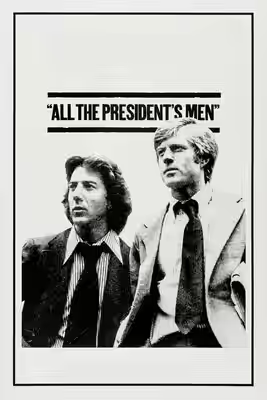
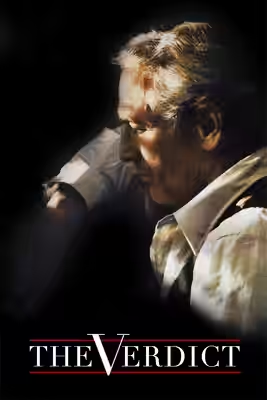
After Absence of Malice, try Ace in the Hole (1951, Fi1m 87): Billy Wilder’s reporter is worse than Megan and knows it; the nastiest newspaper film made. Then All the President's Men (1976, Fi1m 90): The flattering version of the same trade: the same phone calls, the opposite outcome; and The Verdict (1982, Fi1m 84): Newman a year later, in a courtroom, playing a man with even less left to lose.

Cast

Awards

Academy Awards, 1982

Nominated
Best Actor
Nominated
Best Supporting Actress
Nominated
Best Writing, Original Screenplay

If you liked this, try…

  1. Ace in the Hole (1951, Fi1m 87)Billy Wilder’s reporter is worse than Megan and knows it; the nastiest newspaper film made.

  2. All the President's Men (1976, Fi1m 90)The flattering version of the same trade: the same phone calls, the opposite outcome.

  3. The Verdict (1982, Fi1m 84)Newman a year later, in a courtroom, playing a man with even less left to lose.

  4. The Insider (1999, Fi1m 89)A source, a journalist and a lawyer deciding what can be aired, with real consequences.

  5. Shattered Glass (2003) · not reviewed yetA newsroom, an editor and the slow realisation that the facts were never checked.

Free account

Know what to watch tonight

Two lists that know where things are streaming, collections you can share, your own score beside ours, and Discover that remembers what you have seen.

  • Want to see, sorted by what is streaming now
  • Seen, with your score out of ten
  • No adverts, ever