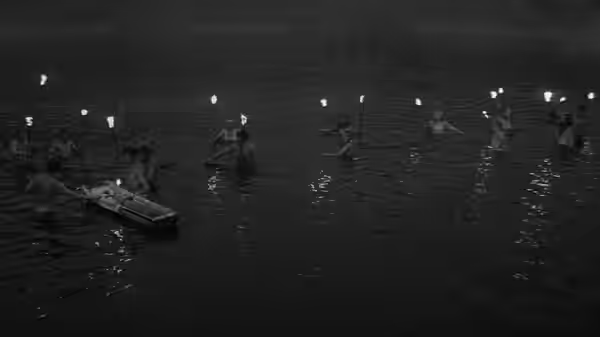
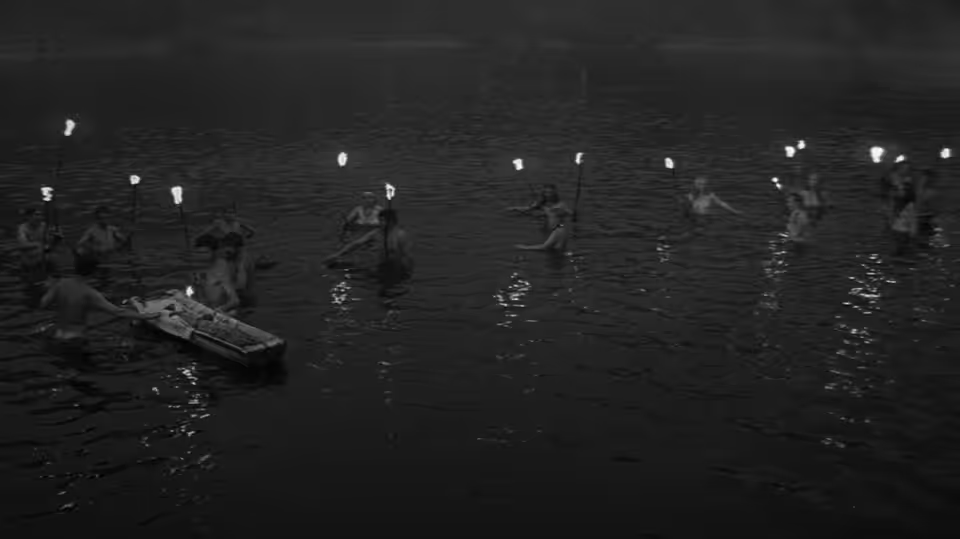
Workers wade through a river beside a small boat in the darkness
Film review

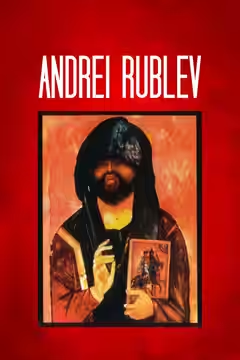
Andrei Rublev

1966 · Directed by Andrei Tarkovsky · 3h 03m

In a sentenceA painter tries to work while everyone else makes that seem an unreasonable ambition

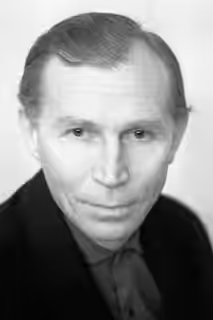
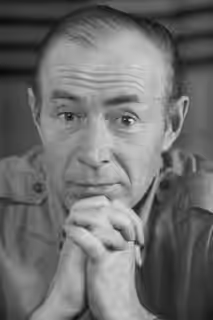
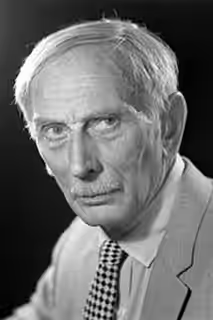
Andrei Rublev (Anatoly Solonitsyn) tries to make art amid violence and hardship. His story unfolds alongside those of Kirill (Ivan Lapikov), Daniil Chornyy (Mykola Hrynko) and Theophanus the Greek (Nikolay Sergeev). Around them, people suffer while continuing the business of living. Rublev has to consider what his paintings can offer the people whose lives he witnesses, and how he can keep working when those lives give him so much reason to doubt. Making art becomes bound up with a question he cannot put aside: how to live among others when their suffering makes his work seem inadequate.

Plays from YouTube when you press play; nothing loads from them until then.

Fi1m review

Andrei Tarkovsky’s portrait of an artist earns its demands through the humanity of Anatoly Solonitsyn and the force of Vadim Yusov’s images. Some symbolism remains stubbornly obscure, but we recommend giving it the time and attention it needs.

Andrei Tarkovsky’s Andrei Rublev is demanding, sometimes needlessly obscure, and worth the concentration it asks for. Its subject is an artist trying to work amid violence, and it takes that difficulty seriously without making him automatically admirable. At 183 minutes, it gives us ample time to consider how much use painting can be to people who are suffering. It also makes the question uncomfortable enough that we cannot settle for a reassuring answer about the importance of art.

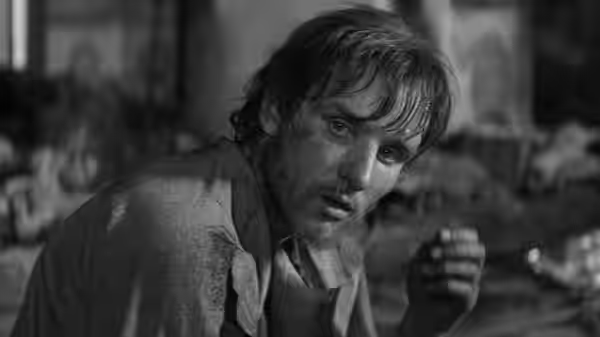
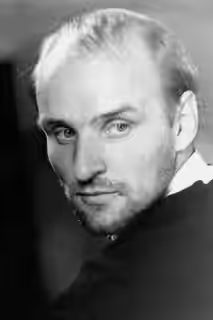
Anatoly Solonitsyn is central to that achievement. His Rublev seems vulnerable to what he sees, and the performance keeps the artist’s uncertainty from becoming an invitation to admire his sensitivity. We were moved by his struggle to continue working amid so much suffering, because Solonitsyn makes that persistence seem difficult to justify even to himself. The performance gives us someone to care about through passages where the film’s meaning is harder to follow.

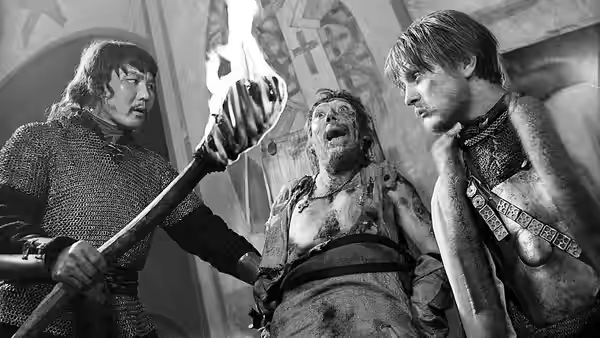
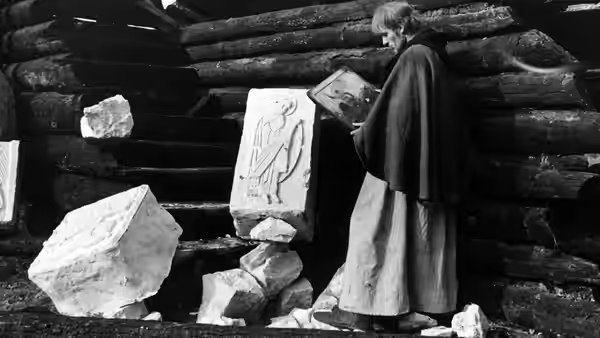
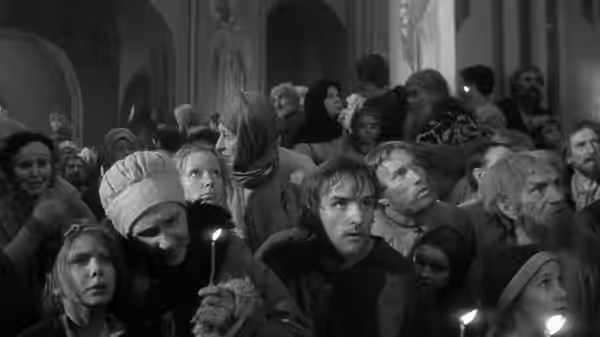
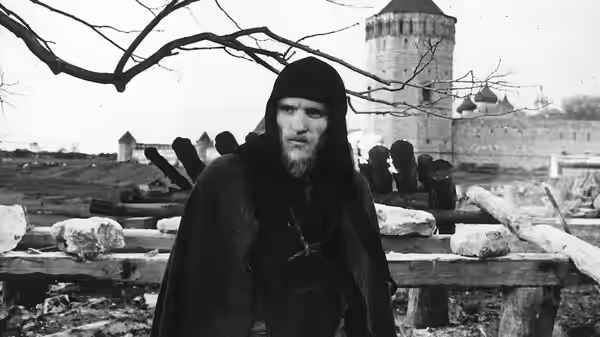
Vadim Yusov’s cinematography gives the crowded landscapes room to hold our attention; there is more to look at than the person carrying the story. The compositions reward that wandering eye, and the camera movements make us feel the extent of the world around Rublev. Production designers Sergey Voronkov, Evgeniy Chernyaev and Ippolit Novoderyozhkin help make those surroundings convincing as places where people live. We never feel that the scenery exists simply to flatter the artist.

The sheer weight of the images can become tiring, however. Vyacheslav Ovchinnikov’s music sometimes seems to insist on a seriousness we have already understood, adding to that heaviness. This makes the lighter touches especially welcome: the film has room for people to be something other than miserable or significant. They make its humanity easier to believe, and prevent the solemnity from becoming uniform.

The larger reservation is narrative clarity. Editors Olga Shevkunenko, Tatyana Egorycheva and Lyudmila Feiginova give the images time, but there are stretches where patience does not bring greater understanding. Tarkovsky’s symbolism can leave us puzzling over what an image means while losing touch with the person it concerns. We do not need everything explained, though the film occasionally leaves us wanting a clearer connection between its images and its people.

For all that, the screenplay by Andrei Tarkovsky and Andrei Konchalovsky takes Rublev’s doubts seriously. Artist biographies often hurry to explain a talent, as though a handful of experiences can account for everything a person makes. Here, the question of whether Rublev can keep working is allowed to remain difficult, and the people around him do not exist merely to encourage him. That is a substantial reason to stay with the film when its symbolism becomes less persuasive.

We recommend it warmly, with a firm caveat about the concentration it requires. There are passages we admire without fully understanding them, and a few where we would welcome less insistence on the mystery. Set aside an uninterrupted evening; this is not a film to fit around other plans.
Critical consensus AI synthesised

80
Positive
8
Mixed
1
Negative
0

Most critics respond warmly to Andrei Rublev, with praise clustering around Tarkovsky’s images and his portrait of an artist trying to work amid violence and hardship. The reviews repeatedly single out the compositions, camera movements and crowded landscapes, while also finding humanity, vitality and occasional lightness in a demanding film. Several describe its emotional force as the reward for staying with it, rather than treating its visual qualities as sufficient in themselves.

The reservations concern length, difficulty and symbolism, though these usually qualify a recommendation rather than overturn it. Radio Times finds some of Tarkovsky’s symbolism impenetrable despite its enthusiastic verdict. The Los Angeles Times offers the clearest dissent, finding the film overlong and demanding while still admiring its imagery and daring. The spread is therefore wider in enthusiasm than in the assessment of the craft: even the least persuaded review finds much to admire on screen.

Radio Times
★★★★★ · David Parkinson
100

The critic calls it a remarkable, beautifully photographed study of Rublev’s struggle to create art amid violence and hardship. They praise its striking set pieces while faulting some of Tarkovsky’s symbolism as impenetrable.

Read the full review →
Slant Magazine
18 September 2018 · ★★★★½ · Jake Cole
90

Cole praises the Criterion edition as a definitive reissue of Tarkovsky’s magisterial epic. He singles out its restored image and sound quality, along with the extensive bonus features.

Read the full review →
The New Yorker
24 August 2018 · Anthony Lane
90*

Lane strongly recommends Tarkovsky’s film as an extraordinary, transporting work. He praises its vivid, elemental panorama of suffering and vitality, comparing its crowded landscapes to Bruegel.

Read the full review →
The Guardian
16 August 1973
85*

The review calls the film one of the best Soviet works and praises its subtlety. It singles out Tarkovsky’s focus on Rublev’s humanity as the key to its convincing portrait of an artist.

Read the full review →
Total Film
2 July 2004 · ★★★★ · Total Film
80

The review finds the film difficult to follow but ultimately deeply moving. It praises the finale, when Rublev’s paintings emerge in colour, as wondrous.

Read the full review →
Empire
1 January 2000 · David Parkinson
78*

The review presents the film as compelling and enduring, praising Tarkovsky’s majestic vision. It singles out the film’s lighter touches and striking images as what make it such compulsive viewing.

Read the full review →

Straight answers AI written, from our review

Is Andrei Rublev worth watching?
Andrei Rublev is worth watching for patient viewers drawn to demanding historical drama, and we score it 86 out of 100. Anatoly Solonitsyn makes the painter’s struggle amid suffering moving, while Vadim Yusov’s images reward close attention. At 183 minutes, it needs an uninterrupted evening, with some symbolism remaining obscure even when we give it our full concentration.
How long is Andrei Rublev, and what is it rated?
Andrei Rublev runs 3h 03m. It is a drama and history film.
Where can I watch Andrei Rublev in Singapore?
Andrei Rublev is not on any streaming or rental service in Singapore at the moment. Availability is checked daily.
How violent or frightening is Andrei Rublev, and is it suitable for children?
Andrei Rublev has a UK 15 certificate and contains violence and sustained suffering, making it unsuitable for children under 15. We find its portrait of an artist living amid hardship emotionally demanding, with solemnity that can become tiring. Older teenagers comfortable with difficult historical drama are a more suitable audience than younger viewers.
How does Andrei Rublev compare to The Passion of Joan of Arc?
Andrei Rublev is the more sprawling, contemplative choice beside The Passion of Joan of Arc, which we recommend more confidently for its immediate human impact. Both make difficult questions of faith personal through a vulnerable central performance. Choose Dreyer’s film for the concentrated pressure of a church trial and exhausting close-ups; choose Tarkovsky’s for crowded landscapes and an artist’s prolonged doubts.
What should I watch after Andrei Rublev?
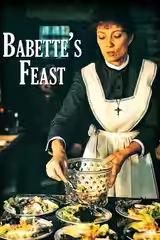
After Andrei Rublev, try The Passion of Joan of Arc (1928, Fi1m 94): Another difficult encounter with faith, made immediate through an exposed human face. Then Ugetsu (1953, Fi1m 89): Another patient account of people trying to live while violence rearranges their lives; and Babette's Feast (1987, Fi1m 86): A gentler consideration of what making something well can offer other people.

Cast

If you liked this, try…

  1. The Passion of Joan of Arc (1928, Fi1m 94)Another difficult encounter with faith, made immediate through an exposed human face.

  2. Ugetsu (1953, Fi1m 89)Another patient account of people trying to live while violence rearranges their lives.

  3. The Colour of Pomegranates (1969) · not on Fi1m yetFor the patient viewer who wants an artist’s life told through images.

  4. Babette's Feast (1987, Fi1m 86)A gentler consideration of what making something well can offer other people.

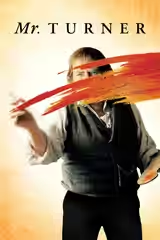
  5. Mr. Turner (2014) · not on Fi1m yetA more earthbound painter, with stubbornness and daily work given proper attention.